Buy the EcoFlow RIVER 3 Plus if you want 600 W of output instead of 300 W or the option to add a battery later; buy the Anker SOLIX C300 if you need a 12 V car socket for a CPAP's DC cable or a 12 V fridge, or three 140 W USB-C ports for laptops. Both are roughly 290 Wh LiFePO4 units with a 10 ms UPS switchover, so on AC they run the same devices for about the same time. Neither is a unit for backing up a kitchen fridge.
As an Amazon Associate, RightSizePower earns from qualifying purchases. That never changes how models are ranked. How we recommend
Quick answer
- CPAP on its DC cable
- Anker SOLIX C300 (has a car socket)
- 12 V portable fridge
- Anker SOLIX C300 (has a car socket)
- Laptops over USB-C
- Anker SOLIX C300 (three 140 W ports vs one 100 W)
- Devices from 300 to 600 W
- EcoFlow RIVER 3 Plus (600 W vs 300 W)
- Might want more capacity later
- EcoFlow RIVER 3 Plus (up to 858 Wh)
- Charging from solar
- EcoFlow RIVER 3 Plus (220 W vs 100 W)
- Lightest
- Anker SOLIX C300 (9.1 lb vs 10.4 lb)
Specs side by side
From each maker's US product page, checked 2026-11-01. Rows where they differ are in darker text; starred values aren't fully confirmed by the maker.
| Spec | Anker SOLIX C300 | EcoFlow RIVER 3 Plus |
|---|---|---|
| Capacity | 288 Wh | 286 Wh |
| Continuous output | 300 W | 600 W |
| Surge | Not published | 1,200 W |
| Boost mode (heating loads) | 600 W | 1,200 W |
| Battery | LiFePO4, 3,000 cycles to 80% | LiFePO4, 3,000 cycles to 80% |
| Weight | 9.1 lb | 10.4 lb |
| AC outlets | 3* | 3 |
| USB-C | 3 × up to 140 W | 1 × up to 100 W |
| 12 V car outlet | Yes | No* |
| Wall charge, 0–100% | Not published | 60 min |
| Solar input | 100 W, 11-28V, 8.2A (XT60) | 220 W |
| UPS switchover | ≤10 ms | ≤10 ms |
| Extra batteries | Not expandable | Up to 858 Wh |
| Warranty | 5 years | Not published* |
* Not stated on the maker's spec sheet, or derived from other official figures.
Why pick the Anker SOLIX C300?
For DC devices and laptops. Its car socket takes a CPAP's DC cable or a 12 V portable fridge, and running a CPAP on DC skips the inverter and its standby draw: without the humidifier, it runs about 21 h by our estimate, against about 11 h for the RIVER on the CPAP's AC adapter. Three USB-C ports at up to 140 W (one also charges the unit) handle a 16-inch laptop, and it lists a 10 ms UPS switchover. It's rated for 3,000 cycles to 80%, carries a 5-year warranty and weighs 9.1 lb.
The limit is power. 300 W continuous rules out anything that heats or has a big motor; SurgePad lets resistive devices up to 600 W run at reduced power but doesn't raise that limit. Solar input is 100 W at 11–28 V through an XT60 port, and it can't take an extra battery. Anker's page lists the AC outlets as “NEMA 6-20”, which we read as an error for standard 120 V outlets; we mark the count as unconfirmed. One Amazon listing for this ASIN has shown it bundled with a 60 W panel, so check the box contents.
Not for you if: you want to run anything between 300 and 600 W, or you might need more than one night of a humidified CPAP.
Why pick the EcoFlow RIVER 3 Plus?
For headroom and growth. 600 W continuous with a 1,200 W surge runs things the C300 can't, such as a corded drill (about 440 W by our appliance data). EcoFlow's EB300 and EB600 extra batteries take it from 286 Wh to 858 Wh. It takes up to 220 W of solar, charges from the wall in 60 minutes at 380 W and lists a UPS switchover under 10 ms. It has three AC outlets, one 100 W USB-C port and two USB-A ports, is rated for 3,000 cycles to 80%, and weighs 10.4 lb.
Its gap is DC. EcoFlow's US spec table lists no 12 V car output, so a 12 V fridge won't plug in and a CPAP has to use its AC adapter, which costs runtime. We couldn't confirm the warranty term from the page we used.
Not for you if: you camp with a 12 V fridge or want the longest CPAP night per pound. Our RIVER 3 Plus guide explains why a full-size fridge is a poor match for it.
For either unit: turn off any auto-off or ECO setting in the app before relying on it overnight. This is power planning, not medical advice; check your CPAP maker's guidance on DC cables and humidifier use, and ask your doctor and your utility about its medical-needs registry before counting on a battery through longer outages.
How long does each run the same devices?
| Load (typical daily use) | SOLIX C300 | RIVER 3 Plus | RIVER 3 Plus + EB600 (858 Wh) |
|---|---|---|---|
| CPAP, no humidifier, DC cable where possible | 18–22 h | 9.4–12 h (AC) | 28–35 h (AC) |
| CPAP with heated humidifier (AC adapter) | 3.5–4.3 h | 3.5–4.3 h | 10–13 h |
| Laptop on USB-C | 3.3–4.1 h | 3.3–4.1 h | 9.8–12 h |
| Wi-Fi router + modem | 8–9.8 h | 7.9–9.8 h | 24–29 h |
| 12 V portable fridge on the car socket | 15–18 h | No 12 V socket | No 12 V socket |
| Mini fridge | 5.1–6.4 h | 5.1–6.3 h | 15–19 h |
Estimates from our published formula. “(AC)” means the device runs on its AC adapter because the unit has no matching DC port. Neither maker publishes standby draw, so both use the same default. The mini fridge's start-up draw is an estimate. Try your own devices in the runtime calculator.
When does the quiz engine prefer each one?
We ran five situations through the engine the quiz uses. The RIVER 3 Plus comes out ahead in 2 of 5. The quiz assumes a CPAP runs on its AC adapter, so the C300's DC advantage doesn't show here; the RIVER gains from its published one-hour full charge and, for a humidified CPAP through a day, its extra battery. The C300 wins when a 12 V device needs its car socket.
| Situation | Engine prefers | Why |
|---|---|---|
| CPAP for one night, no humidifier | RIVER 3 Plus | Scores 81 vs 85 (Anker vs EcoFlow) |
| CPAP with heated humidifier, one night | Neither | SOLIX C300: Runs your devices for about 4.7 h; you asked for 10 h. RIVER 3 Plus: Runs your devices for about 4.7 h; you asked for 10 h. |
| CPAP with humidifier through a 24-hour outage, by the bed | RIVER 3 Plus | RIVER 3 Plus needs an extra battery. SOLIX C300: Runs your devices for about 9 h; you asked for 24 h. |
| Camping with a 12 V fridge | SOLIX C300 | RIVER 3 Plus: No 12 V car socket for the 12 v portable fridge (45 l). |
| Phones on solar over a long weekend | SOLIX C300 | Scores 72 vs 67 (Anker vs EcoFlow) |
Who should buy which
- Buy the Anker SOLIX C300 for a CPAP without the humidifier on its DC cable, a 12 V fridge in the car, or laptop work away from a desk.
- Buy the EcoFlow RIVER 3 Plus if you want 600 W for small tools or appliances, or room to add a battery for a humidified CPAP: with a heated humidifier, a base unit lasts only about 4.1 h by our estimate.
- Step up to a larger unit if you need a full-size fridge, a microwave or more than one night of a humidified CPAP. Our best small power station guide covers the next sizes, and the sizing quiz checks your exact devices.
Which model does the quiz pick for these situations?
Across the whole catalog, not just these two. Open any row in the quiz and swap in your own devices.
CPAP for one night, no humidifier
0.1 kWh/day · 10 h
Open this in the quiz and change the devices
Engine's pick
EcoFlow RIVER 3 Plus
About 11 h · also Anker SOLIX C300, Bluetti Elite 30 V2
CPAP with heated humidifier, one night
0.4 kWh/day · 10 h
Open this in the quiz and change the devices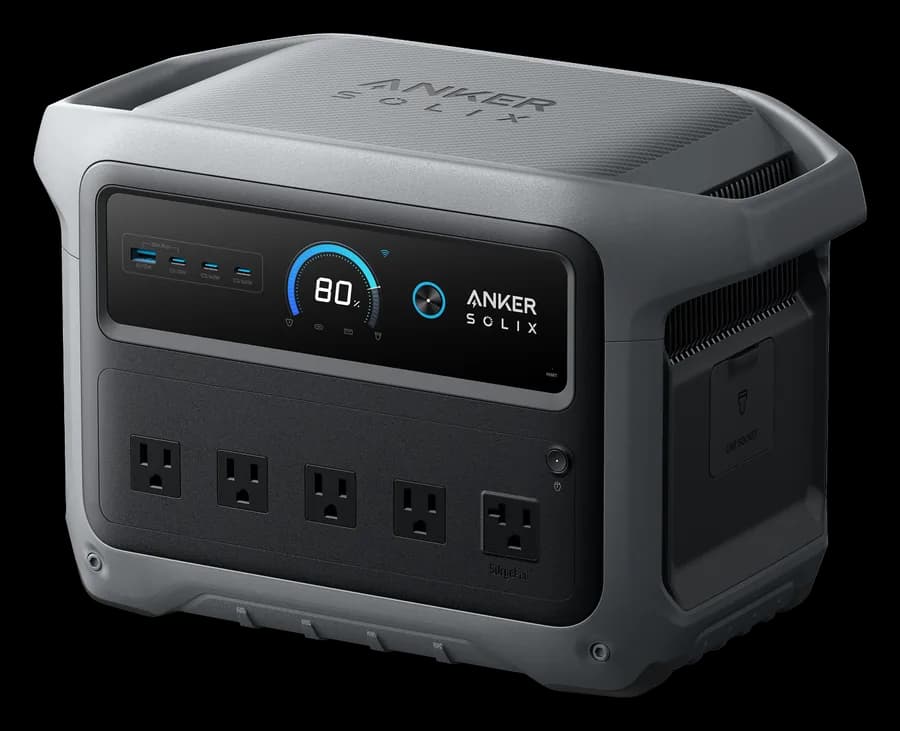
Engine's pick
Anker SOLIX C1000 Gen 2
About 16 h · also Anker SOLIX C800X / C800 Plus, EcoFlow RIVER 2 Pro
CPAP with humidifier through a 24-hour outage, by the bed
0.4 kWh/day · 24 h · extra battery allowed
Open this in the quiz and change the devicesEngine's pick
Anker SOLIX C1000 Gen 2
About 30 h · also EcoFlow DELTA 3 Classic, OUPES Mega 1
Camping with a 12 V fridge
0.3 kWh/day · 10 h
Open this in the quiz and change the devices
Engine's pick
EcoFlow RIVER 3
About 15 h · also Jackery Explorer 300, Anker SOLIX C300 DC
Phones on solar over a long weekend
0.0 kWh/day · 24 h
Open this in the quiz and change the devices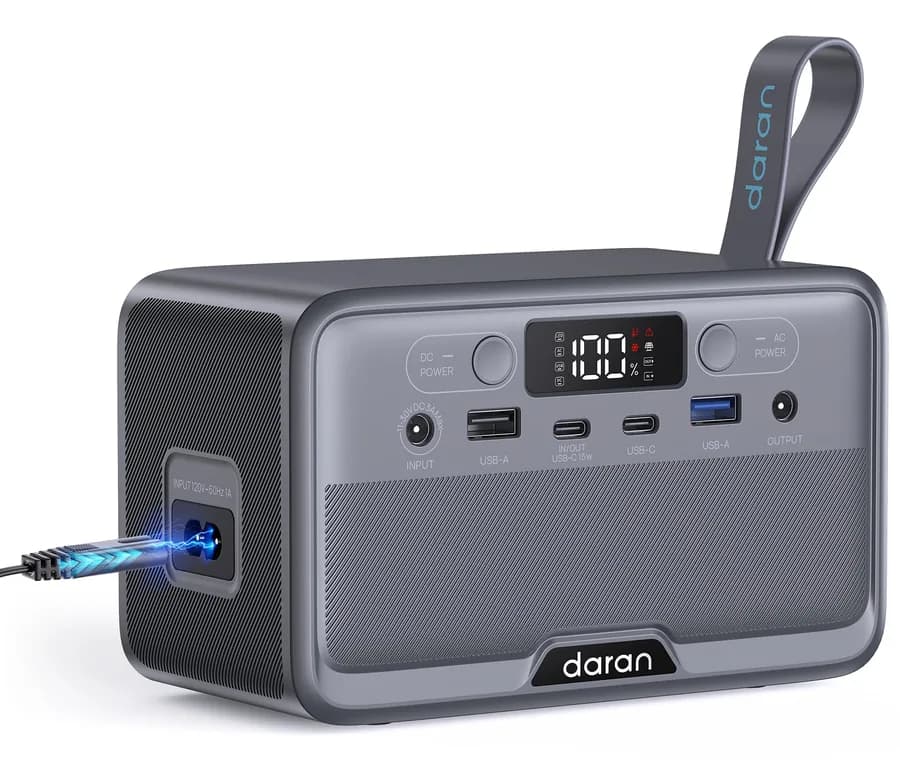
Engine's pick
DARAN 89.6Wh LiFePO4 Power Station
About 44 h · also MARBERO 88Wh Portable Power Station, Bluetti Elite 10 Mini
Picks come from the same engine as the quiz, recalculated whenever our catalog changes.
What people actually ask
Can the Anker C300 or EcoFlow RIVER 3 Plus run a refrigerator?
Not a full-size one in any useful way. A typical top-freezer fridge needs about 1,200 W for a moment to start: the C300 can't supply that, and the RIVER 3 Plus's 1,200 W surge rating only just matches it, with nothing to spare. Even then, 286 Wh runs that fridge for only about 4.4 h by our estimate. A mini fridge or a 12 V portable fridge is the right match; the 12 V fridge needs a car-style socket, which only the C300 has.
Which one is better for a CPAP?
Without the humidifier, the C300, because its car socket takes a CPAP's DC cable and skips the inverter's losses. The RIVER 3 Plus has no 12 V car output on EcoFlow's US spec table, so the CPAP runs on its AC adapter, for a shorter night. With a heated humidifier, neither lasts a full night; only the RIVER can add a battery to close the gap.
What do X-Boost and SurgePad mean?
Both are boost modes that let resistive devices rated above the inverter's limit run at reduced power: up to 1,200 W on the RIVER 3 Plus (X-Boost) and 600 W on the C300 (SurgePad). They don't raise continuous output or help motors start, so we treat the RIVER as a 600 W unit and the C300 as a 300 W unit.
Can I add a battery to either one?
Only to the RIVER 3 Plus. EcoFlow lists the EB300 (286 Wh) and EB600 (572 Wh) extra batteries, for up to 858 Wh in total. The C300 can't be expanded.
Which charges faster?
From the wall, EcoFlow lists a full charge in 60 minutes at 380 W, and Anker lists 0–80% in 50 minutes at 330 W. From solar, the RIVER takes up to 220 W and the C300 up to 100 W through its XT60 port.
The bottom line
Same battery size, same 10 ms switchover, very different strengths. The Anker SOLIX C300 is the DC specialist: a car socket, three 140 W USB-C ports and the lightest weight. The EcoFlow RIVER 3 Plus is the more flexible AC unit: twice the output, more than twice the solar input and room for an extra battery. For another small-unit matchup, see Jackery Explorer 300 vs Anker C300, or compare every model in the comparison chart.
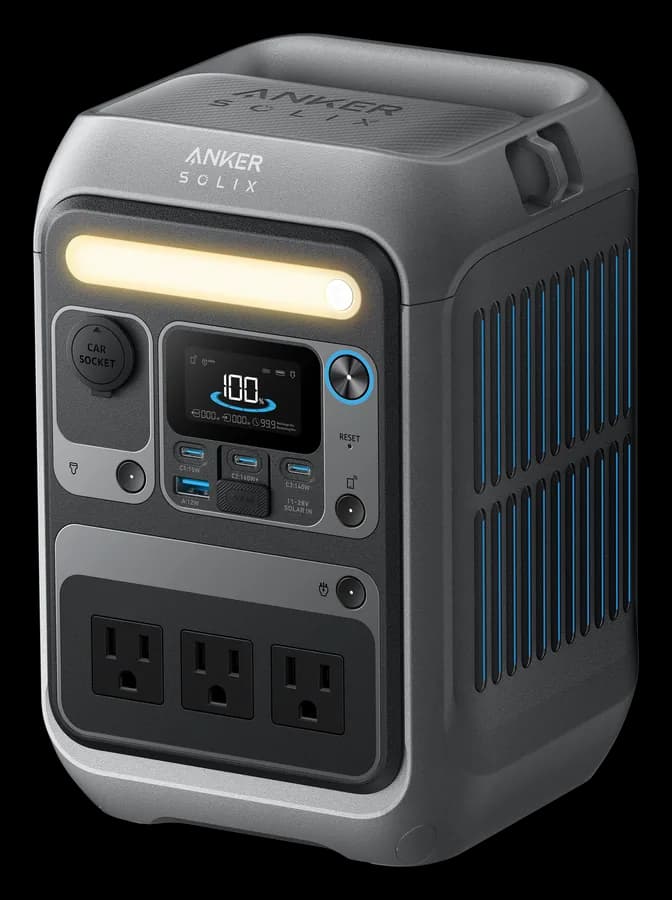
Anker SOLIX C300
Laptop work and phone charging on the go, with a 140W two-way USB-C port and 3 AC outlets.
- Capacity
- 288 Wh
- Output
- 300 W
- Weight
- 9.1 lb
- UPS
- 10 ms
Paid link
Check price on AmazonEcoFlow RIVER 3 Plus
One night of CPAP without the humidifier, or a router and phones for about eight hours, with the option to add an extra battery later.
- Capacity
- 286 Wh
- Output
- 600 W
- Weight
- 10.4 lb
- UPS
- 10 ms
Paid link
Check price on Amazon