Buy the Anker SOLIX C300 for CPAP and laptop use, because it publishes a 10 ms UPS switchover and has three 140 W USB-C ports; buy the Jackery Explorer 300 if the lightest bag-sized unit for phones, lights and a camera is what you're after. Both are roughly 290 Wh LiFePO4 units with 300 W of AC output, so they run the same small devices for about the same time, and neither can run a fridge, microwave or anything that heats.
As an Amazon Associate, RightSizePower earns from qualifying purchases. That never changes how models are ranked. How we recommend
Quick answer
- Lightest to carry
- Jackery Explorer 300 (1.6 lb lighter)
- CPAP through a power cut
- Anker C300 (10 ms UPS published)
- Laptops over USB-C
- Anker C300 (three 140 W ports vs one 100 W)
- More AC outlets
- Anker C300 (3 vs 2)
- Known wall-charge speed
- Anker C300 (0–80% in 50 min)
- Higher cycle rating
- Jackery Explorer 300 (4,000 to 70% vs 3,000 to 80%; not directly comparable)
Specs side by side
From each maker's US product page, checked 2026-11-01. Rows where they differ are in darker text; starred values aren't fully confirmed by the maker.
| Spec | Jackery Explorer 300 | Anker SOLIX C300 |
|---|---|---|
| Capacity | 292 Wh | 288 Wh |
| Continuous output | 300 W | 300 W |
| Surge | Not published | Not published |
| Boost mode (heating loads) | None | 600 W |
| Battery | LiFePO4, 4,000 cycles to 70% | LiFePO4, 3,000 cycles to 80% |
| Weight | 7.5 lb | 9.1 lb |
| AC outlets | 2 | 3* |
| USB-C | 1 × up to 100 W | 3 × up to 140 W |
| 12 V car outlet | Yes | Yes |
| Wall charge, 0–100% | Not published | Not published |
| Solar input | 100 W* | 100 W, 11-28V, 8.2A (XT60) |
| UPS switchover | Not published | ≤10 ms |
| Extra batteries | Not expandable | Not expandable |
| Warranty | 5 years* | 5 years |
* Not stated on the maker's spec sheet, or derived from other official figures.
Jackery Explorer 300: small, light, few extras
The current Explorer 300 holds 292 Wh of LiFePO4 and weighs 7.5 lb, the lighter of the two by a clear margin. It has two AC outlets (300 W total), one 100 W USB-C port, two USB-A ports and a car outlet. That covers phones, a camera, camp lights, a small fan, a laptop and a CPAP without the humidifier.
Jackery's page leaves gaps. We couldn't confirm its solar input limit (we use 100 W as a conservative figure), its wall-charging speed, whether it has a UPS mode or app control. Jackery rates it for 4,000 cycles to 70% capacity and lists a 5-year warranty for this version. Buy from a listing that clearly says LiFePO4 and 292 Wh: the older 293 Wh NMC model shares the name.
Anker SOLIX C300: built around USB-C and backup
The C300 holds 288 Wh and supplies 300 W through three AC outlets. Its three USB-C ports deliver up to 140 W, one of them two-way, so it can charge from a USB-C laptop charger too. Anker lists a 10 ms UPS switchover, wall charging at up to 330 W with 0–80% in 50 minutes, up to 100 W of solar through an XT60 input at 11–28 V, app control and a 5-year warranty. The battery is rated for 3,000 cycles to 80%. It weighs 9.1 lb.
SurgePad lets resistive devices up to 600 W run at reduced power; it isn't extra capacity and won't start a motor. Anker's spec page labels the outlets in a way that looks like a page error, so we mark the outlet count as unconfirmed. Don't confuse it with the C300 DC, which has no AC outlets at all.
How long does each run the same devices?
| Load (typical daily use) | Explorer 300 | SOLIX C300 |
|---|---|---|
| CPAP, no humidifier, on the DC cable | 18–22 h | 18–22 h |
| CPAP with heated humidifier (AC adapter) | 3.5–4.4 h | 3.5–4.3 h |
| Laptop on USB-C | 3.4–4.1 h | 3.3–4.1 h |
| Wi-Fi router + modem | 8.1–10 h | 8–9.8 h |
| 12 V portable fridge | 15–18 h | 15–18 h |
Estimates from our published formula. Neither maker publishes standby draw, so both use the same default; the Jackery's slightly larger battery gives it a few extra minutes. Try your own devices in the runtime calculator.
What can't either one run?
Both cut off when the load passes 300 W, and neither lists a surge rating above that. These common devices are out of reach for both:
| Device | Typical draw | Why it won't work |
|---|---|---|
| Full-size refrigerator (top freezer) | 160 W, 1,200 W to start | Start-up surge is above 300 W |
| Microwave (1,000–1,200 W cooking power) | 1,500 W | Needs more than 300 W while running |
| Drip coffee maker | 1,000 W | Needs more than 300 W while running |
| Electric kettle | 1,500 W | Needs more than 300 W while running |
| Hair dryer | 1,800 W, 1,900 W to start | Needs more than 300 W while running |
| Space heater (1500 W setting) | 1,500 W | Needs more than 300 W while running |
| Window AC (5,000–6,000 BTU) | 397 W, 1,191 W to start | Needs more than 300 W while running |
Typical values from our appliance wattage chart; check the label on your own device.
When does the quiz engine prefer each one?
Five small-load situations, carried in one hand and in the lowest quiz budget band, run through the engine the quiz uses.
| Situation | Engine prefers | Why |
|---|---|---|
| CPAP for one night, no humidifier | SOLIX C300 | Scores 71 vs 81 (Jackery vs Anker) |
| CPAP that must not stop if the power cuts | SOLIX C300 | Explorer 300: No UPS mode with a published switchover of 20 ms or less. |
| Laptop and phones for a work session | Tie | Explorer 300: Runs your devices for about 8.4 h; you asked for 10 h. |
| Camping on solar: phones and lights | Tie | Explorer 300: Runs your devices for about 9.2 h; you asked for 10 h. |
| Tailgate: TV, speaker, phones | Tie | Explorer 300: Runs your devices for about 6.2 h; you asked for 10 h. |
Who should buy which
- Buy the Anker SOLIX C300 for a CPAP (it runs one without the humidifier for about 21 h on the DC cable), for laptop work away from a desk, or as a small UPS for a router. Turn off any auto-off or ECO setting in the app before relying on it overnight, and check your CPAP maker's guidance and your utility's medical registry for longer outages.
- Buy the Jackery Explorer 300 if it goes in a backpack or car for phones, lights and a camera, and you don't need a UPS or fast USB-C.
- Buy neither if you want a fridge, coffee maker or microwave; that takes a 1 kWh unit with at least 1,500 W. See what each size can run, or let the sizing quiz check your devices.
Which model does the quiz pick for these situations?
Across the whole catalog, not just these two. Open any row in the quiz and swap in your own devices.
CPAP for one night, no humidifier
0.1 kWh/day · 10 h
Open this in the quiz and change the devices
Engine's pick
EcoFlow RIVER 3 Plus
About 11 h · also Anker SOLIX C300, Bluetti Elite 30 V2
CPAP that must not stop if the power cuts
0.1 kWh/day · 10 h · UPS
Open this in the quiz and change the devicesEngine's pick
EcoFlow RIVER 3 Plus
About 11 h · also Anker SOLIX C300, Bluetti Elite 30 V2
Laptop and phones for a work session
0.3 kWh/day · 10 h
Open this in the quiz and change the devicesJackery512 WhEngine's pick
Jackery Explorer 500 v2
About 15 h · also Anker SOLIX C1000 Gen 2, Anker SOLIX C800X / C800 Plus
Camping on solar: phones and lights
0.2 kWh/day · 10 h
Open this in the quiz and change the devicesJackery512 WhEngine's pick
Jackery Explorer 500 v2
About 16 h · also EcoFlow RIVER 3 Max, Anker SOLIX C800X / C800 Plus
Tailgate: TV, speaker, phones
0.3 kWh/day · 10 h
Open this in the quiz and change the devicesAnker SOLIX768 WhEngine's pick
Anker SOLIX C800X / C800 Plus
About 16 h · also EcoFlow RIVER 2 Pro, Jackery Explorer 500 v2
Picks come from the same engine as the quiz, recalculated whenever our catalog changes.
What people actually ask
Can the Jackery Explorer 300 or Anker C300 run a refrigerator?
No. Both supply 300 W, and a full-size fridge needs around 1,200 W for a moment to start its compressor. A 12 V portable fridge on the car outlet is the right match for this size.
Will either one get me through a night of CPAP?
Without the humidifier, yes, comfortably, especially on the CPAP's DC cable. With a heated humidifier and tube running all night, expect only about 4.1 h by our estimate, so turn the humidifier down or off, or step up to a larger unit.
What does Anker's SurgePad 600 W mean?
It's a boost mode that lets resistive devices rated up to 600 W run at reduced power. It doesn't raise continuous output and doesn't help motors or compressors start, so we treat the C300 as a 300 W unit.
Is the Jackery Explorer 300 still the old NMC model?
The Explorer 300 sold now is a 292 Wh LiFePO4 unit. Jackery's 2019 Amazon listing originally sold the 293 Wh NMC version and was updated in place, so older reviews on that listing describe a different battery. Don't confuse it with the Explorer 300 Plus or the DC-only 300D.
Which one charges laptops better?
The Anker. It has three USB-C ports at up to 140 W, enough for a 16-inch laptop. The Jackery has one 100 W USB-C port.
The bottom line
Same size class, same runtime, same 300 W ceiling. The Anker SOLIX C300 is the more complete unit, with a published UPS switchover, 140 W USB-C, an extra outlet and known charging speed. The Jackery Explorer 300 is the lighter, simpler choice for phones and lights. Compare every small model in the comparison chart.
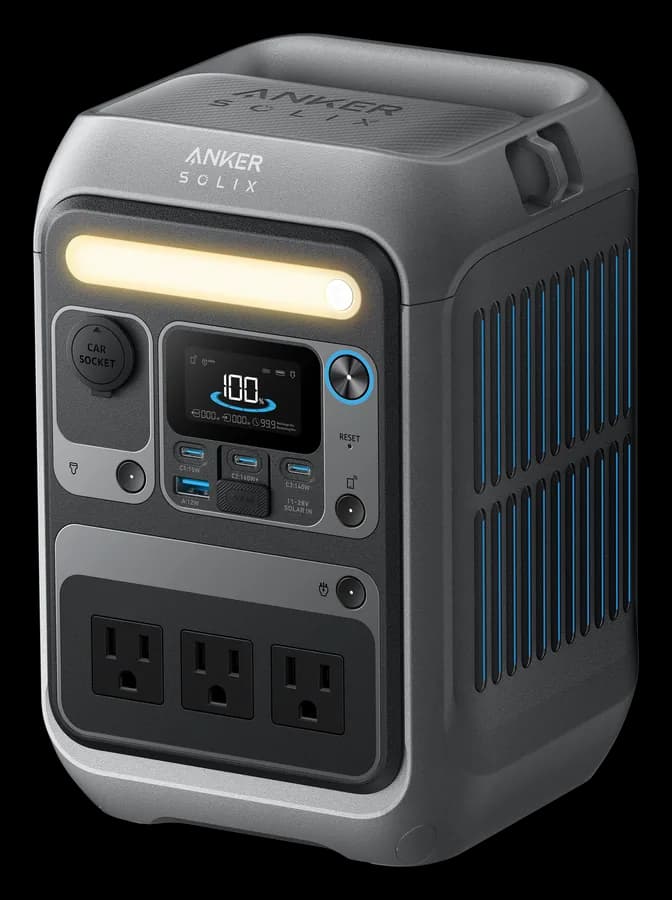
Anker SOLIX C300
Laptop work and phone charging on the go, with a 140W two-way USB-C port and 3 AC outlets.
- Capacity
- 288 Wh
- Output
- 300 W
- Weight
- 9.1 lb
- UPS
- 10 ms
Paid link
Check price on Amazon
Jackery Explorer 300
Phones, a laptop and camp lights, or one night of CPAP without the humidifier, at 7.5 lb.
- Capacity
- 292 Wh
- Output
- 300 W
- Weight
- 7.5 lb
- UPS
- None
Paid link
Check price on Amazon