Buy the Jackery Explorer 300 if you want a 7.5 lb unit for phones, a laptop, camp lights or a couple of nights of CPAP with the humidifier off. Skip it if you need to run a household fridge, a kettle, a coffee maker or anything over 300 W, or want a heated humidifier through the night. It holds 292 Wh of LiFePO4 and supplies 300 W from two AC outlets, with USB-C and a 12 V car outlet for DC devices.
As an Amazon Associate, RightSizePower earns from qualifying purchases. That never changes how models are ranked. How we recommend

Jackery Explorer 300
Phones, a laptop and camp lights, or one night of CPAP without the humidifier, at 7.5 lb.
- Capacity
- 292 Wh
- Output
- 300 W
- Weight
- 7.5 lb
- UPS
- None
Paid link
Check price on AmazonQuick verdict
- Good fit
- CPAP without humidifier; phones, laptop and lights; a 12 V camping fridge for a day
- Poor fit
- Household fridge; kettle, coffee maker or heater; CPAP with heated humidifier
- Weight
- 7.5 lb, one hand
- Grow later?
- No expansion
- Watch out for
- Amazon reviews mix the old NMC model and this one
Key specs
From Jackery's US product page. Several details, including solar input, weren't retrievable there, so those rows are starred or blank; the solar figure is a cautious low value.
| Spec | Jackery Explorer 300 |
|---|---|
| Capacity | 292 Wh |
| Continuous output | 300 W |
| Surge | Not published |
| Boost mode (heating loads) | None |
| Battery | LiFePO4, 4,000 cycles to 70% |
| Weight | 7.5 lb |
| AC outlets | 2 |
| USB-C | 1 × up to 100 W |
| 12 V car outlet | Yes |
| Wall charge, 0–100% | Not published |
| Solar input | 100 W* |
| UPS switchover | Not published |
| Extra batteries | Not expandable |
| Warranty | 5 years* |
* Not stated on the maker's spec sheet, or derived from other official figures.
What will it run, and for how long?
Each device on its own from a full charge, running nonstop (fridges and the blanket cycle as normal). Includes the battery reserve, conversion losses and standby draw from our published formula.
| Device | Plugged into | Runtime or limit |
|---|---|---|
| CPAP, humidifier off11 W | 12 V outlet | 18–22 h |
| CPAP with heated humidifier and tube45 W | 12 V outlet | 4.4–5.5 h |
| 12 V portable camping fridgeabout 0.3 kWh a day | 12 V outlet | 15–18 h |
| Wi-Fi router and modem15 W | AC outlet | 8.1–10 h |
| Laptop60 W | USB-C | 3.4–4.1 h |
| 50–55 in TV96 W | AC outlet | 1.8–2.2 h |
| Electric blanket (queen)110 W, cycles on and off | AC outlet | 3–3.7 h |
| Top-freezer fridgeabout 0.99 kWh a day, 1,200 W to start | AC outlet | Won't run: needs about 1,200 W to start, and no surge rating is published |
| Microwave1,500 W | AC outlet | Won't run: needs 1,650 W with a safety margin; it supplies 300 W |
Try your own devices in the runtime calculator.
Where the Explorer 300 wins, and where it's ruled out
We ran eight common situations through the quiz engine. Rank is among every model that passes the hard limits.
| Situation | Result | Runtime or reason |
|---|---|---|
| Outage overnight: fridge, Wi-Fi and phones (carry it) | Ruled out | No published surge rating, and your start-up load (about 1,215 W) exceeds its continuous output. |
| Outage for a full day, same devices (wheels OK) | Ruled out | No published surge rating, and your start-up load (about 1,235 W) exceeds its continuous output. |
| CPAP for two nights away, one-hand carry | Ruled out | Runs your devices for about 17 h; you asked for 24 h. |
| Weekend car camping: 12 V fridge, lights, phones, with solar | Ruled out | Runs your devices for about 8 h; you asked for 24 h. |
| RV day: fan, TV, laptop, phones | Ruled out | Runs your devices for about 4.6 h; you asked for 24 h. |
| Remote work day: Starlink, laptop, phone | Ruled out | Runs your devices for about 2.1 h; you asked for 24 h. |
| Home office on UPS: router, laptop, phone, overnight | Ruled out | No UPS mode with a published switchover of 20 ms or less. |
| Overnight essentials on a budget under $500 | Ruled out | No published surge rating, and your start-up load (about 1,215 W) exceeds its continuous output. |
The Explorer 300 drops out of every situation in that table, and that's useful to know. The outage and budget cases include a household fridge, which it can't be counted on to start. The others ask for a full day of devices, and 292 Wh runs out sooner: the two-night CPAP case asks for 24 hours of running, CPAP plus a phone, and it falls short of that. For one or two nights of CPAP alone, it's enough.
What does it do well?
- Easy to carry. 7.5 lb, against 9.1 lb for a typical current model near this size.
- CPAP without the humidifier. On its 12 V cable a typical CPAP runs about 21 h, roughly 2 nights of 8 hours.
- The basics for small devices. A 100 W USB-C port charges most laptops directly, plus 2 USB-A ports and a car outlet that runs a 12 V camping fridge for about 18 h.
- LiFePO4 battery. Rated for 4,000 cycles to 70% of capacity.
- Warranty. Jackery lists 5 years for the current version; we mark it unconfirmed until the spec sheet states it.
What should you know before you buy?
- 300 W and no published surge. That rules out kettles, coffee makers, hair dryers and household fridges. Check the label watts on anything you plan to plug into the AC outlets.
- A heated humidifier changes everything. CPAP with a heated humidifier and tube lasts about 5.2 h, less than one night. Use the CPAP maker's approved DC cable, and talk to your doctor and your utility's medical program before relying on any battery.
- Reading the Amazon reviews. The listing dates to 2019, when it sold the older 293 Wh Explorer 300 with NMC cells. Jackery updated the same listing to the current 292 Wh LiFePO4 version, so its large review history mixes both. Older comments about battery chemistry or missing features may describe the old unit. Check the title and photos say 292 Wh and LiFePO4.
- Don't mix up the names. The Explorer 300 Plus, 300 v2 and 300D are different products; the 300D has no AC outlets at all.
- Missing details. Jackery's US page didn't show solar input limits, wall-charging time or a UPS mode, so we don't assume any. We treat it as having no app.
What are the closest alternatives?
The Anker SOLIX C300 holds 288 Wh and also supplies 300 W, but adds a listed 10 ms UPS switchover and three USB-C ports at up to 140 W, at 9.1 lb. The Bluetti Elite 30 V2 holds 288 Wh with 600 W continuous, double the Explorer's, and a 10 ms UPS switchover, at 9.48 lb. Neither starts a household fridge either; for that, step up to a 1 kWh unit such as the Jackery Explorer 1000 v2.
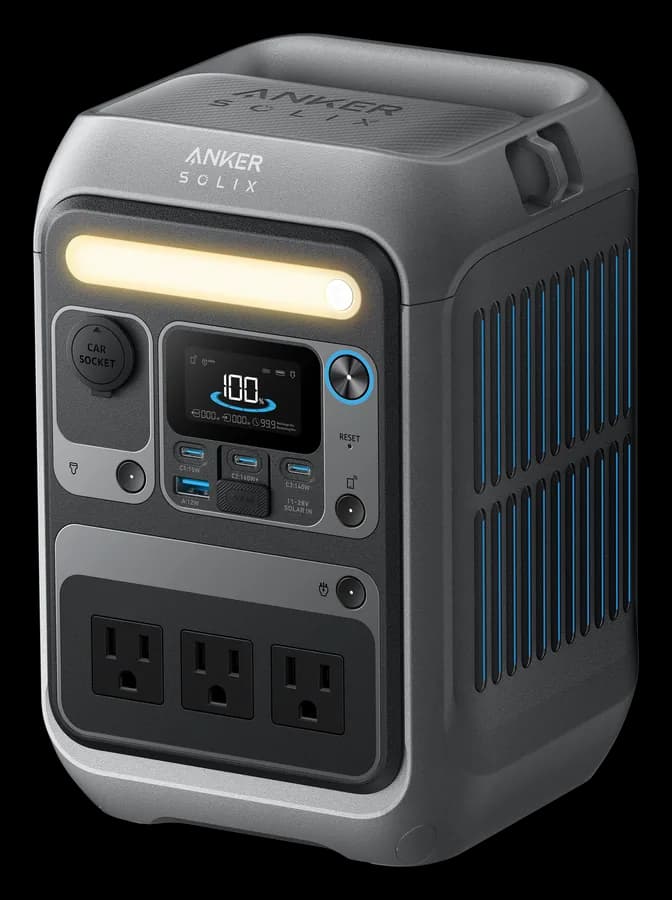
Anker SOLIX C300
288 Wh and 300 W, with a 10 ms UPS switchover and three 140 W USB-C ports.
- Capacity
- 288 Wh
- Output
- 300 W
- Weight
- 9.1 lb
- UPS
- 10 ms
Paid link
Check price on Amazon
Bluetti Elite 30 V2
288 Wh with 600 W continuous and a 10 ms UPS switchover.
- Capacity
- 288 Wh
- Output
- 600 W
- Weight
- 9.5 lb
- UPS
- 10 ms
Paid link
Check price on AmazonWho should buy it, and who shouldn't?
- Buy it for a night or two of CPAP without the humidifier, for camping with phones, a laptop, lights or a 12 V fridge for a day, or as a light grab-and-go battery for small electronics.
- Skip it if your list includes a household fridge, anything that heats, or a CPAP humidifier through the night; a 1 kWh unit is the realistic minimum for an outage. The sizing quiz checks your devices against every model.
For CPAP and outages: what each battery size can run and the winter storm power plan, or every model in the comparison chart.
What people actually ask
How many nights of CPAP will the Jackery Explorer 300 run?
About two 8-hour nights for a typical CPAP with the humidifier off, on its 12 V DC cable. With a heated humidifier and tube it's about 5 hours, less than one night. This is power planning, not medical advice: use your CPAP maker's approved DC cable, check its power specs, talk to your doctor, and register with your utility's medical program.
Can the Explorer 300 run a refrigerator?
Not a household fridge. A fridge compressor needs around 1,200 W for a moment to start, and Jackery publishes no surge rating above the 300 W continuous output, so we don't count on it. A 12 V portable camping fridge on the car outlet is a different story: about 18 hours on a full charge.
Is the Explorer 300 on Amazon the new LiFePO4 version?
The current listing describes the 292 Wh LiFePO4 version. The same listing sold the older 293 Wh NMC Explorer 300 from 2019, so its review history covers both. Check the title and photos show 292 Wh and LiFePO4 before you buy.
What's the difference between the Explorer 300, 300 Plus and 300D?
They're separate models. The 300D is DC-only, with no AC outlets, and the 300 Plus and 300 v2 are different units with their own specs. This page covers the Explorer 300 with two AC outlets and a 292 Wh LiFePO4 battery.
Can the Explorer 300 run a TV or a router in an outage?
Yes, for a while. A 50 to 55 inch TV runs about 2 hours on its own and a Wi-Fi router and modem about 9 to 10 hours. For a whole outage night with a fridge, you need a 1 kWh unit.
The bottom line
The Explorer 300 is a light, simple battery for small DC and USB devices and a couple of nights of CPAP without the humidifier. It isn't an outage unit: it can't be counted on for a fridge and stops at 300 W. If you buy it on Amazon, make sure the listing shows the 292 Wh LiFePO4 version.
Jackery Explorer 300
Phones, a laptop and camp lights, or one night of CPAP without the humidifier, at 7.5 lb.
- Capacity
- 292 Wh
- Output
- 300 W
- Weight
- 7.5 lb
- UPS
- None
Paid link
Check price on Amazon