The best small portable power station is a roughly 300 Wh LiFePO4 unit that weighs 6.2 to 10.4 lb and covers phones, a laptop or a night of CPAP. These units top out at 300 to 600 W, so they won't run a microwave, coffee maker or heater, and most can't start a full-size fridge. The picks below come from our sizing engine, run only on the 6 models we track in this class, so each shows the runtime behind it.
As an Amazon Associate, RightSizePower earns from qualifying purchases. That never changes how models are ranked. How we recommend
Quick picks
- For a CPAP nightEcoFlow RIVER 3 Plus
- For laptop workJackery Explorer 300 (closest)
- For phones over a weekendJackery Explorer 300

EcoFlow RIVER 3 Plus
286 Wh at 10.4 lb, 600 W of AC, UPS switchover in 10 ms or less.
- Capacity
- 286 Wh
- Output
- 600 W
- Weight
- 10.4 lb
- UPS
- 10 ms
Paid link
Check price on Amazon
Jackery Explorer 300
292 Wh at 7.5 lb, 300 W of AC.
- Capacity
- 292 Wh
- Output
- 300 W
- Weight
- 7.5 lb
- UPS
- None
Paid link
Check price on AmazonBest small power station for a CPAP night
A CPAP without the humidifier, plugged into AC, and a phone for one night. About 110 Wh a day at the devices.
Engine's pick
EcoFlow RIVER 3 Plus
Black mark: the 10 h you asked for (the low end falls short).
- 600 W continuous for your 11 W of devices.
- Refills from a wall outlet in about 1 h.
- 10 lb, one-hand carry.
- UPS mode: switches over in 10 ms or less.
- Not for you if: a full-size fridge is the main load (its start-up uses the whole 1,200W surge and 286Wh lasts only a few hours) or you need a space heater or kettle; 600W is the running limit.
Also a fit: Anker SOLIX C300 (about 11 h) and Bluetti Elite 30 V2 (about 11 h).
Best small power station for laptop work
A laptop and two phones on USB-C for a day away from outlets, topped up by a solar panel. About 280 Wh a day at the devices.
Closest fit in this class
Jackery Explorer 300
Black mark: the 24 h you asked for (the low end falls short).
- Takes up to 100 W of solar.
- 8 lb, one-hand carry.
- Covers about 20 h of the 24 h you asked for. Recharge once, cut a device or add an extra battery to close the gap.
- Not for you if: you need over 300W for a kettle, saw or heater.
Also a fit: Anker SOLIX C300 (about 20 h) and Bluetti Elite 30 V2 (about 20 h).
Best small power station for phones over a weekend
Three phones or tablets for two to three days, recharged only from the car. About 60 Wh a day at the devices.
Engine's pick
Jackery Explorer 300
Black mark: the 3 days you asked for.
- 8 lb, one-hand carry.
- Not for you if: you need over 300W for a kettle, saw or heater.
Also a fit: Anker SOLIX C300 DC (about 3.9 days) and Anker SOLIX C300 (about 3.9 days).
Specs side by side
The four AC models most people compare in this class. The Anker SOLIX C300 DC is the same size with no AC outlets at all, for USB-C and 12 V gear only.
| Spec | Jackery Explorer 300 | Anker SOLIX C300 | Bluetti Elite 30 V2 | EcoFlow RIVER 3 Plus |
|---|---|---|---|---|
| Capacity | 292 Wh | 288 Wh | 288 Wh | 286 Wh |
| Continuous output | 300 W | 300 W | 600 W | 600 W |
| Surge | Not published | Not published | Not published | 1,200 W |
| Boost mode (heating loads) | None | 600 W | 1,500 W | 1,200 W |
| Battery | LiFePO4, 4,000 cycles to 70% | LiFePO4, 3,000 cycles to 80% | LiFePO4, cycles not stated* | LiFePO4, 3,000 cycles to 80% |
| Weight | 7.5 lb | 9.1 lb | 9.48 lb | 10.4 lb |
| AC outlets | 2 | 3* | 2* | 3 |
| USB-C | 1 × up to 100 W | 3 × up to 140 W | 2 × up to 140 W | 1 × up to 100 W |
| 12 V car outlet | Yes | Yes | Yes | No* |
| Wall charge, 0–100% | Not published | Not published | Not published | 60 min |
| Solar input | 100 W* | 100 W, 11-28V, 8.2A (XT60) | 200 W, 12-28V, 10A | 220 W |
| UPS switchover | Not published | ≤10 ms | ≤10 ms | ≤10 ms |
| Extra batteries | Not expandable | Not expandable | Not expandable | Up to 858 Wh |
| Warranty | 5 years* | 5 years | 5 years | Not published* |
* Not stated on the maker's spec sheet, or derived from other official figures.
What can't a small power station run?
One device running continuously on a full charge, checked by our engine: hours if it runs, or why it doesn't. The 12 V fridge runs from the car socket; everything else from AC.
| Device | Jackery Explorer 300300 W, no surge rating | EcoFlow RIVER 3 Plus600 W, 1,200 W surge |
|---|---|---|
| 12 V camping fridge | 18 h | Too much power |
| Wi-Fi router and modem | 9.5 h | 9.3 h |
| CPAP with humidifier and heated tube | 4.2 h | 4.1 h |
| Box fan | 4.6 h | 4.5 h |
| TV, 50 to 55 in | 2.1 h | 2.1 h |
| Mini fridge | 6.1 h | 6 h |
| Full-size fridge | Won't start | 4.4 h |
| Drip coffee maker | Too much power | Too much power |
| Microwave | Too much power | Too much power |
| Space heater | Too much power | Too much power |
Output, not capacity, is the real limit
A 300 Wh battery holds enough energy to run a coffee maker for around a quarter of an hour. The reason it can't is output: a drip coffee maker draws about 1,000 W and a microwave around 1,500 W from the outlet, far above the 300 to 600 W these units supply. Boost modes such as Power Lifting or SurgePad let a heating appliance run at reduced power, but they don't help a compressor start or add battery.
Starting a fridge is the other wall. A full-size fridge needs around 1,200 W for a moment when its compressor kicks on. In this class only the EcoFlow RIVER 3 Plus publishes a surge rating high enough, and it runs the fridge only a few hours. A 12 V compressor fridge is the small-station way to keep food cold. Our EcoFlow RIVER 3 Plus guide shows how thin that start-up margin is.
Small units and CPAP
This is power planning, not medical advice. A CPAP without the humidifier is the load small stations handle best: on the Anker SOLIX C300, about 21 h on a DC cord against 11 h through the AC outlet, because the DC path skips inverter loss and standby draw. Use a DC cable or converter approved by your CPAP's maker. With the humidifier and heated tube the draw roughly quadruples, to about 5.2 h on the same battery, short of a full 8-hour night. Turn off the station's ECO or auto-off mode before bed; a low CPAP load can fall under the threshold that switches the outlet off. For outages at home, also ask your doctor about a backup plan and your electric company about its medical registry, which can warn you before planned shutoffs but doesn't guarantee power.
When to size up
- A full-size fridge or a microwave: a 1 kWh unit with 1,800 W or more of output.
- A CPAP with the humidifier, or a router and laptop alongside the CPAP through an outage: about 1 kWh.
- Starlink Mini all day: see our Starlink picks.
Change one thing, see where a small unit stops
A CPAP and a phone for one night, then one change per row. These rows run the quiz engine on the full catalog, so it moves to a bigger unit as soon as a small one falls short.
CPAP (no humidifier) and a phone, one night
0.1 kWh/day · 10 h
Open this in the quiz and change the devicesEngine's pick
EcoFlow RIVER 3 Plus
About 11 h · also Anker SOLIX C300, Bluetti Elite 30 V2
Turn on the humidifier and heated tube
0.4 kWh/day · 10 h
Open this in the quiz and change the devices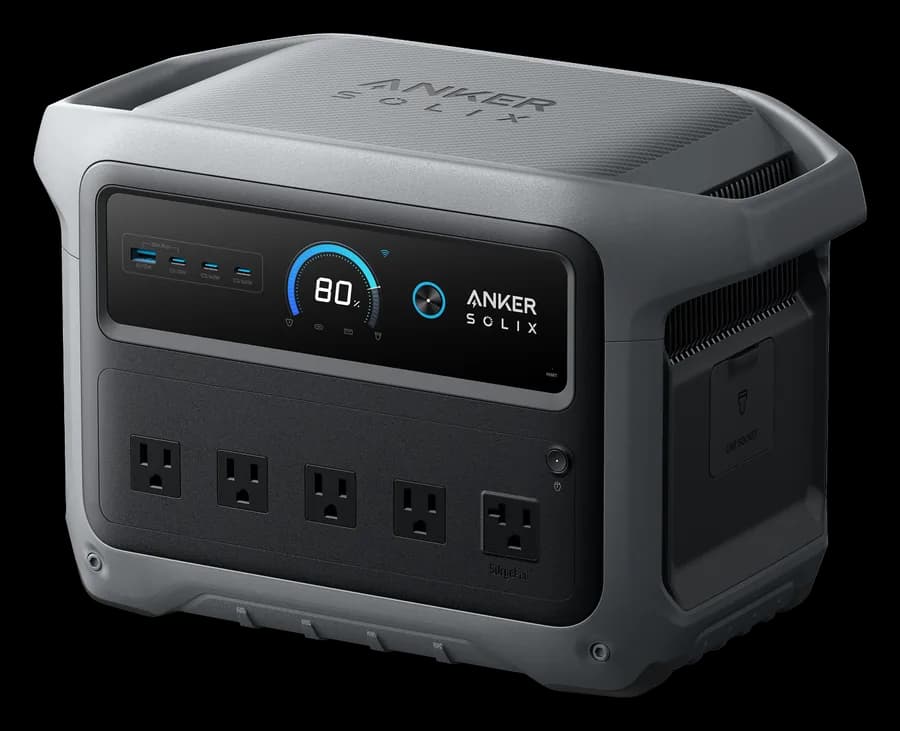
Engine's pick
Anker SOLIX C1000 Gen 2
About 16 h · also Anker SOLIX C800X / C800 Plus, EcoFlow RIVER 2 Pro
Two to three nights, no recharge
0.1 kWh/day · 3 days
Open this in the quiz and change the devicesClosest fit
Anker SOLIX C1000 Gen 2
Covers about 2.2 days · also Jackery Explorer 1000 v2, Jackery HomePower 1000 Plus v2
Add a laptop and the Wi-Fi router
0.7 kWh/day · 10 h
Open this in the quiz and change the devicesEngine's pick
Anker SOLIX C1000 Gen 2
About 13 h · also Anker SOLIX C800X / C800 Plus, Jackery Explorer 1000 v2
Add a full-size fridge
1.1 kWh/day · 10 h
Open this in the quiz and change the devicesEngine's pick
Anker SOLIX C1000 Gen 2
About 13 h · also Jackery Explorer 1000 v2, Jackery HomePower 1000 Plus v2
Picks come from the same engine as the quiz, recalculated whenever our catalog changes.
What people actually ask
What can a 300 Wh power station run?
Phones, laptops, a CPAP, a router, a 12 V fridge for most of a day, and small AC devices up to its output rating. It can't run a microwave, coffee maker or space heater, and most can't start a full-size fridge. For anything that heats, it's the output, not the battery, that stops you.
How many nights will a 300 Wh power station run a CPAP?
Without the humidifier, about 21 h on a DC cord, roughly 2 eight-hour nights, and about 11 h through the AC outlet. With the humidifier and heated tube, about 5.2 h, short of a full 8-hour night. Power planning only: check your CPAP maker's DC options and talk with your doctor about going without humidification.
Can a small power station run a refrigerator?
A 12 V compressor fridge, yes: about 17 h from the 12 V socket. A full-size kitchen fridge needs around 1,200 W to start, and only EcoFlow RIVER 3 Plus in this class can start one, for a few hours. For a kitchen fridge, look at 1 kWh units.
How many times will a 300 Wh station charge a laptop?
About 3 full charges of a 60 Wh laptop battery from USB-C, allowing for the battery reserve and conversion loss. Charging through the AC outlet with the laptop's brick gives fewer, because the inverter adds loss and standby draw.
Is a small power station worth it over a power bank?
If you need AC outlets, a 12 V socket or solar input, yes. A large USB power bank covers phones and a laptop for a day, but it can't run a CPAP brick, a router or a 12 V fridge. If everything you own charges over USB-C, a DC-only unit or a power bank is lighter and enough.
Who should buy which
- CPAP travel and overnight outages: a model with a fast UPS mode and a DC route for the CPAP.
- Laptop work and camping: the most USB-C wattage and solar input in the class.
- Phones and lanterns only: the lightest one, or the DC-only Anker SOLIX C300 DC.
- Anything that heats or a kitchen fridge: skip this class and start at 1 kWh.
The bottom line
A 300 Wh station is a carry-anywhere battery for electronics and a CPAP, not a small generator. Pick it for weight and the outlets you need, and size up as soon as anything that heats or a kitchen fridge is on your list. For your own devices, the sizing quiz runs the same engine, and the runtime calculator and comparison chart fill in the rest. For camping loads, see the camping picks.
Sources (checked 2026-11-01)
- ResMed Battery Guide (12 V DC current draw)
- ResMed AirSense 11 user guide
- Dometic CFX3 FAQ: power consumption
- ENERGY STAR certified residential refrigerators (dataset)
- Honda generator wattage estimation guide (starting watts)
- Jackery Explorer 300 (official)
- Anker SOLIX C300 (official)
- Bluetti Elite 30 V2 (official)
- EcoFlow RIVER 3 Plus (official)