Buy the DJI Power 2000 for home backup you may grow: it supplies 3,000 W instead of 2,400 W, has eight USB ports and takes up to ten expansion batteries for about 22.5 kWh. Buy the EcoFlow DELTA 3 Max if you want a car outlet and solar panels that plug straight in, or a lower price band. Both hold 2,048 Wh of LiFePO4 and switch over in 10 ms in UPS mode, so they run the same devices for the same time.
As an Amazon Associate, RightSizePower earns from qualifying purchases. That never changes how models are ranked. How we recommend
Quick answer
- Several big appliances at once
- DJI Power 2000 (3,000 W vs 2,400 W)
- Multi-day outages, adding batteries
- DJI Power 2000 (up to about 22.5 kWh)
- Lots of phones, tablets and laptops
- DJI Power 2000 (four 140 W USB-C + four USB-A)
- 12 V fridge or car-socket devices
- EcoFlow DELTA 3 Max (has a car outlet)
- Solar panels without extra modules
- EcoFlow DELTA 3 Max (500 W direct)
- Lighter to move
- EcoFlow DELTA 3 Max (3.7 lb lighter)
Specs side by side
From each maker's US spec and product pages, checked 2026-11-01. Rows where they differ are in darker text; starred values aren't fully confirmed by the maker.
| Spec | DJI Power 2000 | EcoFlow DELTA 3 Max |
|---|---|---|
| Capacity | 2,048 Wh | 2,048 Wh |
| Continuous output | 3,000 W | 2,400 W |
| Surge | Not published | 4,800 W* |
| Boost mode (heating loads) | None | 3,400 W |
| Battery | LiFePO4, 4,000 cycles to 80% | LiFePO4, cycles not stated* |
| Weight | 48.5 lb | 44.8 lb |
| AC outlets | 4 | 4 |
| USB-C | 4 × up to 140 W | 3 × up to 100 W |
| 12 V car outlet | No | Yes |
| Wall charge, 0–100% | Not published | Not published |
| Solar input | 400 W, Via DJI MPPT adapter module; up to 1800W with the DJI 1.8kW Solar/Car Super Fast Charger* | 500 W |
| UPS switchover | ≤10 ms | ≤10 ms |
| Extra batteries | Up to 22,528 Wh | Not expandable* |
| Warranty | 5 years | 3 years |
* Not stated on the maker's spec sheet, or derived from other official figures.
What does the DJI Power 2000 do better?
It handles bigger loads and grows further. 3,000 W continuous covers a microwave and a drip coffee maker together (about 2,500 W by our appliance data), which a 2,400 W unit can't. Up to ten DJI Power Expansion Battery 2000 packs take it to about 22.5 kWh, far beyond any other unit at this size. It has four AC outlets, four 140 W USB-C ports and four USB-A ports, a 10 ms UPS switchover, a 4,000-cycle rating to 80% and a 5-year warranty. DJI lists 0–80% from the wall in 55 minutes and up to 2,200 W of combined AC and DC input.
The trade-offs are real. There's no 12 V car socket. Solar needs DJI's MPPT adapter module (400 W) or its 1.8 kW Solar/Car Super Fast Charger; Gough Lui's bench review of the smaller Power 1000 found that MPPT module delivering about 200–305 W against its 400 W rating and running hot. DJI doesn't publish a surge figure, so our engine treats its surge as its 3,000 W continuous rating. It's the heavier unit at 48.5 lb. DJI products have had uneven US availability, so check that the listing actually ships before you plan around it.
Not for you if: you camp with a 12 V fridge, you want to plug in any brand's panels, or you want the lighter unit.
What does the EcoFlow DELTA 3 Max do better?
It's the simpler package. It has a car outlet for 12 V devices, takes up to 500 W of solar with no extra module, and weighs 44.8 lb. It supplies 2,400 W continuously, enough for a fridge, a sump pump or a window AC, and X-Boost lets heating appliances up to 3,400 W run at reduced power (it doesn't help motors start). It switches over in 10 ms and charges from the wall at up to 1,800 W, reaching 80% in 68 minutes.
Its limits: our sources list no extra battery, so plan on 2 kWh for life (the DELTA 3 Max Plus is the expandable version). EcoFlow's 4,800 W surge figure appears only in marketing copy, and the page we used states no cycle rating. Its three USB-C ports top out at 100 W. The warranty is 3 years, plus 2 after app registration.
Not for you if: you want more than 2 kWh later or need to run two kitchen appliances at once. On either unit, turn off any ECO or auto-off setting for the AC output before leaving a fridge on it; EcoFlow's own manuals advise keeping AC output always on for a fridge holding medicine.
How long does each run the same devices?
| Load (typical daily use) | Power 2000 | DELTA 3 Max | Power 2000 + one extra battery |
|---|---|---|---|
| Top-freezer fridge | 24–29 h | 24–29 h | 47 h – 2.4 days |
| French-door fridge + chest freezer | 13–16 h | 13–16 h | 26–32 h |
| Fridge + Wi-Fi + ½ hp sump pump | 12–14 h | 12–14 h | 23–29 h |
| 8,000 BTU window AC, nonstop | 4–4.9 h | 4–4.9 h | 7.9–9.8 h |
| 12 V portable fridge on the car socket | No 12 V socket | 4.4–5.4 days | No 12 V socket |
Estimates from our published formula. Neither maker publishes standby draw, so both use the same default. The last column adds one 2,048 Wh DJI expansion battery (4,096 Wh total). Try your own devices in the runtime calculator.
When does the quiz engine prefer each one?
We ran five situations through the engine the quiz uses. The Power 2000 comes out ahead in 3 of 5, thanks to its warranty, published cycle rating and expansion. The DELTA 3 Max wins when a 12 V device or a tighter budget rules the DJI out.
| Situation | Engine prefers | Why |
|---|---|---|
| Outage night: fridge, Wi-Fi, phones, lights | Power 2000 | Scores 77 vs 72 (DJI vs EcoFlow) |
| Same, plus a ½ hp sump pump | Power 2000 | Scores 77 vs 72 (DJI vs EcoFlow) |
| Same devices for three days, on wheels | Power 2000 | Power 2000 needs extra batteries. DELTA 3 Max: Runs your devices for about 20 h; you asked for 3 days. |
| Camping with a 12 V fridge and lights | DELTA 3 Max | Power 2000: No 12 V car socket for the 12 v portable fridge (45 l). |
| Outage night on a $500 to $1,000 budget | DELTA 3 Max | Power 2000: Usually sells above your budget. |
Who should buy which
- Buy the DJI Power 2000 if it stays home for outages, you may want days of backup later, or you charge a lot of devices over USB, and you've confirmed it's in stock.
- Buy the EcoFlow DELTA 3 Max if it also goes camping or in the car, you want to plug in your own solar panels, or 2 kWh from the wall is all you'll ever need. A top-freezer fridge runs about 28 h on either.
- Look at the Anker C2000 Gen 2 too: it scores higher than both in several of the situations below. Our DELTA 3 Max vs C2000 Gen 2 guide compares it head to head. If you need 240 V, see the best power station for home backup; any connection to home circuits needs a transfer switch installed by a licensed electrician.
Which model does the quiz pick for these situations?
Across the whole catalog, not just these two. Open any row in the quiz and swap in your own devices.
Outage night: fridge, Wi-Fi, phones, lights
1.5 kWh/day · 10 h
Open this in the quiz and change the devices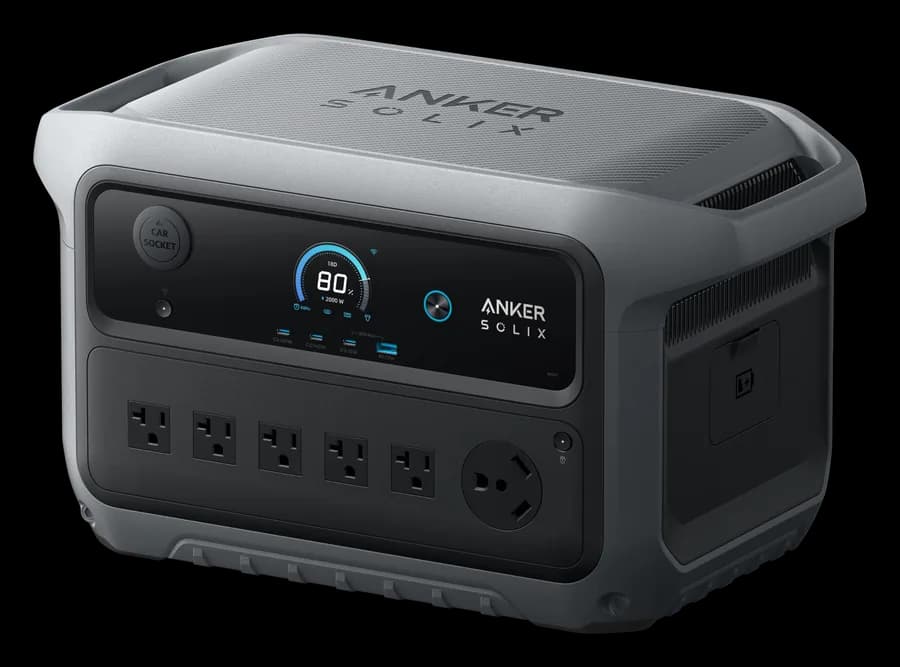
Engine's pick
Anker SOLIX C2000 Gen 2
About 18 h · also Jackery Explorer 1500 Ultra, Anker SOLIX S2000
Same, plus a ½ hp sump pump
2.5 kWh/day · 10 h
Open this in the quiz and change the devicesEngine's pick
Anker SOLIX C2000 Gen 2
About 12 h · also Jackery HomePower 2000 Plus v2, DJI Power 2000
Same devices for three days, on wheels
1.5 kWh/day · 3 days · extra batteries allowed
Open this in the quiz and change the devices
Engine's pick
DJI Power 1000 V2
About 4.9 days with an extra battery · also Jackery HomePower 1000 Plus v2, DJI Power 2000
Camping with a 12 V fridge and lights
0.5 kWh/day · 10 h
Open this in the quiz and change the devicesAnker SOLIX768 WhEngine's pick
Anker SOLIX C800X / C800 Plus
About 16 h · also EcoFlow RIVER 2 Pro, Anker SOLIX C1000 Gen 2
Outage night on a $500 to $1,000 budget
1.5 kWh/day · 10 h
Open this in the quiz and change the devicesEngine's pick
Anker SOLIX C2000 Gen 2
About 18 h · also Jackery Explorer 1500 Ultra, Anker SOLIX S2000
Picks come from the same engine as the quiz, recalculated whenever our catalog changes.
What people actually ask
Does the DJI Power 2000 have a 12 V car outlet?
No. DJI lists no car-style 12 V socket, so a 12 V portable fridge or a CPAP's DC cable can't plug in without a DJI accessory; the CPAP can still run on its AC adapter, at a shorter runtime. The DELTA 3 Max has a car outlet.
Can I plug solar panels straight into the DJI Power 2000?
Not directly. DJI routes solar through its MPPT adapter module, rated 400 W, or its 1.8 kW Solar/Car Super Fast Charger for up to 1,800 W. We mark both figures as unconfirmed. The DELTA 3 Max accepts up to 500 W of solar with no extra module.
Is the EcoFlow DELTA 3 Max expandable?
Not according to our catalog sources: EcoFlow's page is ambiguous and lists no extra battery for it, so we treat it as fixed at 2,048 Wh. The DELTA 3 Max Plus is EcoFlow's expandable model at this size. The DJI Power 2000 takes up to ten expansion batteries.
Can either one run a window air conditioner?
Yes, both have the power to start and run a typical 8,000 BTU window unit. On 2,048 Wh, expect about 4.7 h of nonstop cooling by our estimate: enough for the hottest part of a night, not a full night or day.
Which has the better warranty?
DJI lists 5 years for the Power 2000. EcoFlow advertises 5 years for the DELTA 3 Max, made up of 3 years standard plus 2 when you register it in the EcoFlow app.
The bottom line
Same 2 kWh battery and the same 10 ms switchover. The DJI Power 2000 is the stronger home-backup unit: 600 W more output, eight USB ports, a 5-year warranty and room to grow to about 22.5 kWh, provided you can get one and don't need a car socket. The EcoFlow DELTA 3 Max is the easier all-purpose unit with a car outlet and direct solar input. Check your devices in the sizing quiz or compare every model in the comparison chart.

DJI Power 2000
Home backup with 3000W output, many USB ports and up to ten expansion batteries.
- Capacity
- 2,048 Wh
- Output
- 3,000 W
- Weight
- 48.5 lb
- UPS
- 10 ms
Paid link
Check price on Amazon
EcoFlow DELTA 3 Max
A fridge for a full day, or a sump pump or small window AC for part of one, from a 2 kWh unit best recharged from the wall.
- Capacity
- 2,048 Wh
- Output
- 2,400 W
- Weight
- 44.8 lb
- UPS
- 10 ms
Paid link
Check price on Amazon