A 1,000 Wh power station runs a fridge for about 15 hours, a Wi-Fi router for more than a day and a CPAP for several nights, but a space heater for only about half an hour. What it can run at all depends on its output in watts; how long depends on its capacity in watt-hours. The chart below shows both for four common sizes.
As an Amazon Associate, RightSizePower earns from qualifying purchases. That never changes how models are ranked. How we recommend
Runtime chart by power station size
One device running alone, continuously. “Too much power” means typical models of that size can't supply the device's running watts; “won't start it” means its start-up surge is above their typical surge rating.
| Device | Watts | 300 Wh | 1,000 Wh | 2,000 Wh | 3,000 Wh |
|---|---|---|---|---|---|
| Phone or tablet (USB) | 10 | 24 h | 3.4 days | 6.8 days | 10.1 days |
| Laptop (USB-C) | 60 | 4 h | 13 h | 27 h | 41 h |
| Wi-Fi router + modem | 15 | 9.8 h | 30 h | 2.1 days | 3.2 days |
| Starlink Mini (DC) | 30 | 8.1 h | 27 h | 2.2 days | 3.4 days |
| Starlink Standard | 88 | 2.4 h | 7.8 h | 15 h | 22 h |
| LED bulb | 10 | 12 h | 38 h | 2.5 days | 3.8 days |
| TV (50–55 in, LED) | 96 | 2.2 h | 7.2 h | 14 h | 21 h |
| CPAP, no humidifier (DC cable) | 11.2 | 22 h | 3 days | 6 days | 9 days |
| CPAP with humidifier and heated tube | 45.2 | 4.3 h | 14 h | 25 h | 38 h |
| Electric blanket or heated mattress pad (queen) | 110 | 3.6 h | 12 h | 22 h | 33 h |
| Full-size refrigerator (top freezer) | 160 | Won't start it | 15 h | 27 h | 41 h |
| Chest freezer | 100 | Won't start it | 22 h | 38 h | 2.4 days |
| Gas furnace blower (needs an electrician-installed inlet) | 400 | Too much power | 4.5 h | 8.7 h | 13 h |
| Sump pump, 1/2 hp, while pumping | 1,050 | Too much power | 43 min | 1.4 h | 2.2 h |
| Window AC, 8,000 BTU | 533 | Too much power | 2.3 h | 4.6 h | 6.8 h |
| Drip coffee maker, while brewing | 1,000 | Too much power | 45 min | 1.5 h | 2.3 h |
| Microwave (1,000–1,200 W cooking power) | 1,500 | Too much power | 30 min | 1 h | 1.5 h |
| Space heater on high (1,500 W) | 1,500 | Too much power | 30 min | 1 h | 1.5 h |
| Typical current model | 300 W out, 9 lb5 models | 1,800 W out, 27 lb14 models | 2,400 W out, 42 lb9 models | 3,600 W out, 76 lb8 models | |
Typical output and weight are the median of current models we track within 25% of each capacity. Runtimes use a 10% battery reserve, 85% inverter efficiency and standby draw; fridges and freezers use ENERGY STAR daily energy. Method
How to read a size: watts and watt-hours
Watts are how much power the station can deliver at one moment. Watt-hours are how much energy it holds. A coffee maker needs about 1,000 W but only for a few minutes, so a 1,000 Wh station handles it easily; a 300 Wh station has enough energy for several pots but can't deliver 1,000 W at once. A router is the opposite: tiny power, all day long, so capacity is what matters.
About 300 Wh: phones, laptops, a router, a CPAP
Current 300 Wh models such as the Jackery Explorer 300 weigh around 9 lb and typically supply about 300 W. That's plenty for electronics, lights, a router or a CPAP on its DC cable, and not enough for anything with a heating element or a compressor.
About 1,000 Wh: a fridge overnight, a home office for a day
This is where most people land. Around 27 lb, with roughly 1,800 W of output, a 1 kWh unit starts a fridge, runs a microwave or coffee maker in short bursts and keeps a router, laptop and phones going for a day. It won't keep a fridge going for a full day, and a space heater drains it in about half an hour.
About 2,000 Wh: a fridge for a full day
At roughly 42 lb, 2 kWh units are still movable by one person. They run a typical fridge for a little over a day, or a fridge plus Wi-Fi for most of one, and their surge ratings of around 4,000 W start sump pumps and window air conditioners.
About 3,000 Wh: multi-day essentials
At 3 kWh the median weight jumps to around 76 lb, and most units have wheels. They keep a fridge, a router and a light going for about a day and a half, a fridge alone for well over a day, and supply roughly 3,600 W, enough for a microwave alongside a running fridge. For 240 V loads such as well pumps, you need a home-backup model with split-phase output and a transfer switch installed by a licensed electrician.
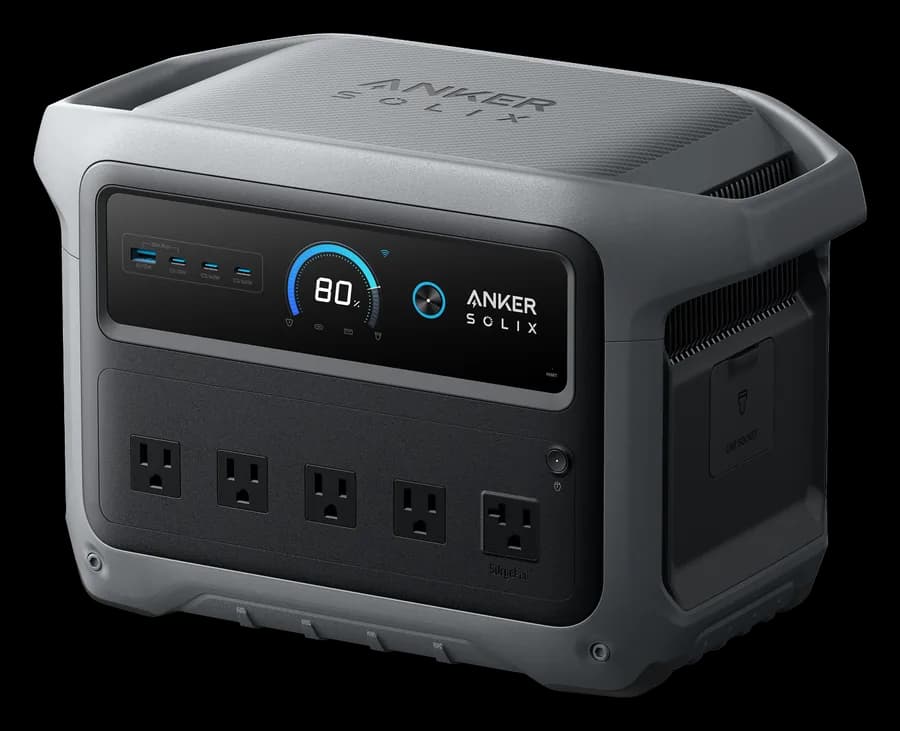
Anker SOLIX C1000 Gen 2
A fridge, microwave or coffee maker in an outage, from a 1 kWh unit under 25 lb.
- Capacity
- 1,024 Wh
- Output
- 2,000 W
- Weight
- 24.9 lb
- UPS
- 10 ms
Paid link
Check price on Amazon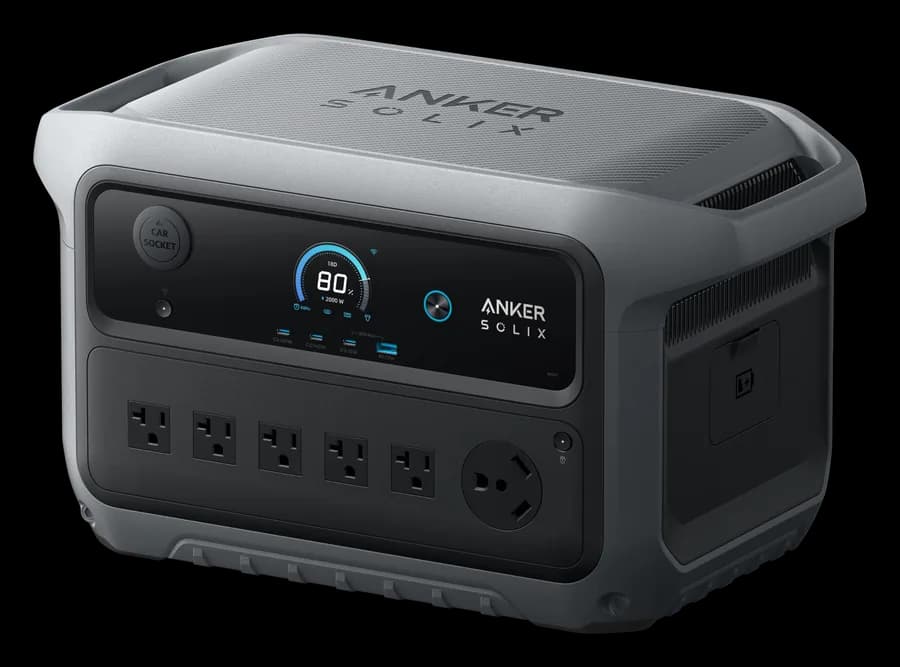
Anker SOLIX C2000 Gen 2
A fridge, sump pump or RV via the TT-30 outlet, with one extra battery to reach 4 kWh.
- Capacity
- 2,048 Wh
- Output
- 2,400 W
- Weight
- 41.7 lb
- UPS
- 10 ms
Paid link
Check price on AmazonWhat people actually ask
What can a 1000 Wh power station run?
A typical 1,000 Wh unit runs a full-size fridge for about 15 hours, a Wi-Fi router for more than a day, a CPAP without humidifier for several nights on its DC cable, or a 1,500 W space heater for about half an hour. Most current 1 kWh units supply around 1,800 W, enough for a microwave or coffee maker in short bursts.
What can a 300 Wh power station run?
Phones, laptops, lights, a router or a CPAP for a night or two. Current 300 Wh models typically supply around 300 W continuously, so they can't start a fridge or run a coffee maker, microwave or heater.
Can a 2000 Wh power station run a refrigerator?
Yes. A typical top-freezer fridge runs a little over a day on 2,000 Wh, and current 2 kWh units have surge ratings well above the roughly 1,200 W a fridge compressor needs to start.
Why does the chart say 'too much power' for some devices?
Capacity and power output are separate limits. A small station may hold enough energy for a few minutes of microwaving but can't deliver 1,500 W at once, so it shuts off. We compare each device with the typical continuous rating of current models in that size.
Is watt-hours divided by watts a good estimate?
It's too optimistic. You lose about 10% to the battery's reserve and about 15% in the inverter, and the inverter draws standby power while the outlets are on. This chart includes all three, which is why its times are shorter than the simple division.
The bottom line
Check two numbers: the station's continuous watts must exceed what you'll run at once, and its watt-hours divided by your hourly use, minus about 25% for losses, tells you how long. For phones and a CPAP, 300 Wh is enough; for a fridge overnight, 1,000 Wh; for a fridge through a day, 2,000 Wh. Put in your own devices with the runtime calculator or let the sizing quiz pick models.