Buy the Anker SOLIX C1000 Gen 2 if you want the lighter unit with more continuous output and the faster top-up; buy the EcoFlow DELTA 3 Plus if you might add batteries later, because it expands to about 5 kWh and the Anker can't be expanded at all. Both hold 1,024 Wh of LiFePO4 and switch over in under 10 ms in UPS mode, so they run your devices for the same amount of time.
As an Amazon Associate, RightSizePower earns from qualifying purchases. That never changes how models are ranked. How we recommend
Quick answer
- Carrying it often
- Anker C1000 Gen 2 (2.7 lb lighter)
- Microwave, kettle or several devices at once
- Anker C1000 Gen 2 (2,000 W vs 1,800 W)
- Might want more capacity later
- EcoFlow DELTA 3 Plus (expandable)
- Most AC outlets
- EcoFlow DELTA 3 Plus (6 vs 5)
- Laptops and USB-C devices
- Anker C1000 Gen 2 (three 140 W ports vs two)
- Longest standard warranty
- Anker C1000 Gen 2 (5 years; EcoFlow is 3 + 2 with app registration)
Specs side by side
From each maker's US product page and manual. Rows where they differ are in darker text.
| Spec | Anker SOLIX C1000 Gen 2 | EcoFlow DELTA 3 Plus |
|---|---|---|
| Capacity | 1,024 Wh | 1,024 Wh |
| Continuous output | 2,000 W | 1,800 W |
| Surge | 3,000 W | 3,600 W |
| Boost mode (heating loads) | None | 2,200 W |
| Battery | LiFePO4, 4,000 cycles to 80% | LiFePO4, 4,000 cycles to 80% |
| Weight | 24.9 lb | 27.6 lb |
| AC outlets | 5* | 6 |
| USB-C | 3 × up to 140 W | 2 × up to 140 W |
| 12 V car outlet | Yes | Yes |
| Wall charge, 0–100% | 49 min | 56 min |
| Solar input | 600 W, 11-60V (XT60i) | 500 W, 11-60V* |
| UPS switchover | ≤10 ms | ≤10 ms |
| Extra batteries | Not expandable | Up to 5,000 Wh |
| Warranty | 5 years | 3 years |
* Not stated on the maker's spec sheet, or derived from other official figures.
Output: the Anker runs more at once
The C1000 Gen 2 supplies 2,000 W continuously against the DELTA 3 Plus's 1,800 W. That 200 W matters when you stack loads. A microwave sold as 1,000 to 1,200 W of cooking power typically draws about 1,500 W from the outlet; add a running fridge and you're near 1,660 W. That sits comfortably inside the Anker's limit and right at the edge of the EcoFlow's. The EcoFlow answers with a higher surge rating, 3,600 W against 3,000 W, which helps compressors and pumps start, though both clear the roughly 1,200 W a typical fridge needs.
The DELTA 3 Plus also lists X-Boost up to 2,200 W. That lowers the voltage so heating appliances such as a hair dryer run at reduced power instead of tripping the unit; it doesn't raise real capacity or help motors start.
Capacity: identical today, different tomorrow
Both batteries are 1,024 Wh and rated for 4,000 cycles to 80% of capacity, so day-one runtime is the same. The difference is the ceiling. EcoFlow sells extra batteries that connect to the DELTA 3 Plus for about 5 kWh in total. The C1000 Gen 2 has no expansion port; Anker's route to more capacity is a bigger unit such as the C2000 Gen 2.
Runtime on the same devices
| Load (typical daily use) | C1000 Gen 2 | DELTA 3 Plus |
|---|---|---|
| Top-freezer fridge | 13–16 h | 13–16 h |
| CPAP, no humidifier, on the DC cable | 2.6–3.2 days | 2.6–3.2 days |
| Wi-Fi router + laptop (USB-C) | 8.1–10 h | 8.1–10 h |
Estimates from our published formula; neither maker publishes standby draw, so both use the same default.
Charging: both refill in about an hour
Anker quotes a full charge in 49 minutes, but only with UltraFast charging switched on in the app and the cells above about 68°F (20°C); standard AC charging runs at 1,200 W. EcoFlow quotes 56 minutes at up to 1,500 W. For solar, Anker lists up to 600 W on one XT60 input at 11–60 V. EcoFlow lists 500 W solar inputs and two ports, but its spec page doesn't make the combined limit clear, so plan around 500 W until you confirm it in the manual.
Ports and everyday use
The DELTA 3 Plus has six AC outlets to the Anker's five, which helps if you're plugging in a fridge, lamp, router and TV during an outage. The Anker has three 140 W USB-C ports to EcoFlow's two, which matters more if you're charging laptops. Both have a 12 V car outlet and an app, and both list a switchover under 10 ms when used as a UPS.
Who should buy which
- Buy the Anker SOLIX C1000 Gen 2 if you'll carry it to campsites or between rooms, run a microwave or several devices at once, charge laptops over USB-C, or want the longer standard warranty, and you're sure 1 kWh is enough.
- Buy the EcoFlow DELTA 3 Plus if it's for home backup and you might want two or three days of runtime later, if you need the sixth AC outlet, or if you want the higher surge rating for a pump or compressor.
- Buy neither if you need a full day of a fridge plus Wi-Fi; at about 12 hours, that needs a 2 kWh unit. The sizing quiz checks your exact devices.
What people actually ask
Which lasts longer, the Anker C1000 Gen 2 or the EcoFlow DELTA 3 Plus?
On the same devices, neither. Both hold 1,024 Wh of LiFePO4, so runtime is effectively identical. Only the DELTA 3 Plus can be extended, by adding EcoFlow extra batteries for up to about 5 kWh.
Can the Anker SOLIX C1000 Gen 2 add an extra battery?
No. The C1000 Gen 2 has no expansion port. If you think you'll want more capacity later, the DELTA 3 Plus, or a larger Anker such as the C2000 Gen 2, is the better starting point.
Which one charges faster from the wall?
Anker lists a full charge in 49 minutes, but that needs its UltraFast mode switched on in the app and warm cells; normal AC charging is 1,200 W. EcoFlow lists 56 minutes at up to 1,500 W. In practice both refill in about an hour.
Can either one run a refrigerator or a microwave?
Both can start a typical full-size fridge, since each lists 3,000 W or more of surge. For a microwave, check the input wattage on its label: the Anker supplies 2,000 W continuous, the EcoFlow 1,800 W.
Do they work as a UPS for a computer or CPAP?
Both list a switchover under 10 ms. That suits most home electronics and CPAP machines. Power station makers generally advise against using this mode in place of a dedicated UPS for servers or workstations.
The bottom line
These two run the same devices for the same time. Pick the Anker C1000 Gen 2 for lighter weight, more continuous output and better USB-C; pick the EcoFlow DELTA 3 Plus for expansion and more AC outlets. If you're unsure whether 1 kWh is enough, that uncertainty is itself the case for the EcoFlow.
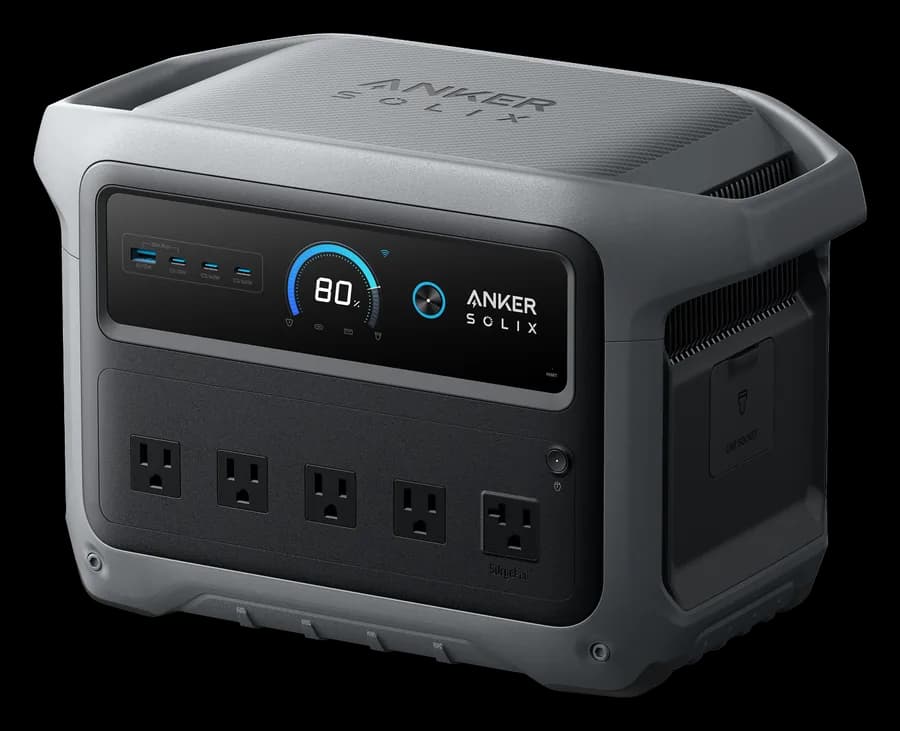
Anker SOLIX C1000 Gen 2
A fridge, microwave or coffee maker in an outage, from a 1 kWh unit under 25 lb.
- Capacity
- 1,024 Wh
- Output
- 2,000 W
- Weight
- 24.9 lb
- UPS
- 10 ms
Paid link
Check price on Amazon
EcoFlow DELTA 3 Plus
A fridge and home office through an outage, with six AC outlets and a path to 5 kWh with extra batteries.
- Capacity
- 1,024 Wh
- Output
- 1,800 W
- Weight
- 27.6 lb
- UPS
- 10 ms
Paid link
Check price on Amazon