Buy the Anker SOLIX C1000 Gen 2 if you want one 1 kWh unit under 25 lb that can run a fridge, a microwave or a coffee maker in an outage, charge laptops fast and act as a UPS. Skip it if you might ever want more capacity, because it can't take an extra battery. It holds 1,024 Wh of LiFePO4 and supplies 2,000 W continuously, more than most units its size.
As an Amazon Associate, RightSizePower earns from qualifying purchases. That never changes how models are ranked. How we recommend
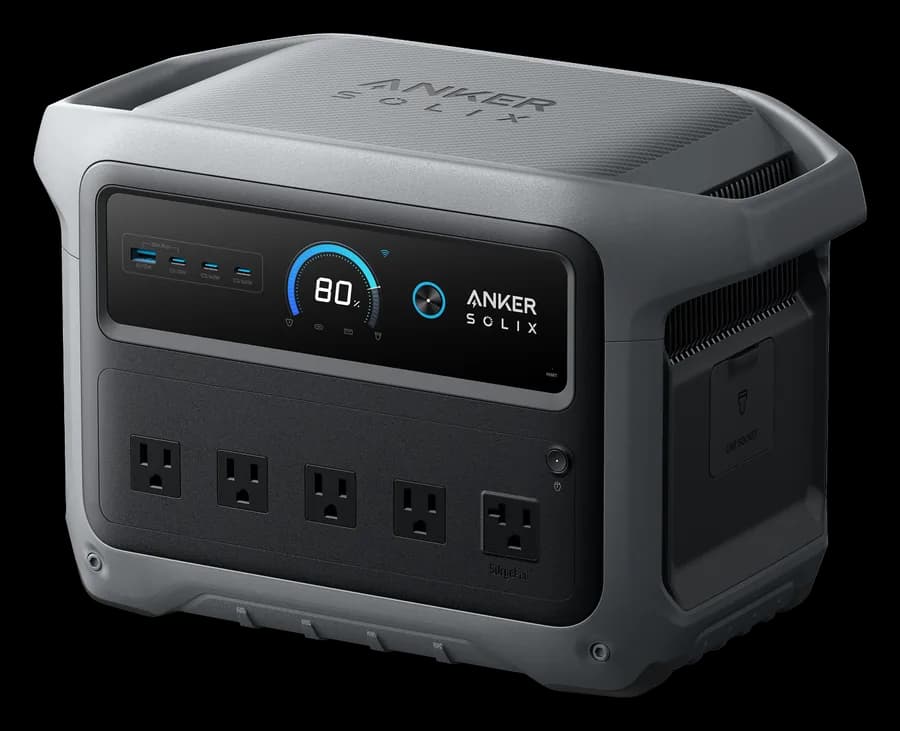
Anker SOLIX C1000 Gen 2
A fridge, microwave or coffee maker in an outage, from a 1 kWh unit under 25 lb.
- Capacity
- 1,024 Wh
- Output
- 2,000 W
- Weight
- 24.9 lb
- UPS
- 10 ms
Paid link
Check price on AmazonQuick verdict
- Good fit
- Overnight outage with a fridge and router; microwave or coffee maker; home office UPS
- Poor fit
- A full day of fridge backup; anyone who wants to add batteries
- Weight
- 24.9 lb
- Grow later?
- No expansion port
- Watch out for
- The 49-minute charge needs a setting in the app
Key specs
From Anker's US product page and manual. Starred values aren't confirmed on the spec sheet yet.
| Spec | Anker SOLIX C1000 Gen 2 |
|---|---|
| Capacity | 1,024 Wh |
| Continuous output | 2,000 W |
| Surge | 3,000 W |
| Boost mode (heating loads) | None |
| Battery | LiFePO4, 4,000 cycles to 80% |
| Weight | 24.9 lb |
| AC outlets | 5* |
| USB-C | 3 × up to 140 W |
| 12 V car outlet | Yes |
| Wall charge, 0–100% | 49 min |
| Solar input | 600 W, 11-60V (XT60i) |
| UPS switchover | ≤10 ms |
| Extra batteries | Not expandable |
| Warranty | 5 years |
* Not stated on the maker's spec sheet, or derived from other official figures.
What will it run, and for how long?
Each device on its own from a full charge, running nonstop (the fridge and blanket cycle as normal). Includes the battery reserve, conversion losses and standby draw from our published formula.
| Device | Plugged into | Runtime or limit |
|---|---|---|
| Top-freezer fridgeabout 0.99 kWh a day, 1,200 W to start | AC outlet | 13–16 h |
| CPAP, humidifier off11 W | 12 V outlet | 2.6–3.2 days |
| Wi-Fi router and modem15 W | AC outlet | 26–33 h |
| Laptop60 W | USB-C | 12–15 h |
| 50–55 in TV96 W | AC outlet | 6.3–7.7 h |
| Electric blanket (queen)110 W, cycles on and off | AC outlet | 10–13 h |
| Microwave1,500 W | AC outlet | 26–33 min |
| Space heater on high1,500 W | AC outlet | 26–33 min |
The microwave and heater rows show how long the battery lasts if they run nonstop; in practice a microwave runs a few minutes at a time. Add your own mix in the runtime calculator.
Where the C1000 Gen 2 wins, and where it's ruled out
We ran eight common situations through the quiz engine. Rank is among every model that passes the hard limits.
| Situation | Result | Runtime or reason |
|---|---|---|
| Outage overnight: fridge, Wi-Fi and phones (carry it) | #2 of 20 | About 11 h |
| Outage for a full day, same devices (wheels OK) | Ruled out | Runs your devices for about 11 h; you asked for 24 h. |
| CPAP for two nights away, one-hand carry | #3 of 7 | About 2.2 days |
| Weekend car camping: 12 V fridge, lights, phones, with solar | #5 of 16 | About 27 h |
| RV day: fan, TV, laptop, phones | Ruled out | Runs your devices for about 15 h; you asked for 24 h. |
| Remote work day: Starlink, laptop, phone | Ruled out | Runs your devices for about 7.2 h; you asked for 24 h. |
| Home office on UPS: router, laptop, phone, overnight | #1 of 20 | About 16 h |
| Overnight essentials on a budget under $500 | #1 of 8 | About 11 h |
The C1000 Gen 2 is a strong pick wherever one night is enough: an overnight outage, a home office on UPS, an overnight on a budget. It drops out where you need a day or more of the same devices, because no 1 kWh unit gets there and this one can't be expanded.
What does it do well?
- More output than its size suggests. 2,000 W continuous against 1,800 W for the typical current model near 1 kWh. That's the difference between running a microwave, coffee maker or a fridge plus a kettle, and tripping the inverter.
- Light for what it does. 24.9 lb, against 26.85 lb for a typical model near this size.
- Laptop-friendly ports. Three USB-C ports at up to 140 W each charge large laptops without the inverter, and a 12 V car outlet runs a CPAP on its DC cable for about 3.1 days of nonstop use with the humidifier off.
- UPS with a published switchover. Anker lists under 10 ms, so it can sit between the wall and a router, CPAP or desktop and take over in an outage.
- Long warranty. 5 years, and LiFePO4 rated for 4,000 cycles to 80%.
What should you know before you buy?
- It can't grow. There's no expansion port. If you're unsure whether 1 kWh is enough, that uncertainty is a reason to pick an expandable unit instead.
- The fastest charge is opt-in. The 49-minute full charge needs UltraFast mode switched on in the app and cells above about 68°F (20°C). Normal AC charging is 1,200 W.
- Bypass is lower than inverter output. When plugged into the wall, the outlets pass through up to 1,800 W, not the 2,000 W the battery can supply.
- Solar is one XT60 input. Up to 600 W at 11–60 V. At that rate about 1.7 hours of full sun refill it, which takes roughly 860 W of rated panels; check their voltage against that range.
- Outlet count. Anker's comparison data lists 10 ports in total, which we read as five AC outlets; we mark that as unconfirmed until the spec sheet states it.
What are the closest alternatives?
The EcoFlow DELTA 3 Plus has the same 1,024 Wh, a 3,600 W surge and six AC outlets, and it expands to about 5 kWh with extra batteries; it gives up 200 W of continuous output and weighs 2.7 lb more. See C1000 Gen 2 vs DELTA 3 Plus. The Jackery Explorer 1000 v2 is 1.1 lb lighter but stops at 1,500 W, too little for most microwaves, and Jackery doesn't publish a UPS switchover time; see Explorer 1000 v2 vs C1000 Gen 2. If you already know you need a day of fridge backup, the Anker C2000 Gen 2 doubles the capacity. The original C1000 is still sold at a discount and takes one extra battery; C1000 Gen 2 vs C1000 covers when that's worth it.

EcoFlow DELTA 3 Plus
Same 1,024 Wh and 1,800 W output, with extra batteries for about 5 kWh.
- Capacity
- 1,024 Wh
- Output
- 1,800 W
- Weight
- 27.6 lb
- UPS
- 10 ms
Paid link
Check price on Amazon
Jackery Explorer 1000 v2
Same 1,024 Wh at 23.8 lb; 1,500 W output, so no microwave.
- Capacity
- 1,024 Wh
- Output
- 1,500 W
- Weight
- 23.8 lb
- UPS
- 20 ms
Paid link
Check price on AmazonWho should buy it, and who shouldn't?
- Buy it for overnight outages with a fridge and a microwave or coffee maker, as a UPS for a home office or CPAP, or for camping and RV weekends where you want laptop charging and a unit you can still carry.
- Skip it if you want a full day or more of fridge backup, plan to add batteries, or need a TT-30 RV outlet. The sizing quiz checks your devices against every model.
More on sizing: how long a power station runs a refrigerator and picks for home backup by outage type, or every model in the comparison chart.
What people actually ask
Can the Anker SOLIX C1000 Gen 2 run a microwave?
Yes, most of them. A microwave sold as 1,000 to 1,200 W of cooking power typically draws about 1,500 W from the outlet, and the C1000 Gen 2 supplies 2,000 W continuously. Check the input wattage on your microwave's label; anything up to about 1,800 W leaves the margin we look for.
How long will the C1000 Gen 2 run a refrigerator?
About 15 hours for a typical top-freezer fridge on its own, from a full charge. Its 3,000 W surge covers the compressor's start. For a full day of fridge backup you need about 2 kWh, such as the Anker C2000 Gen 2.
Can I add an extra battery to the C1000 Gen 2?
No. The C1000 Gen 2 has no expansion port, so 1,024 Wh is the ceiling. If you might want more capacity later, look at an expandable 1 kWh unit such as the EcoFlow DELTA 3 Plus, or Anker's C2000 Gen 2, which takes one extra battery.
Does it really charge in 49 minutes?
Only with UltraFast charging switched on in the Anker app and the cells above about 68°F (20°C). Normal wall charging runs at 1,200 W, which still refills it in roughly an hour.
Can the C1000 Gen 2 work as a UPS for a CPAP or computer?
Anker lists a switchover under 10 ms, which suits most home electronics, routers and CPAP machines. For servers and workstations, power station makers generally advise a dedicated UPS instead.
The bottom line
The C1000 Gen 2 is the 1 kWh unit to beat for running more at once: 2,000 W output, a published UPS switchover and a 5-year warranty at 24.9 lb. Its one real limit is that it can't be expanded, so buy it when you're sure a night of backup, about 15 h with a fridge, is what you need.
Anker SOLIX C1000 Gen 2
A fridge, microwave or coffee maker in an outage, from a 1 kWh unit under 25 lb.
- Capacity
- 1,024 Wh
- Output
- 2,000 W
- Weight
- 24.9 lb
- UPS
- 10 ms
Paid link
Check price on Amazon