Yes, most 1,000 Wh and larger power stations can start and run a corded drill or a 7-1/4 inch circular saw, but a corded chainsaw needs one of the biggest units. Start-up surge decides which tools a station can run; capacity decides for how long. A circular saw uses about 27 Wh of battery per minute of cutting, so a 1 kWh station gives about 33 min of nonstop cutting, spread across a day of real work.
As an Amazon Associate, RightSizePower earns from qualifying purchases. That never changes how models are ranked. How we recommend
Which station sizes can start which tool?
Median continuous and surge output of current models near each capacity, checked against each tool's running watts plus a 10% margin and its starting watts.
| Typical station | Output / surge | Corded drill | Circular saw | Electric chainsaw |
|---|---|---|---|---|
| 300 Wh 5 models | 300 / 600 W | No | No | No |
| 500 Wh 2 models | 550 / 1,100 W | Yes | No | No |
| 1,000 Wh 14 models | 1,800 / 2,850 W | Yes | Yes | No |
| 2,000 Wh 9 models | 2,400 / 4,000 W | Yes | Yes | No |
| 3,000 Wh 8 models | 3,600 / 7,200 W | Yes | Yes | Yes |
| Tool draw | running / start | 440 / 600 W | 1,400 / 2,300 W | 1,740 / 5,220 W* |
| Models that start it | 39 of 42 | 30 of 42 | 10 of 42 |
Drill and saw figures from Honda's and Champion's wattage guides. *The chainsaw's running watts come from Greenworks' 14.5 A rating; no maker publishes a starting figure, so we use three times running watts as a cautious estimate. Check your own tool's nameplate amps × 120.

Bluetti Elite 100 V2
1,800 W continuous and 2,700 W surge start a 2,300 W circular saw; 1,024 Wh at 25.3 lb, about 33 min of nonstop cutting.
- Capacity
- 1,024 Wh
- Output
- 1,800 W
- Weight
- 25.3 lb
- UPS
- 10 ms
Paid link
Check price on Amazon
EcoFlow DELTA 3 Max Plus
3,000 W continuous and 6,000 W surge cover even our cautious chainsaw estimate; 2,048 Wh gives about 54 min of nonstop chainsaw use, or about 66 min of circular saw.
- Capacity
- 2,048 Wh
- Output
- 3,000 W
- Weight
- 48.7 lb
- UPS
- 10 ms
Paid link
Check price on AmazonHow long can you cut?
Minutes of nonstop full-power use, including the battery reserve, inverter loss and standby draw. Real work has pauses between cuts, so the same energy lasts across many more minutes on the clock.
| Tool | 512 Wh | 1,024 Wh | 2,048 Wh | 3,072 Wh |
|---|---|---|---|---|
| Corded drill (3/8 in)about 9 Wh of battery per minute | 52 min | 104 min | 3.4 h | 5.2 h |
| Circular saw (7-1/4 in, corded)about 27 Wh of battery per minute | 17 min | 33 min | 66 min | 100 min |
| Electric chainsaw (corded, 14–15 A)about 34 Wh of battery per minute | 13 min | 27 min | 54 min | 80 min |
| Power-tool battery charger100 W estimate, charging | 3.6 h | 7.1 h | 14 h | 20 h |
Why start-up surge matters more than capacity
A tool motor pulls far more than its running watts for a moment as it spins up. Honda lists a 3/8 inch corded drill at 440 W running and 600 W starting, and a 7-1/4 inch circular saw at 1,400 W running and 2,300 W starting. If the station's surge rating is lower, it shuts off the moment you pull the trigger, however much battery is left.
A typical 1 kWh model puts out about 1,800 W with 2,850 W of surge, enough for a circular saw. Nothing smaller than 1,024 Wh in our catalog starts one; the Anker SOLIX C1000 Gen 2 is one of the smallest that does. Boost modes such as X-Boost or Power Lifting don't help a motor start; they're for heating appliances.
Chainsaws: the hard case
Greenworks rates its 18-inch corded chainsaw at 14.5 A, which is about 1,740 W. With no published starting figure, we size for up to 5,220 W. Only 10 current models cover that, and the lightest, the EcoFlow DELTA 3 Max Plus, weighs 48.7 lb. A station of that size runs the saw for about 54 min per 2 kWh of nonstop cutting. If you clear storm damage regularly, a battery chainsaw with spare packs charged from the station is lighter to haul.
Charging tool batteries instead
Charging packs is the gentlest job-site use: no surge on the station and a steady, modest draw. We don't have a sourced figure for tool chargers; our estimate is about 100 W, and rapid chargers can reach 300 W, so check the charger's label. To count charges, multiply the pack's volts by its amp-hours: an 18 V, 5 Ah pack holds 90 Wh, and a 1,024 Wh station delivers about 783 Wh through AC, so roughly 8 charges before the charger's own losses.
Job site safety
- GFCI on construction sites. OSHA 1926.404(b)(1)(ii) requires GFCI protection for 120 V, 15 and 20 A receptacles in use by workers that aren't part of the building's permanent wiring. It doesn't mention power stations, so use a portable GFCI cord or follow your site's safety plan.
- Plug in directly. Run saws from the station's outlet or a heavy-gauge cord rated for the tool, not a light household power strip.
- One big tool at a time. A saw starting while another tool runs adds both loads at the moment of surge. The calculator below checks the combination.
Which station fits your work day?
A tool battery charger and a phone, run through our quiz engine under different plans. Corded saws aren't in the quiz yet, so check their start-up in the table above. Open any row to add devices.
Charging packs through a work day
0.1 kWh/day · 24 h
Open this in the quiz and change the devicesAnker SOLIX768 WhEngine's pick
Anker SOLIX C800X / C800 Plus
About 44 h · also Jackery Explorer 500 v2, EcoFlow RIVER 2 Pro
Packs and a laptop, carried with one hand
0.4 kWh/day · 24 h
Open this in the quiz and change the devices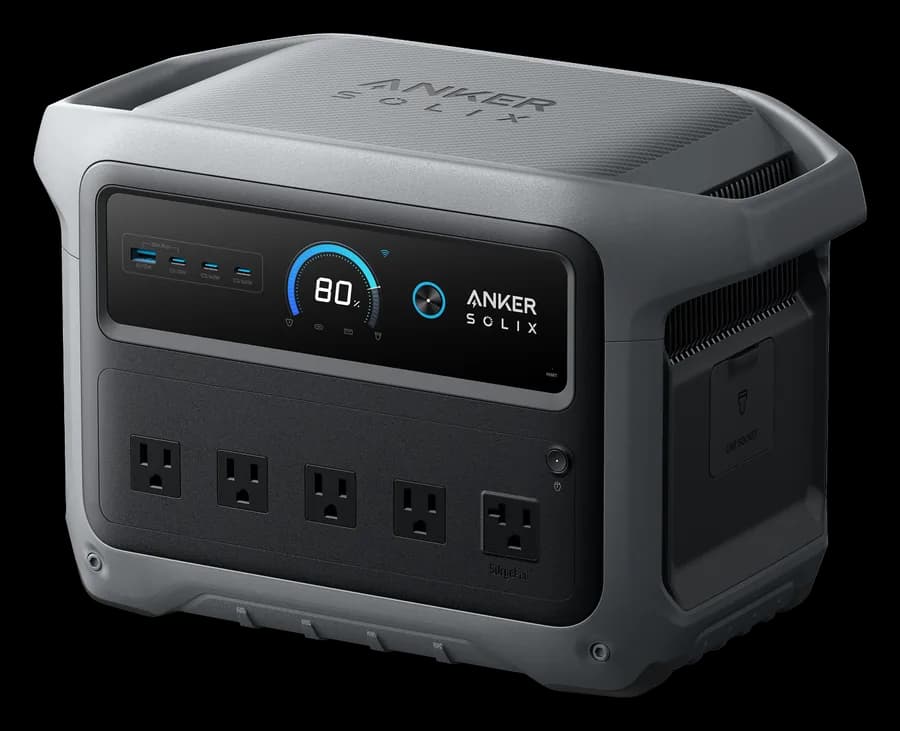
Engine's pick
Anker SOLIX C1000 Gen 2
About 32 h · also Anker SOLIX C800X / C800 Plus, Jackery Explorer 1000 v2
Packs and work lights for three days
0.2 kWh/day · 3 days
Open this in the quiz and change the devices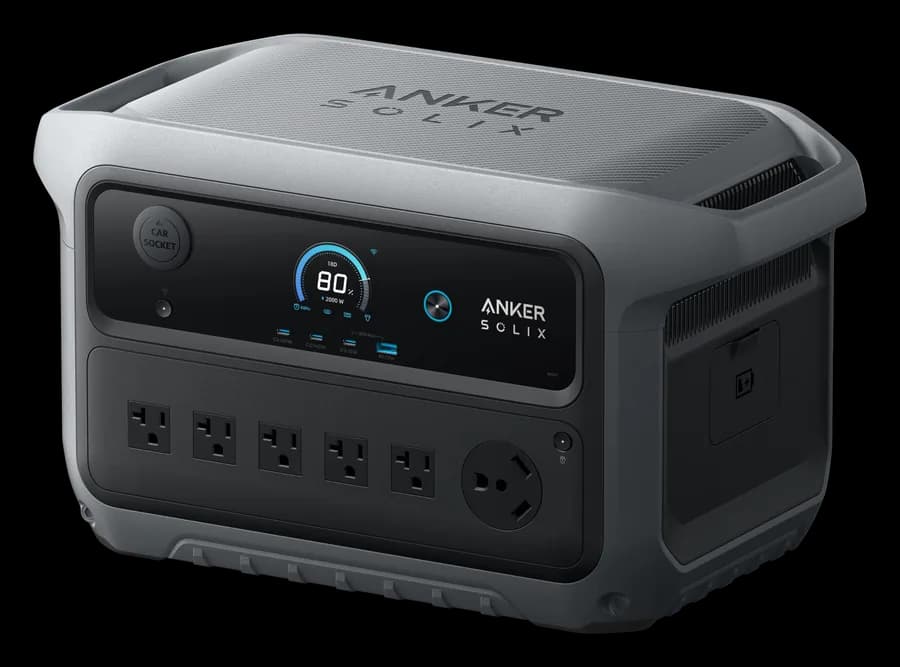
Closest fit
Anker SOLIX C2000 Gen 2
Covers about 2.6 days · also Jackery HomePower 2000 Plus v2, DJI Power 2000
Three days off-grid, recharging with solar
0.2 kWh/day · 24 h
Open this in the quiz and change the devicesAnker SOLIX768 WhEngine's pick
Anker SOLIX C800X / C800 Plus
About 32 h · also Anker SOLIX C1000 Gen 2, Jackery Explorer 1000 v2
A work day, under $500
0.1 kWh/day · 24 h
Open this in the quiz and change the devicesAnker SOLIX768 WhEngine's pick
Anker SOLIX C800X / C800 Plus
About 44 h · also Jackery Explorer 500 v2, EcoFlow RIVER 2 Pro
Picks come from the same engine as the quiz, recalculated whenever our catalog changes.
Check your own tools
Set the minutes you actually cut per day and add your other tools; the calculator checks the start-up surge against the station. The full runtime calculator has the drill, chainsaw and garage door opener too.
1. What you want to run
Circular saw (7-1/4 in, corded)
Power-tool battery chargerestimate
Rapid chargers sit at the high end. Check the charger label.
2. The power station
What people actually ask
Can a 1000 Wh power station run a circular saw?
Most can. A 7-1/4 inch corded saw needs about 1,400 W running and 2,300 W to start, which a typical 1 kWh model's output covers. Expect about half an hour of nonstop cutting per 1 kWh; real work with pauses between cuts stretches that across a day.
Can a power station run a chainsaw?
Only a large one, and not for long. A 14.5 A corded chainsaw draws about 1,740 W. No starting figure is published, so we size for up to three times running watts, which only big 2 to 5 kWh stations cover. Battery chainsaws charged from the station are the easier route.
Is it better to charge tool batteries or run corded tools?
Charging is easier on the station. A tool charger draws a steady, modest load, so a small unit keeps a few packs going all day, and the start-up surge happens in the battery tool, not the station. Corded saws need a station with enough surge to start them.
How many tool batteries can a power station charge?
Multiply your pack's volts by its amp-hours to get watt-hours: an 18 V, 5 Ah pack holds 90 Wh. A 1,024 Wh station delivers about 780 Wh through its AC outlet, so roughly eight such charges before the charger's own losses, which lower the count.
Do I need GFCI protection on a job site?
On construction sites, OSHA requires GFCI protection for 120 V, 15 and 20 A receptacles in use by workers that aren't part of the building's permanent wiring. The rule doesn't mention power stations, so plug tools in through a portable GFCI cord or ask your site's safety lead.
The bottom line
For drills, circular saws and pack chargers, a 1 kWh station with at least 2,300 W of surge does the job and still lifts with two hands. A corded chainsaw pushes you to the biggest, heaviest units, so battery tools charged from the station are usually the smarter pairing. Don't count on a station to move a car far, either: see why EV charging adds only a few miles. Compare surge ratings in the chart, read what each size can run, or take the quiz.