For car camping with a 12 V fridge, phones and lights, the best portable power station is a 700 to 1,000 Wh unit with a 12 V car socket, solar input and a weight you can lift into the trunk. Go bigger only for AC gear like a coffee maker (about 1.5 kWh) or three days or more without sun (about 2 kWh). The picks below come from our sizing engine, run on four common camping setups, so each one shows the runtime behind it.
As an Amazon Associate, RightSizePower earns from qualifying purchases. That never changes how models are ranked. How we recommend
Quick picks
- A weekend with a 12 V fridgeAnker SOLIX C800X / C800 Plus
- If you want coffee and other AC gear at campJackery Explorer 1500 Ultra
- Three days without solarAnker SOLIX C2000 Gen 2
- Camping with a CPAPAnker SOLIX C2000 Gen 2
Anker SOLIX C800X / C800 Plus
About 41 h on this setup. 23 lb, up to 300 W of solar.
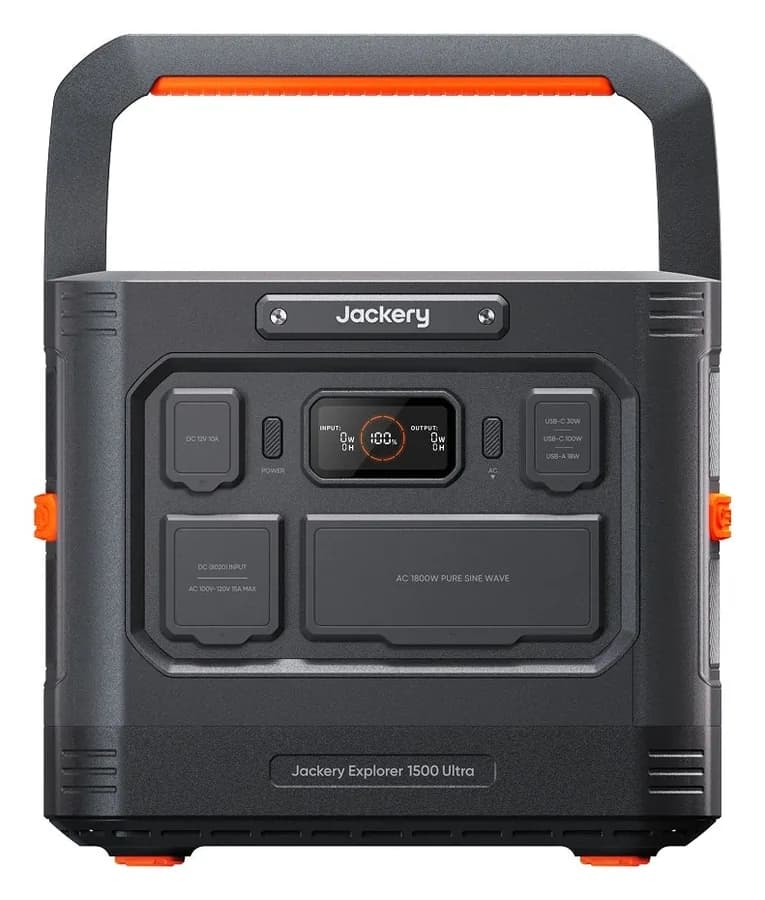
Jackery Explorer 1500 Ultra
About 34 h on this setup. 39 lb, up to 800 W of solar.
- Capacity
- 1,536 Wh
- Output
- 1,800 W
- Weight
- 38.6 lb
- UPS
- 20 ms
Paid link
Check price on Amazon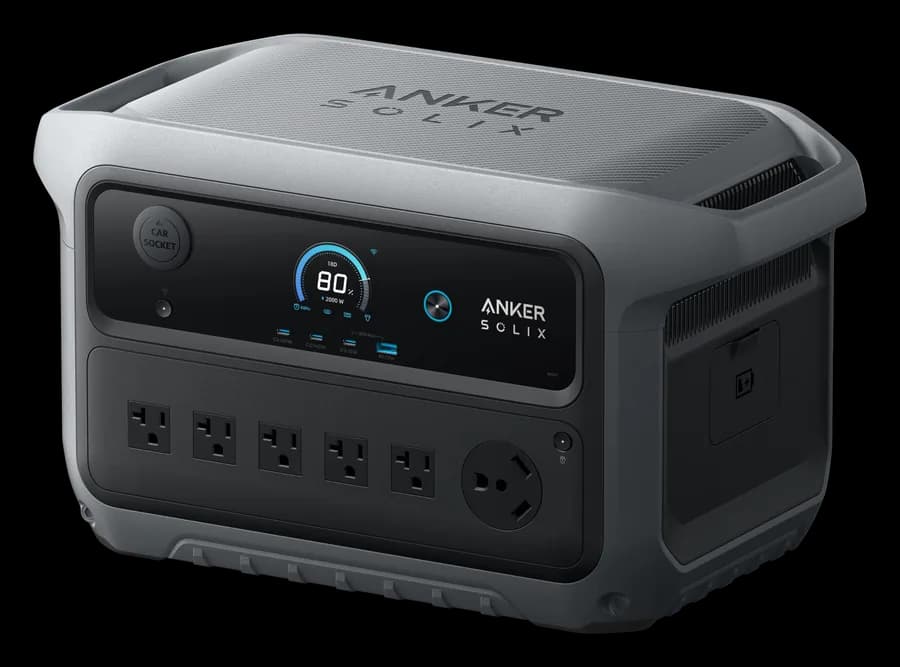
Anker SOLIX C2000 Gen 2
About 4.6 days on this setup. 42 lb, up to 800 W of solar.
- Capacity
- 2,048 Wh
- Output
- 2,400 W
- Weight
- 41.7 lb
- UPS
- 10 ms
Paid link
Check price on AmazonBest for a weekend with a 12 V fridge
A 45 L 12 V fridge and two phones, USB lanterns for light, a day on battery and then solar or the car to top up. About 0.4 kWh a day at the devices.
Engine's pick
Anker SOLIX C800X / C800 Plus
Black mark: the 24 h you asked for.
- Takes up to 300 W of solar.
- 23 lb, one-hand carry.
- From a car's 12 V socket, about 7 hours of driving to put back 90%.
- Not for you if: you need more than 1,200 W at once or want to keep a full-size fridge running through a whole day.
Also a fit: EcoFlow RIVER 2 Pro (about 41 h) and Anker SOLIX C1000 Gen 2 (about 2.3 days).
Best if you want coffee and other AC gear at camp
The same fridge and phones plus a drip coffee maker each morning, for a full day between charges. About 0.6 kWh a day at the devices.
Engine's pick
Jackery Explorer 1500 Ultra
Black mark: the 24 h you asked for.
- 1,800 W continuous for your 1,000 W of devices.
- 39 lb, two-hand carry.
- From a car's 12 V socket, about 14 hours of driving to put back 90%.
- Not for you if: you need 240V, more than three AC outlets or more than 1800W at once.
Also a fit: Anker SOLIX C2000 Gen 2 (about 39 h) and Jackery Explorer 2000 v2 (about 39 h).
Best for three days without solar
The 12 V fridge and two phones for two to three days, recharging only from the car's 12 V socket. About 0.4 kWh a day at the devices.
Engine's pick
Anker SOLIX C2000 Gen 2
Black mark: the 3 days you asked for.
- 42 lb, two-hand carry.
- From a car's 12 V socket, about 18 hours of driving to put back 90%.
- Not for you if: you need 240V or more than 2400W at once.
Also a fit: Jackery Explorer 2000 v2 (about 4.5 days) and Jackery HomePower 2000 Plus v2 (about 4.6 days).
Best for camping with a CPAP
A CPAP without the humidifier, the 12 V fridge and two phones, a day on battery and then solar or the car. About 0.5 kWh a day at the devices.
Engine's pick
Anker SOLIX C2000 Gen 2
Black mark: the 24 h you asked for.
- 2,400 W continuous for your 11 W of devices.
- Takes up to 800 W of solar.
- 42 lb, two-hand carry.
- UPS mode: switches over in 10 ms or less.
- From a car's 12 V socket, about 18 hours of driving to put back 90%.
- Not for you if: you need 240V or more than 2400W at once.
Also a fit: Jackery HomePower 2000 Plus v2 (about 47 h) and Anker SOLIX C1000 Gen 2 (about 28 h).
How much power does a camp setup use in a day?
Energy at the device for one day of typical use, from our appliance data. Running anything on AC also keeps the inverter on, which costs standby power around the clock.
| Device | Per day |
|---|---|
| 12 V fridge, 45 LFrom the 12 V socket; hot weather can double it | 324 Wh |
| Two phonesUSB charging | 40 Wh |
| Two LED bulbs on AC6 hours each, plus inverter standby below | 120 Wh |
| CPAP, no humidifier8 hours; DC cord draws less | 90 Wh |
| CPAP with humidifier and heated tube8 hours | 362 Wh |
| Drip coffee maker15 minutes of brewing | 250 Wh |
| Inverter standby, mid-size station12 W while AC is on, all day | 288 Wh |
Why USB lights beat AC lamps at camp
With the Anker SOLIX C1000 Gen 2, a 12 V fridge and two phones run about 2.3 days, because nothing uses the inverter. Add two LED bulbs on the AC outlet and the same battery lasts about 27 h. The bulbs themselves are small; the inverter's standby draw of roughly 288 Wh a day is not. Rechargeable or USB lanterns keep the inverter off, and that alone lets a smaller, lighter station do the job.
Which outlets matter for camping?
- A 12 V car socket. Portable compressor fridges plug into it. Not every station has one, so we ran the picks above only on models that do.
- USB-C at 60 W or more for a laptop, and USB-A or USB-C for phones and lanterns.
- AC outlets only for what has no DC option: a coffee maker, a CPAP without a DC cord, a TV.
Recharging at camp: solar and the car
A car's 12 V socket is usually fused at about 10 A, so it supplies roughly 100 W. That puts back about 1 kWh in ten hours of driving, enough to cover a day of fridge and phones, not much more. Run the engine while charging, so you don't drain the starter battery, and never idle a car in a closed garage.
Solar does more. A 200 W panel, which delivers about 140 W in real sun, refills 90% of the Anker SOLIX C800X / C800 Plus in about 1.2 days at 4 peak sun hours, or tops up a day of fridge and phones in a single day. Check the station's solar input limit before buying a bigger panel; anything above it is wasted.
Camping with a CPAP
Power planning for a CPAP, not medical advice. Without the humidifier, a typical machine draws about 11 W; with the humidifier and heated tube, closer to 45 W. A DC cord or converter approved by your CPAP's maker avoids the inverter and stretches runtime further. Turn off the station's ECO or auto-off mode before bed, because a low CPAP load can fall under the threshold that switches the outlet off. Talk with your doctor about going without humidification.
Weight: what you'll actually carry
A typical 1 kWh station weighs about 27 lb, an easy lift from the trunk to the picnic table. A typical 2 kWh unit weighs about 42 lb, and buying one too heavy to take along is a common owner regret. If you camp mostly in a vehicle with a big battery, the weight doesn't matter; if you carry the station to a site, pick the smallest one that covers your days.
Specs of the picks
| Spec | Anker SOLIX C800X / C800 Plus | Jackery Explorer 1500 Ultra | Anker SOLIX C2000 Gen 2 |
|---|---|---|---|
| Capacity | 768 Wh | 1,536 Wh | 2,048 Wh |
| Continuous output | 1,200 W | 1,800 W | 2,400 W |
| Surge | 1,920 W | 3,600 W | 4,000 W |
| Boost mode (heating loads) | 1,600 W | None | None |
| Battery | LiFePO4, 3,000 cycles to 80% | LiFePO4, 4,000 cycles to 70% | LiFePO4, 3,000 cycles to 80% |
| Weight | 23.15 lb* | 38.6 lb | 41.7 lb |
| AC outlets | 5 | 3 | 4 + TT-30* |
| USB-C | 2 × up to 100 W | 2 × up to 100 W | 3 × up to 140 W |
| 12 V car outlet | Yes | Yes | Yes |
| Wall charge, 0–100% | 58 min | 90 min | 58 min |
| Solar input | 300 W, 11-60V, 10A (XT-60) | 800 W, 2 x DC8020, 16-60V, 12A each | 800 W, 11-60V, 17A (XT60i) |
| UPS switchover | ≤20 ms | ≤20 ms | ≤10 ms |
| Extra batteries | Not expandable | Not expandable | Up to 4,096 Wh |
| Warranty | 5 years | 3 years | 5 years |
* Not stated on the maker's spec sheet, or derived from other official figures.
Change one thing, see the pick change
A 12 V fridge and two phones for a weekend with solar and the car, then one change per row. Each row runs the quiz engine on the full catalog, so if you run a 12 V fridge, check that the pick has a 12 V car socket.
12 V fridge and two phones, weekend with solar
0.4 kWh/day · 24 h
Open this in the quiz and change the devicesAnker SOLIX768 WhEngine's pick
Anker SOLIX C800X / C800 Plus
About 41 h · also EcoFlow RIVER 2 Pro, Anker SOLIX C1000 Gen 2
Add two LED bulbs on AC
0.5 kWh/day · 24 h
Open this in the quiz and change the devicesEngine's pick
Jackery Explorer 1500 Ultra
About 40 h · also Anker SOLIX C2000 Gen 2, Jackery Explorer 2000 v2
No solar: three days on the car only
0.4 kWh/day · 3 days
Open this in the quiz and change the devicesEngine's pick
Anker SOLIX C2000 Gen 2
About 4.6 days · also Jackery Explorer 2000 v2, Jackery HomePower 2000 Plus v2
One hand, 24 hours
0.4 kWh/day · 24 h
Open this in the quiz and change the devicesAnker SOLIX768 WhEngine's pick
Anker SOLIX C800X / C800 Plus
About 41 h · also EcoFlow RIVER 2 Pro, Jackery Explorer 500 v2
Add a CPAP (no humidifier)
0.5 kWh/day · 24 h
Open this in the quiz and change the devicesEngine's pick
Anker SOLIX C2000 Gen 2
About 47 h · also Jackery HomePower 2000 Plus v2, Anker SOLIX C1000 Gen 2
Picks come from the same engine as the quiz, recalculated whenever our catalog changes.
Try your own setup
Add your fridge, lights and chargers, set the hours, and switch devices to 12 V or USB-C where you can.
1. What you want to run
12 V portable fridge (45 L)
Cycles on about 30% of the time; typical use is 0.3 kWh a day.
Plug into the 12 V car socket. Hot weather or freezer mode can double its daily use.
Phone or tablet chargingestimate
Tiny load. Use the USB ports, not the AC outlet.
2. The power station
What people actually ask
What size power station do I need for camping?
For a 12 V fridge and phones, about 360 Wh a day at the devices, so a 700 to 1,000 Wh unit covers a weekend when solar or the car tops it up, and about 2 kWh covers three days without recharging. Adding AC lights or a coffee maker moves you up a size, because the inverter's standby draw runs all day.
How long will a power station run a 12 V camping fridge?
A 45 L compressor fridge uses roughly 0.3 kWh a day in mild weather, so a 1,024 Wh station runs it alone for about 2.6 days from the 12 V socket. In hot weather or freezer mode it can use twice as much, which halves that.
How long does it take to charge a power station from a car?
A car's 12 V socket supplies only about 100 W, so putting back 90% of a 1,024 Wh battery takes about 9 hours of driving. Run the engine while charging so you don't drain the starter battery. Solar or an alternator charger installed in the vehicle is much faster.
Can I run a CPAP on a power station while camping?
Yes. A CPAP without the humidifier draws about 11 W, so even a 288 Wh unit runs one for about 21 h on a DC cord, or about 2 eight-hour nights. The humidifier and heated tube roughly quadruple the draw. Use the CPAP maker's approved DC cable, turn off the station's ECO or auto-off mode, and treat this as power planning, not medical advice.
Can I charge a power station in freezing weather?
Not below 32°F with LiFePO4 batteries, which most current models use; their battery management blocks charging until the cells warm up. Cold also cuts usable capacity, by about 15% around 14°F. Keep the station in the tent or car overnight, not on the ground outside.
Who should buy which
- Weekend car camping with a 12 V fridge: a 700 to 1,000 Wh unit with a 12 V socket and solar input.
- Coffee maker, TV or AC lamps at camp: step up to about 1.5 kWh, since the inverter runs all day.
- Three days or more without sun: about 2 kWh, and accept the extra weight.
- Phones, lanterns and a CPAP on DC only: a 300 Wh unit can be enough; see the small power station picks.
The bottom line
Size camping power by your fridge and your days between charges, and keep everything you can on 12 V and USB. A 700 to 1,000 Wh unit with a car socket and solar input covers most weekends; go bigger only for longer trips without sun or for AC appliances. For your own gear, the sizing quiz runs the same engine, and the runtime calculator and comparison chart fill in the details. Taking a CPAP? The what a power station can run chart shows each size class.
Sources (checked 2026-11-01)
- Dometic CFX3 FAQ: power consumption
- ICECO VL45 product page
- ResMed Battery Guide (12 V DC current draw)
- FirstEnergy: understanding electricity use
- EngineerFix: 12 V accessory socket fuse ratings
- Bressan et al., Batteries (2025): LiFePO4 capacity in the cold
- Anker SOLIX C800X user guide A1755 (official)
- Jackery Explorer 1500 Ultra (official)
- Anker SOLIX C2000 Gen 2 (official)