Usually not: many well pumps, especially deep-well submersibles, run on 240 V and need over 7,000 VA for a moment to start, while almost every portable power station puts out 120 V only. Of the 42 current models with AC outlets we track, 5 have 240 V split-phase output, and they are wheeled home-backup units that connect to the pump circuit through a transfer switch or inlet installed by a licensed electrician. If that's your plan, the start-up draw decides which ones can do it.
As an Amazon Associate, RightSizePower earns from qualifying purchases. That never changes how models are ranked. How we recommend
How much power does a well pump need to start?
Franklin Electric's data for common 230 V submersible pumps. Running watts are at full load; the higher figure is at the motor's maximum service factor. Start-up is the locked-rotor draw, the burst the motor takes before it spins up.
| Pump | Running | Start-up | Franklin minimum generator |
|---|---|---|---|
| 1/2 hp, 2-wire | 670–960 W | 7.4 kVA | 3 kW / 3.75 kVA |
| 3/4 hp, 2-wire | 940–1,310 W | 9.4 kVA | 4.5 kW |
| 1 hp, 2-wire | 1,210–1,600 W | 11.2 kVA | 6 kW |
| 1/2 hp, 3-wireWith a control box | 670–960 W | Lower | 2 kW / 2.5 kVA |
Start-up kVA = locked-rotor amps × 230 V. Your pump's nameplate or the well installer's records give the exact model.
Why most power stations can't run a well pump
Two things rule them out. First, voltage: US homes get 120/240 V split-phase power, and deep-well submersible pumps are often wired for 240 V. A station with only 120 V outlets can't run a 240 V pump, whatever its battery size. Second, start-up: a 1/2 hp pump draws about 7.4 kVA for a moment, more than ten times its 670 W running draw. Most 1 to 3 kWh stations peak below that even at 120 V.
Boost modes don't change this. X-Boost, Power Lifting and SurgePad lower the voltage for heating appliances, and a pump motor at low voltage stalls or overheats instead of starting.
Which power stations can, on paper?
These current models have 240 V output. Compare each surge rating with the start-up figures above; a rating at or above the pump's locked-rotor kVA is a good sign, not a guarantee, since makers don't publish how long the surge lasts. Confirm with the station maker and your installer before you rely on it.
| Model | 240 V outlet | 240 V output | Surge | Clears start-up of | 1/2 hp pump, 30 min a day |
|---|---|---|---|---|---|
| Bluetti Apex 3002,765 Wh | 14-50 (120/240 V selectable) | 3,840 W | Not published | Can't confirm | 2.2 days |
| Jackery HomePower 3600 Pro Max3,584 Wh | 14-50 | 4,000 W | 8,000 W | 1/2 hp | 2.9 days |
| Anker SOLIX F3800 Plus3,840 Wh | L14-30 | 6,000 W | 9,000 W | 1/2 hp | 3.1 days |
| EcoFlow DELTA Pro 34,096 Wh | L14-30 and 6-20 | 4,000 W | 8,000 W | 1/2 hp | 3.3 days |
| Jackery Explorer 5000 Plus5,040 Wh | L14-30/14-50 | 7,200 W | 14,400 W | 1/2 hp, 3/4 hp, 1 hp | 4.1 days |
Runtime is the 1/2 hp pump alone at about 30 minutes of pumping a day, plus the station's standby draw. Surge figures are the makers' peak ratings; Anker's pages list two values for the F3800 Plus and we show the lower.
The standby draw matters more than the pump
A well pump runs in short bursts to refill the pressure tank, so its daily energy is small: about 335 Wh if a 1/2 hp pump runs 30 minutes a day. A large station's inverter, left on all day so the pump can start when you open a tap, draws around 30 W (our default for this class when the maker doesn't publish it), which adds about 0.7 kWh a day. That's why the runtimes above are days, not weeks. Switching the station's AC output on only when you need water stretches it much further.
What about 120 V well and jet pumps?
Some shallow-well and jet pumps run on 120 V, and those are a different story: they work like a large sump pump, with a running draw and a start-up burst several times higher. We don't have sourced wattage figures for them, so we don't publish runtimes. Read the pump's nameplate: if it says 115 or 120 V, multiply its amps by 120 for running watts, add it to the calculator below as a custom device, and ask the pump maker for the starting amps before you choose a station.
Connecting a station to a well pump safely
- Use a licensed electrician. A 240 V well pump is hard-wired to its breaker. The station connects through a transfer switch, an inlet box or the maker's home panel, installed by a licensed electrician, usually with a permit.
- Never back-feed. Plugging a station into a wall outlet to power the house can energize utility lines and endanger line workers.
- Check the pump type. A 3-wire pump with a control box starts more easily than a 2-wire pump of the same size.
- If you use a generator instead, run it outdoors only, at least 20 feet from windows, doors and attached garages, because of carbon monoxide.
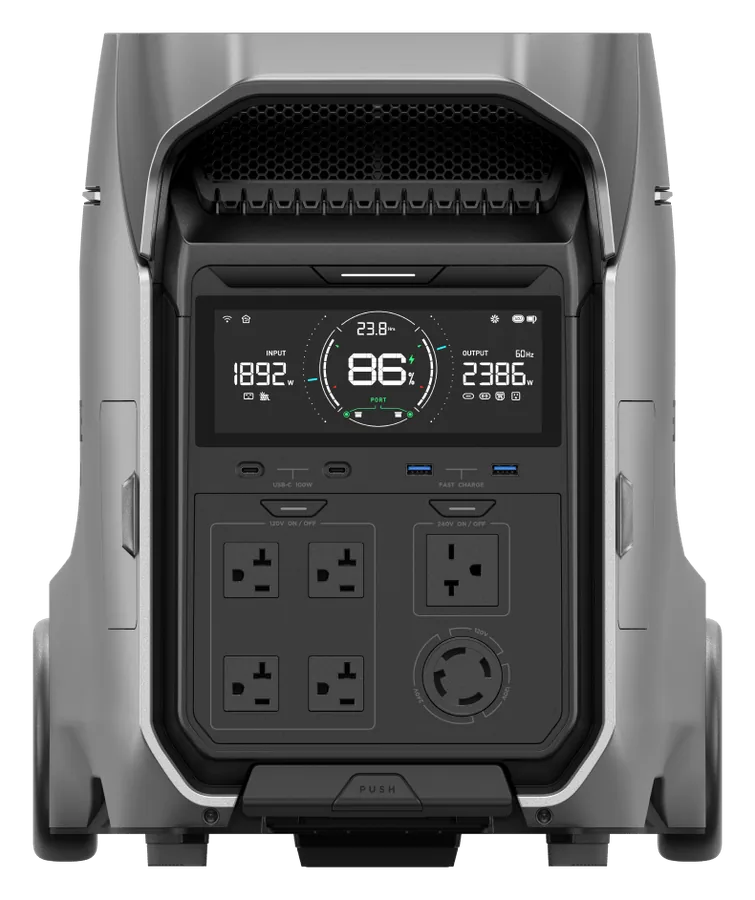
EcoFlow DELTA Pro 3
4,000 W at 120/240 V with 8,000 W surge, an L14-30 outlet and expansion to 12,288 Wh. Needs a licensed electrician to connect.
- Capacity
- 4,096 Wh
- Output
- 4,000 W
- Weight
- 113.5 lb
- UPS
- 10 ms
Paid link
Check price on Amazon
Jackery Explorer 5000 Plus
7,200 W and 14,400 W surge: the only current model whose peak rating clears a 1 hp pump's start-up on paper. Pairs with Jackery's transfer switch, installed by an electrician.
- Capacity
- 5,040 Wh
- Output
- 7,200 W
- Weight
- 134.5 lb
- UPS
- 0 ms
Paid link
Check price on AmazonWhich station fits a well-pump plan?
A 1/2 hp 240 V well pump, 30 minutes a day, run through our quiz engine with 240 V output required. Open any row to add your other essentials.
Well pump for a full day
0.3 kWh/day · 24 h
Open this in the quiz and change the devices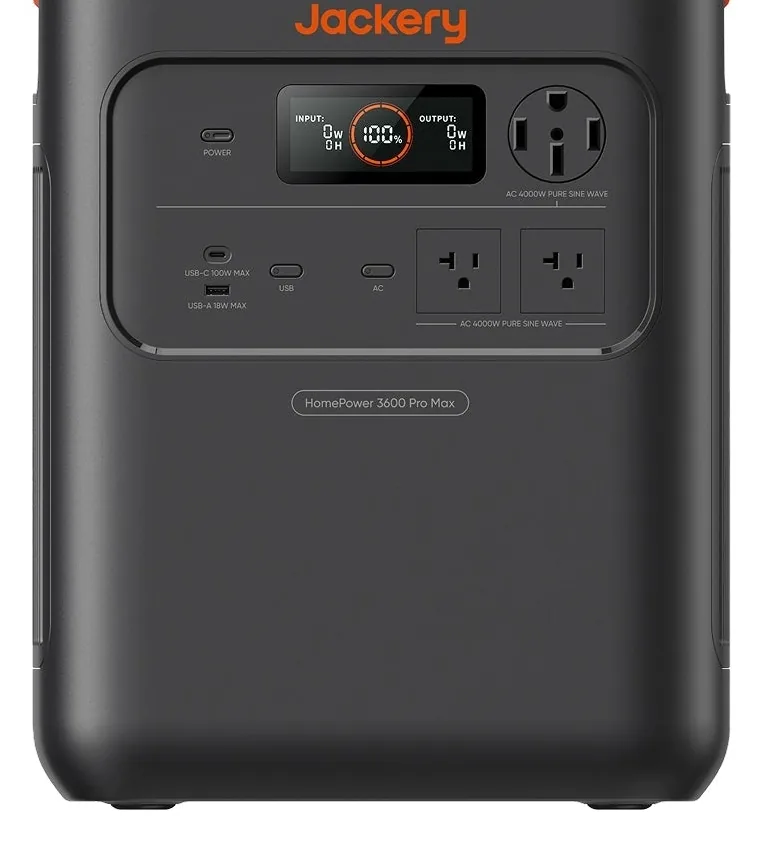
Engine's pick
Jackery HomePower 3600 Pro Max
About 2.9 days · also EcoFlow DELTA Pro 3, Jackery Explorer 5000 Plus
Well pump and fridge for a day
1.3 kWh/day · 24 h
Open this in the quiz and change the devicesEngine's pick
EcoFlow DELTA Pro 3
About 39 h · also Jackery HomePower 3600 Pro Max, Jackery Explorer 5000 Plus
Well pump and fridge for three days
1.3 kWh/day · 3 days
Open this in the quiz and change the devicesEngine's pick
EcoFlow DELTA Pro 3
About 4.9 days with an extra battery · also Jackery HomePower 3600 Pro Max, Jackery Explorer 5000 Plus
Pump, fridge and furnace blower, with solar
5.2 kWh/day · 24 h
Open this in the quiz and change the devicesEngine's pick
EcoFlow DELTA Pro 3
About 39 h with an extra battery · also Jackery Explorer 5000 Plus, Anker SOLIX F3800 Plus
Picks come from the same engine as the quiz, recalculated whenever our catalog changes.
Check your own setup
The calculator flags 240 V loads and shows whether a station's surge covers the start-up. Pick your pump size, add your other essentials and choose a 240 V station, or use the full runtime calculator.
1. What you want to run
Well pump (1/2 hp, 240 V)
Most portable power stations can't start this pump. It needs 240 V output and a very large surge rating.
Full-size refrigerator (top freezer)
Cycles on about 26% of the time; typical use is 0.99 kWh a day.
Runtime uses daily energy, not running watts. Turn off the station's ECO/auto-off mode so it doesn't cut power between compressor cycles. Older fridges use more.
2. The power station
What people actually ask
Can a portable power station run a well pump?
Most can't. Many submersible well pumps run on 240 V, and a 1/2 hp 2-wire pump draws about 7.4 kVA for a moment as it starts. Only a few large split-phase home-backup stations have 240 V output and that much surge, and they connect through a transfer switch or inlet installed by a licensed electrician.
What size power station do I need for a 1/2 hp well pump?
One with 240 V output and surge well above the pump's locked-rotor draw: about 7,400 VA for a 2-wire pump, per Franklin Electric's motor data. Franklin's minimum generator for that pump is 3 kW (3.75 kVA). Capacity matters less: the pump runs in short bursts.
Can two power stations run a 240 V well pump?
Some brands pair two 120 V units into 240 V with a hub, for example Anker's Double Voltage Hub for two SOLIX F3000 units. The pump's start-up draw still has to fit within the pair's 240 V surge rating, and the connection to the pump circuit still needs a licensed electrician.
Can I just plug my well pump into a power station?
Usually not. A 240 V well pump is hard-wired to its breaker, not plugged in. Connecting a station takes a transfer switch or power inlet installed by a licensed electrician. Never back-feed the house through a wall outlet.
Does a 3-wire well pump start more easily?
Yes. A 3-wire pump uses a separate control box, and Franklin lists a smaller minimum generator for it: 2 kW (2.5 kVA) for a 1/2 hp 3-wire pump versus 3 kW (3.75 kVA) for a 2-wire one.
The bottom line
A typical portable power station can't run a well pump: it lacks 240 V output and the surge to start the motor. A few large split-phase home-backup units can, on paper, start a 1/2 hp pump, and fewer still a 1 hp pump, always connected by a licensed electrician. If you're choosing one, compare 240 V output and surge in the comparison chart, read our home backup guide and winter storm plan, or let the quiz rank them with 240 V required.
Sources (checked 2026-11-01)
- Franklin Electric AIM manual, submersible systems (2026)
- Franklin Electric 4-inch 2-wire motor product page
- Anker SOLIX F3000 (Double Voltage Hub for 240 V)
- EcoFlow DELTA Pro 3 (official)
- Jackery HomePower 3600 Pro Max user manual (240 V output)
- Maryland Emergency Management: never back-feed
- Ready.gov: power outages (generator safety)