Buy the Jackery Explorer 5000 Plus if you have a ¾ hp or larger 240 V well pump, want the most output and the biggest starting battery, or need a 0 ms online UPS for computers; buy the EcoFlow DELTA Pro 3 if you want the lighter unit, a TT-30 RV outlet and a better-rated battery. Both are 120/240 V home-backup units with an L14-30 outlet for a transfer switch, and both need a licensed electrician to connect to your house.
As an Amazon Associate, RightSizePower earns from qualifying purchases. That never changes how models are ranked. How we recommend
Quick answer
- Most 240 V output
- Jackery Explorer 5000 Plus (7,200 W vs 4,000 W)
- ¾ hp or 1 hp 240 V well pump
- Jackery Explorer 5000 Plus (14,400 W surge vs 8,000 W)
- Bigger battery out of the box
- Jackery Explorer 5000 Plus (5,040 Wh vs 4,096 Wh)
- Desktop computers on UPS
- Jackery Explorer 5000 Plus (0 ms on its 20 A outlets, up to 3,600 W)
- RV hookup
- EcoFlow DELTA Pro 3 (has a TT-30 outlet)
- Easier to move
- EcoFlow DELTA Pro 3 (21 lb lighter)
Specs side by side
From each maker's US product page and manual, checked 2026-11-01. Rows where they differ are in darker text; starred values aren't fully confirmed by the maker.
| Spec | EcoFlow DELTA Pro 3 | Jackery Explorer 5000 Plus |
|---|---|---|
| Capacity | 4,096 Wh | 5,040 Wh |
| Continuous output | 4,000 W | 7,200 W |
| Surge | 8,000 W | 14,400 W |
| Boost mode (heating loads) | 6,000 W | None |
| Battery | LiFePO4, 4,000 cycles to 80% | LiFePO4, 4,000 cycles to 70% |
| Weight | 113.54 lb | 134.5 lb |
| AC outlets | 4 + TT-30 | 4 |
| USB-C | 2 × up to 100 W | 2 × up to 100 W |
| 12 V car outlet | No* | Yes |
| Wall charge, 0–100% | Not published | 210 min |
| Solar input | 2600 W, High-PV 30-150V (1600W) + Low-PV 11-60V (1000W) | 4000 W, High-PV 135-450V; Low-PV 16-60V* |
| UPS switchover | ≤10 ms | 0 ms |
| Extra batteries | Up to 12,288 Wh | Up to 60,000 Wh* |
| Warranty | 5 years | 5 years |
* Not stated on the maker's spec sheet, or derived from other official figures.
EcoFlow DELTA Pro 3: lighter, with an RV outlet
The DELTA Pro 3 holds 4,096 Wh and supplies 4,000 W at 120/240 V with an 8,000 W surge. Its outlets are four 20 A household receptacles, a TT-30 for an RV, a NEMA 6-20 at 240 V and an L14-30 at 120/240 V. EcoFlow lists a 10 ms UPS switchover and UL 9540 listing, and rates the battery for 4,000 cycles to 80%, a stricter end point than Jackery's 70%. It weighs 113.54 lb on wheels.
Solar goes in through two inputs, up to 1,600 W at 30–150 V and 1,000 W at 11–60 V, 2,600 W in all. Extra batteries take it to 12,288 Wh. X-Boost lets heating loads up to 6,000 W run at reduced power, which doesn't help motors start. 12 V power comes from DC5521 and Anderson ports; a car-style socket isn't confirmed. The warranty is 5 years.
Not for you if: you have a ¾ hp or larger 240 V well pump, or want room to grow past about 12 kWh.
Jackery Explorer 5000 Plus: the most output and the biggest battery
The Explorer 5000 Plus holds 5,040 Wh and supplies 7,200 W at 120/240 V with a 14,400 W surge, the highest surge rating in our catalog. It has four 120 V outlets, a 120/240 V outlet Jackery lists as L14-30R/14-50, a car socket, two 100 W USB-C ports and two USB-A ports. In online UPS mode its NEMA 5-20 outlets switch over in 0 ms, up to 3,600 W; after a restart it reverts to backup mode at under 20 ms. It pairs with Jackery's 60 A Smart Transfer Switch.
Some of its biggest numbers are softer. The 4,000 W solar input (High-PV 135–450 V, Low-PV 16–60 V) and the 60 kWh expansion ceiling are marketing figures we mark as unconfirmed. From a standard outlet it charges at 1,800 W, with a full charge listed at 210 minutes. The battery is rated for 4,000 cycles to 70%. Output drops to 3,600 W at 5–14 °F. It weighs 134.5 lb. The warranty is 5 years.
Not for you if: you need a TT-30 for an RV, the unit lives somewhere very cold, or it has to be moved often.
How do they connect to a house?
The same basic way: the L14-30 outlet feeds a power inlet box with an interlock, a manual transfer switch, or the maker's panel. Each keeps the house disconnected from the grid while the battery runs it. All of these are permanent electrical work, so hire a licensed electrician and pull a permit. Never use a double-male cord or plug either unit into a wall or dryer outlet to feed the house. Our DELTA Pro 3 vs F3800 Plus guide covers the other big 240 V rival.
How long does each run the same devices?
| Load (typical daily use) | DELTA Pro 3 | Explorer 5000 Plus |
|---|---|---|
| French-door fridge | 31–38 h | 38–46 h |
| Fridge + chest freezer + Wi-Fi + 4 LED bulbs | 19–24 h | 24–30 h |
| Fridge + Wi-Fi + ½ hp sump pump | 18–23 h | 23–28 h |
| Fridge + gas furnace blower + Wi-Fi | 10–13 h | 13–15 h |
Estimates from our published formula, using the same default standby draw for both home-size units, at mild temperatures. Run your own circuits in the runtime calculator.
Can each one start a 240 V well pump?
| Load at start-up | Needs about | DELTA Pro 3 | Explorer 5000 Plus |
|---|---|---|---|
| Fridge + ½ hp 240 V well pump | 7,570 W | Yes (peaks at 8,000 W) | Yes (peaks at 14,400 W) |
| Fridge + ¾ hp 240 V well pump | 9,570 W | No (peaks at 8,000 W) | Yes (peaks at 14,400 W) |
| Fridge + 1 hp 240 V well pump | 11,370 W | No (peaks at 8,000 W) | Yes (peaks at 14,400 W) |
Typical starting watts from our appliance data; your pump's nameplate may differ. More in can a power station run a well pump.
When does the quiz engine prefer each one?
Five home-backup situations, each requiring 240 V, run through the engine the quiz uses. Extra batteries are allowed because both units roll or stay put. The Explorer 5000 Plus's bigger battery often covers a full day without them.
| Situation | Engine prefers | Why |
|---|---|---|
| A full day: fridge, sump pump, Wi-Fi, lights | Explorer 5000 Plus | Scores 61 vs 68 (EcoFlow vs Jackery). DELTA Pro 3 needs extra batteries. |
| Same, but the internet must not drop | Explorer 5000 Plus | Scores 65 vs 72 (EcoFlow vs Jackery). DELTA Pro 3 needs extra batteries. |
| Add a ½ hp 240 V well pump | Explorer 5000 Plus | Explorer 5000 Plus needs extra batteries. DELTA Pro 3: Start-up surge too high: needs about 8,665 W; it peaks at 8,000 W. |
| Three days without recharging | Explorer 5000 Plus | Explorer 5000 Plus needs extra batteries. DELTA Pro 3: Runs your devices for about 20 h; you asked for 3 days. |
| Winter: furnace blower instead of the sump pump | DELTA Pro 3 | Scores 61 vs 57 (EcoFlow vs Jackery). DELTA Pro 3 needs extra batteries. Explorer 5000 Plus needs extra batteries. |
Who should buy which
- Buy the Jackery Explorer 5000 Plus if a larger 240 V well pump is on the list, you want a full day of essentials without extra batteries, or a home office needs the 0 ms online outlets. UPS vs EPS explains what that switchover difference means.
- Buy the EcoFlow DELTA Pro 3 if it also powers an RV through a TT-30, you want the more manageable unit, or a battery rated to 80% after 4,000 cycles matters to you.
- Buy neither if you only need a fridge, Wi-Fi and lights; a 2 kWh unit does that without house wiring. Our home backup guide sorts the options by outage type, and cold weather and storage covers winter garages.
Which model does the quiz pick for these situations?
Across the whole catalog, including other 240 V units. Open any row in the quiz and change the devices to match your circuits.
A full day: fridge, sump pump, Wi-Fi, lights
3.1 kWh/day · 24 h · 240 V
Open this in the quiz and change the devices
Engine's pick
Jackery Explorer 5000 Plus
About 25 h · also EcoFlow DELTA Pro 3, Bluetti Apex 300
Same, but the internet must not drop
3.1 kWh/day · 24 h · UPS
Open this in the quiz and change the devicesEngine's pick
Jackery Explorer 5000 Plus
About 25 h · also EcoFlow DELTA Pro 3, Jackery HomePower 3600 Pro Max
Add a ½ hp 240 V well pump
3.4 kWh/day · 24 h
Open this in the quiz and change the devicesEngine's pick
Jackery Explorer 5000 Plus
About 11.4 days with an extra battery · also Anker SOLIX F3800 Plus
Three days without recharging
3.1 kWh/day · 3 days
Open this in the quiz and change the devicesEngine's pick
Jackery Explorer 5000 Plus
About 12.5 days with an extra battery · also Anker SOLIX F3800 Plus, Bluetti Apex 300
Winter: furnace blower instead of the sump pump
5.9 kWh/day · 24 h
Open this in the quiz and change the devices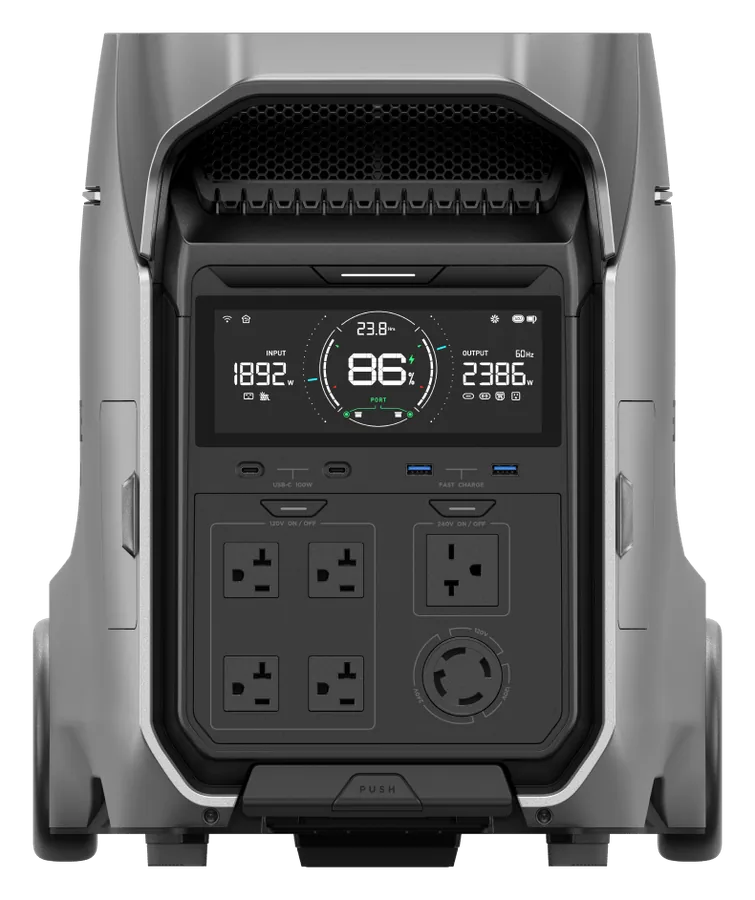
Engine's pick
EcoFlow DELTA Pro 3
About 35 h with an extra battery · also Bluetti Apex 300, Jackery HomePower 3600 Pro Max
Picks come from the same engine as the quiz, recalculated whenever our catalog changes.
What people actually ask
Can the DELTA Pro 3 or Explorer 5000 Plus power my whole house?
Not a typical whole house. Each can feed selected 120 V and 240 V circuits through a transfer switch, an inlet box with an interlock, or a maker's panel such as Jackery's 60 A Smart Transfer Switch, installed by a licensed electrician. Central air, an electric range or an electric water heater will usually exceed what either can supply for long.
Which one can run a 240 V well pump?
Both can start a ½ hp pump with a French-door fridge running, about 7,570 W at start-up. A ¾ hp pump with the fridge needs about 9,570 W and a 1 hp pump about 11,370 W: past the DELTA Pro 3's 8,000 W surge but inside the Explorer 5000 Plus's 14,400 W. Check your pump's starting or locked-rotor amps before relying on either.
How far can each system expand?
The DELTA Pro 3 takes EcoFlow DELTA Pro 3 Extra Batteries up to 12,288 Wh, about 2.9 days of fridge, freezer, Wi-Fi and lights by our estimate. Jackery advertises up to 60 kWh with its Battery Pack 5000 Plus; that's a marketing figure we couldn't confirm from the manual, so treat it as a ceiling, not a plan.
Is the Explorer 5000 Plus's 0 ms UPS mode real?
Yes, with limits. Jackery says the online (0 ms) mode works only on the NEMA 5-20 outlets, up to 3,600 W, and reverts to backup mode (under 20 ms) after a restart. The DELTA Pro 3 lists a 10 ms switchover in backup mode. For a desktop computer, the Jackery's online outlets are the safest choice of the two.
Do they work in a cold garage?
Both work, with caveats. Jackery says the Explorer 5000 Plus's output drops to 3,600 W at 5–14 °F. Lithium iron phosphate batteries in general can't charge below freezing, so keep either indoors or in an insulated space if you'll recharge it during a winter outage.
The bottom line
The Jackery Explorer 5000 Plus is the bigger system in every headline number: 7,200 W, a 14,400 W surge, 5,040 Wh and 0 ms outlets for computers. The EcoFlow DELTA Pro 3 is 21 lb lighter, adds a TT-30, carries the stricter cycle rating and expands to a confirmed 12,288 Wh. Pick by your largest motor first, then by where the unit lives. Either way, budget for a transfer switch or panel and a licensed electrician. Compare every 240 V model in the comparison chart.
Jackery Explorer 5000 Plus
Whole-home circuits at 120/240V with Jackery's 60A transfer switch and a 0 ms online UPS mode.
- Capacity
- 5,040 Wh
- Output
- 7,200 W
- Weight
- 134.5 lb
- UPS
- 0 ms
Paid link
Check price on AmazonEcoFlow DELTA Pro 3
Home backup with 120/240V output for a transfer switch, well pump or dryer circuit.
- Capacity
- 4,096 Wh
- Output
- 4,000 W
- Weight
- 113.5 lb
- UPS
- 10 ms
Paid link
Check price on Amazon