Buy the Anker SOLIX F3800 Plus if you want 6,000 W of 120/240 V output for several house circuits at once, up to 3,200 W of solar input, and room to grow to multi-day backup with extra batteries. Skip it if you'll move it often, need a desktop PC to ride through outages (its UPS switchover is 20 ms), or have a 1 hp 240 V well pump; it can't start one. It holds 3,840 Wh of LiFePO4 with a 9,000 W surge and weighs at least 132.3 lb on wheels.
As an Amazon Associate, RightSizePower earns from qualifying purchases. That never changes how models are ranked. How we recommend

Anker SOLIX F3800 Plus
Whole-circuit home backup at 120/240V with 6000W output and up to six extra batteries.
- Capacity
- 3,840 Wh
- Output
- 6,000 W
- Weight
- 132.3 lb
- UPS
- 20 ms
See today's price on Amazon
Paid link
Find on AmazonQuick verdict
- Good fit
- Several 120/240 V circuits at once; ½ hp well pumps; big solar arrays; multi-day backup
- Poor fit
- Anything you move often; desktop PCs on UPS; 1 hp well pumps
- Weight
- 132.3–136.7 lb, on wheels
- Grow later?
- Up to six BP3800 batteries, 26,880 Wh total
- Watch out for
- House wiring needs a licensed electrician
Key specs
From Anker's US product page. Starred values aren't confirmed on the spec sheet yet; where Anker's pages disagree, we use the lower figure.
| Spec | Anker SOLIX F3800 Plus |
|---|---|
| Capacity | 3,840 Wh |
| Continuous output | 6,000 W |
| Surge | 9,000 W* |
| Boost mode (heating loads) | None |
| Battery | LiFePO4, 3,000 cycles to 80% |
| Weight | 132.3 lb* |
| AC outlets | 6 + TT-30 |
| USB-C | 3 × up to 100 W |
| 12 V car outlet | Yes |
| Wall charge, 0–100% | Not published |
| Solar input | 3200 W, 2 x 1600W, 11-165V 17A |
| UPS switchover | ≤20 ms |
| Extra batteries | Up to 26,880 Wh |
| Warranty | 5 years |
* Not stated on the maker's spec sheet, or derived from other official figures.
What will it run, and for how long?
Each device on its own from a full charge of the base unit, running nonstop (fridges, pumps and air conditioners cycle as normal). Includes the battery reserve, conversion losses and the standby draw of a home-size unit from our published formula.
| Device | Plugged into | Runtime or limit |
|---|---|---|
| Top-freezer fridgeabout 0.99 kWh a day, 1,200 W to start | AC outlet | 37–46 h |
| Chest freezerabout 0.6 kWh a day, 1,200 W to start | AC outlet | 2.1–2.5 days |
| Wi-Fi router and modem15 W | AC outlet | 2.6–3.2 days |
| Gas furnace blower400 W, 1,400 W to start, cycles on and off | AC outlet | 13–17 h |
| Sump pump, ½ hp1,050 W, 2,150 W to start, cycles on and off | AC outlet | 37–46 h |
| Window AC, 8,000 BTU533 W, 1,599 W to start, cycles on and off | AC outlet | 7.2–8.9 h |
| RV air conditioner, 13,500 BTU1,600 W, 2,800 W to start, cycles on and off | AC outlet | 2.5–3.1 h |
| Space heater on high1,500 W | AC outlet | 1.6–2 h |
| Well pump, ½ hp, 240 V670 W, 7,400 W to start | 240 V outlet | 3.6–4.4 h |
| Well pump, 1 hp, 240 V1,210 W, 11,200 W to start | 240 V outlet | Won't run: needs about 11,200 W to start; it peaks at 9,000 W |
A French-door fridge, a chest freezer and Wi-Fi together run about 23 h on the base unit and about 6.7 days with all six batteries. Add your own circuits in the runtime calculator.
Where the F3800 Plus wins, and where it's ruled out
We ran eight common situations through the quiz engine. Rank is among every model that passes the hard limits.
| Situation | Result | Runtime or reason |
|---|---|---|
| Outage overnight: fridge, Wi-Fi and phones (carry it) | Ruled out | 132 lb is heavier than you want to carry. |
| Outage for a full day, same devices (wheels OK) | #13 of 20 | About 33 h |
| CPAP for two nights away, one-hand carry | Ruled out | 132 lb is heavier than you want to carry. |
| Weekend car camping: 12 V fridge, lights, phones, with solar | Ruled out | 132 lb is heavier than you want to carry. |
| RV day: fan, TV, laptop, phones | #15 of 25 | About 45 h |
| Remote work day: Starlink, laptop, phone | Ruled out | 132 lb is heavier than you want to carry. |
| Home office on UPS: router, laptop, phone, overnight | Ruled out | 132 lb is heavier than you want to carry. |
| Overnight essentials on a budget under $500 | Ruled out | 132 lb is heavier than you want to carry. |
The ruled-out rows are all about weight: at 132.3 lb or more, the engine drops it wherever you said you'd carry the unit. Where wheels are fine, it covers a full outage day and an RV day on one charge, though lighter units rank higher for those loads.
What does it do well?
- Lots of 240 V output. 6,000 W at 120/240 V and a 9,000 W surge, through 6 household outlets, a TT-30 for an RV and an L14-30 for an inlet box or transfer switch.
- Starts a small well pump with a fridge running. About 7,570 W combined, inside its surge rating.
- Grows further than most. Up to six BP3800 batteries for 26,880 Wh, enough for about 12.8 days of fridge alone.
- Big solar input. Two inputs at up to 1,600 W each, 3,200 W in all (2 x 1600W, 11-165V 17A).
- Fast charging with the panel. 1,800 W from a standard outlet, and up to 6,000 W through Anker's 240 V Home Power Panel or a generator via the Generator Input Adapter.
- Warranty. 5 years, with the battery rated for 3,000 cycles to 80%.
What should you know before you buy?
- It's heavy, and the weight isn't settled. Anker's pages give 132.3, 135.6 and 136.7 lb. It moves on wheels and stays put.
- A 20 ms UPS switchover. Routers and modems usually ride through, but desktop PCs are marginal at 20 ms, so don't count on it to keep a PC running without a separate UPS.
- Connecting it to the house is electrician work. The Home Power Panel is a 12-circuit backup load center for indoor installation; Anker also sells a 10-circuit manual transfer switch. Either way, hire a licensed electrician and pull a permit.
- No 1 hp well pumps. A typical 1 hp 240 V pump needs about 11,200 W to start.
- Check the Amazon listing. We haven't found a standalone Amazon listing; the button searches Amazon, and some listings bundle an expansion battery, so check what's included.
What are the closest alternatives?
The EcoFlow DELTA Pro 3 is the direct rival: 4,096 Wh and 4,000 W at 120/240 V, a faster 10 ms switchover and 113.54 lb, but less output and expansion to 12,288 Wh; see DELTA Pro 3 vs F3800 Plus and our DELTA Pro 3 guide. The Jackery Explorer 5000 Plus goes bigger: 5,040 Wh and 7,200 W at 120/240 V at 134.5 lb, with a 0 ms online UPS mode on its 20 A outlets up to 3,600 W. If 120 V is enough, the much lighter Jackery HomePower 3600 Plus is worth a look; see F3800 Plus vs HomePower 3600 Plus and our HomePower 3600 Plus guide.
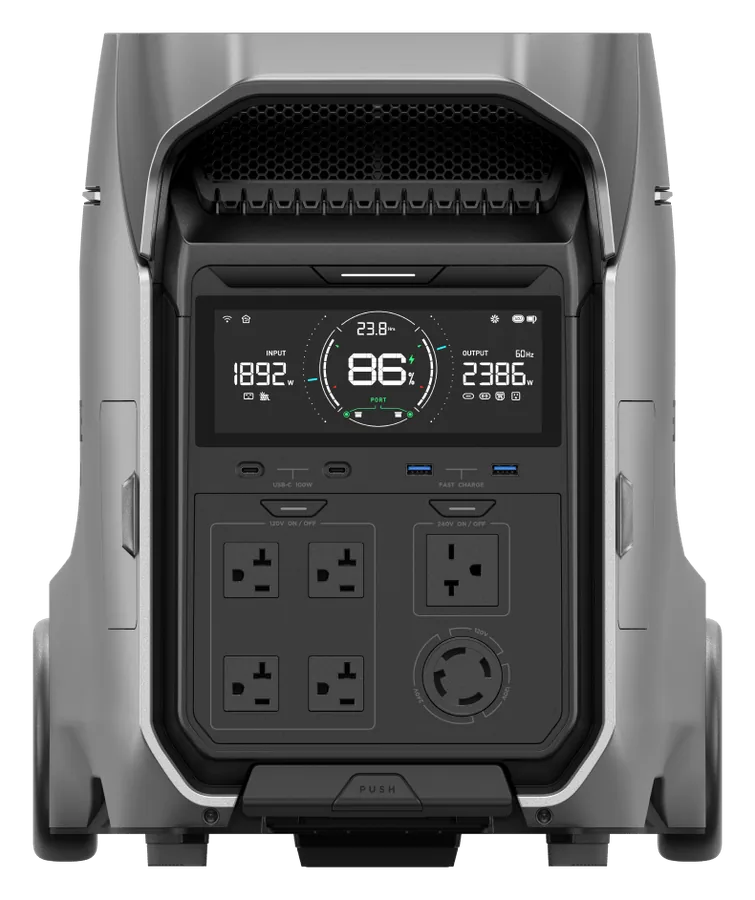
EcoFlow DELTA Pro 3
4,096 Wh and 4,000 W at 120/240 V, 10 ms switchover, 113.54 lb.
- Capacity
- 4,096 Wh
- Output
- 4,000 W
- Weight
- 113.5 lb
- UPS
- 10 ms
Paid link
Check price on Amazon
Jackery Explorer 5000 Plus
5,040 Wh and 7,200 W at 120/240 V; 0 ms UPS on the 20 A outlets.
- Capacity
- 5,040 Wh
- Output
- 7,200 W
- Weight
- 134.5 lb
- UPS
- 0 ms
Paid link
Check price on AmazonWho should buy it, and who shouldn't?
- Buy it if you want to run several 120 V and 240 V circuits at once through a panel or transfer switch, have a ½ hp 240 V well pump, or plan a large solar array and multi-day storage.
- Skip it if the unit has to move, a desktop PC must stay on through switchover, or you have a 1 hp pump. For a fridge and Wi-Fi overnight, a 1–2 kWh unit is a fraction of the weight. The sizing quiz checks your devices against every model.
More on this class: portable power station vs home battery, power station vs generator, what size solar panel you need, and every 240 V model in the comparison chart.
What people actually ask
Can the F3800 Plus power my whole house?
Not a typical whole house. It supplies 6,000 W at 120/240 V, enough for several selected circuits at once, fed through Anker's Home Power Panel or a transfer switch installed by a licensed electrician. Central air, an electric range or an electric water heater will drain 3,840 Wh quickly even if the inverter can start them.
Can the F3800 Plus run a 240 V well pump?
A typical ½ hp 240 V pump, yes: it needs about 7,400 W to start, and about 7,570 W with a fridge running, both inside the 9,000 W surge. A typical 1 hp pump needs about 11,200 W, more than even the 10,200 W figure on another Anker page. Check your pump's starting amps.
How long will the F3800 Plus run a refrigerator?
About 44 h for a typical top-freezer fridge on its own, including the standby draw of a unit this size. With the maximum 26,880 Wh of batteries, the same fridge runs about 12.8 days.
Do I need an electrician to install it?
To connect it to house wiring, yes. The Home Power Panel, a manual transfer switch or an inlet box with an interlock all need a licensed electrician and, in most places, a permit. Never feed the house through a wall or dryer outlet; that backfeeds the grid and can electrocute utility workers.
Can I charge the F3800 Plus from a gas generator?
Anker says it charges at up to 6,000 W through the Home Power Panel or a generator connected through Anker's Generator Input Adapter. Run the generator outdoors, at least 20 feet from windows, doors and attached garages, and keep carbon monoxide detectors working inside. The power station itself burns no fuel.
The bottom line
The F3800 Plus is the high-output choice for 120/240 V home backup: 6,000 W of output, 3,200 W of solar input and a path to 26,880 Wh. Its trade-offs are weight and a 20 ms switchover. Pair it with a panel or transfer switch installed by a licensed electrician; if a lighter unit with a faster UPS matters more, look at the DELTA Pro 3.
Anker SOLIX F3800 Plus
Whole-circuit home backup at 120/240V with 6000W output and up to six extra batteries.
- Capacity
- 3,840 Wh
- Output
- 6,000 W
- Weight
- 132.3 lb
- UPS
- 20 ms
See today's price on Amazon
Paid link
Find on Amazon