Buy a portable power station if you want plug-in backup for essentials with no installation; buy a whole-home battery if you want your panel, including 240 V circuits, to switch over automatically for days at a time. A home battery such as a Powerwall 3 holds 13.5 kWh per unit and needs a licensed installer, a permit and often utility approval. Between the two sit expandable home-backup stations: portable units that stack extra batteries and can feed selected circuits through an electrician-installed transfer switch.
As an Amazon Associate, RightSizePower earns from qualifying purchases. That never changes how models are ranked. How we recommend
How do they differ?
The real split is plug-in versus wired in, more than battery size.
| Factor | Portable power station | Whole-home battery |
|---|---|---|
| Energy per unit | About 0.3 to 5 kWh; the biggest systems expand much further with add-on batteries | About 5 to 13.5 kWh per unit (a Powerwall 3 holds 13.5 kWh), stackable |
| Output | Mostly 120 V only; a few large units add 120/240 V split-phase | Feeds the home panel at 120/240 V (Powerwall 3: 11.5 kW continuous) |
| Installation | None for plug-in use; a transfer switch or brand panel for home circuits | Licensed installer, permit, inspection |
| Utility approval | Generally not needed when a transfer switch only isolates the house | Needed for systems that export to the grid or run in parallel with it |
| Switchover | Extension cords: you move plugs. Brand smart panels: about 20 ms | Automatic, built in |
| Portability | Goes camping, to the RV, to a relative's house | Bolted to the wall or a pad |
| Recharging | Wall, car, portable solar panels, or a generator outdoors | Rooftop solar and the grid |
How much energy does each one hold, compared with what you use?
A fridge, Wi-Fi, three phones and three LED lights use about 1.6 kWh a day at the devices, before conversion losses. A 13.5 kWh home battery holds about 8 times that; a 2 kWh portable station covers most of one day once you count its reserve, inverter loss and standby draw. Home batteries also recharge from rooftop solar every sunny day, which is what makes multi-day backup realistic.
The picture changes once you add the big loads. Central air, heat pumps, electric ranges, electric dryers, electric water heaters and many well pumps run on 240 V and draw thousands of watts. A home battery can run some of them; a 120 V portable station can't run any of them, whatever its capacity.
Why does 240 V matter so much?
US homes get 120/240 V split-phase service. Most outlets are 120 V, but large motors and heaters use both legs for 240 V. Most portable power stations output 120 V only: of the 42 current models with AC outlets we track, 5 offer 120/240 V. If your must-run list includes a 240 V well pump or a furnace on a 240 V circuit, that narrows the choice to a home battery or one of these units.
What is the middle ground?
Expandable home-backup stations with 120/240 V output. They start as a single unit and grow with add-on batteries. Figures from each maker's spec page.
| Model | Battery | Max with add-ons | Continuous | Weight |
|---|---|---|---|---|
| Bluetti Apex 300 | 2,765 Wh | 19.4 kWh | 3,840 W | 84 lb |
| Jackery HomePower 3600 Pro Max | 3,584 Wh | 21.5 kWh | 2,000 W | 74 lb |
| Anker SOLIX F3800 Plus | 3,840 Wh | 26.9 kWh | 6,000 W | 132 lb |
| EcoFlow DELTA Pro 3 | 4,096 Wh | 12.3 kWh | 4,000 W | 114 lb |
| Jackery Explorer 5000 Plus | 5,040 Wh | 60.0 kWh | 7,200 W | 135 lb |
To feed house circuits, each brand sells its own panel or switch, and each requires professional installation:
- EcoFlow Smart Home Panel 2 backs up 12 circuits with about 20 ms switchover and works with the DELTA Pro 3. The newer Smart Home Panel 3 controls 32 circuits; EcoFlow reserves whole-home capability for its DELTA Pro Ultra X.
- Anker SOLIX sells the Home Power Panel (12 circuits, indoor installation) and a 10-circuit manual transfer switch for the F3800 Plus.
- Jackery's Smart Transfer Switch pairs with the Explorer 5000 Plus: up to 12 circuits at 120 V or 6 at 240 V, with about 20 ms switchover.
A generic manual transfer switch or an inlet box with a breaker interlock also works with units that have an L14-30 or similar outlet. Whether your local inspector accepts an interlock kit varies, which is one more reason the job belongs to a licensed electrician with a permit.
What about installation, permits and the utility?
A plug-in station needs nothing: charge it, run cords to the fridge and router. Anything permanently connected to house wiring, whether a home battery, a transfer switch or a brand smart panel, is electrical work that normally needs a permit and inspection. A system that only isolates the house from the grid during an outage generally doesn't need a utility interconnection agreement; a battery that exports to the grid or runs in parallel with it does.
Never plug any battery or generator into a wall or dryer outlet to back-feed the house. It can energize the utility lines that crews believe are dead.
How does cost compare, without the price tags?
Prices change too fast to print, so compare the structure instead. A home battery is quoted installed, with labor, permit and electrical work included, and is sized by the house. A portable station is bought outright, has no installation for plug-in use, and you can start small and add batteries later. Get installer quotes and current station prices side by side, per kilowatt-hour of storage, for the circuits you actually need.
On tax credits: the 30% federal Residential Clean Energy Credit, which covered home batteries, ended for systems placed in service after December 31, 2025, under the law signed in July 2025. Portable power stations generally never qualified on their own. Confirm the current rules on IRS.gov before you count on any credit.
Who should choose which?
- Portable power station: renters, apartment dwellers, anyone whose outages last hours to a day, and anyone who also wants power for camping or an RV. Not for central air, electric heat or 240 V well pumps.
- Expandable 240 V station: homeowners who want selected circuits, including a well pump or furnace, through a transfer switch, but want to start smaller than a home battery and keep the option to unplug it and take it along. Not for running the whole house for days without solar.
- Whole-home battery: homeowners with rooftop solar or plans for it, frequent multi-day outages, or a need for automatic switchover across the panel. Not for renters or anyone who needs the battery to travel.

Anker SOLIX F3800 Plus
3,840 Wh and 6,000 W with an L14-30 outlet; expands to 26.9 kWh. Home circuits through Anker's panel or transfer switch, installed by an electrician.
- Capacity
- 3,840 Wh
- Output
- 6,000 W
- Weight
- 132.3 lb
- UPS
- 20 ms
See today's price on Amazon
Paid link
Find on Amazon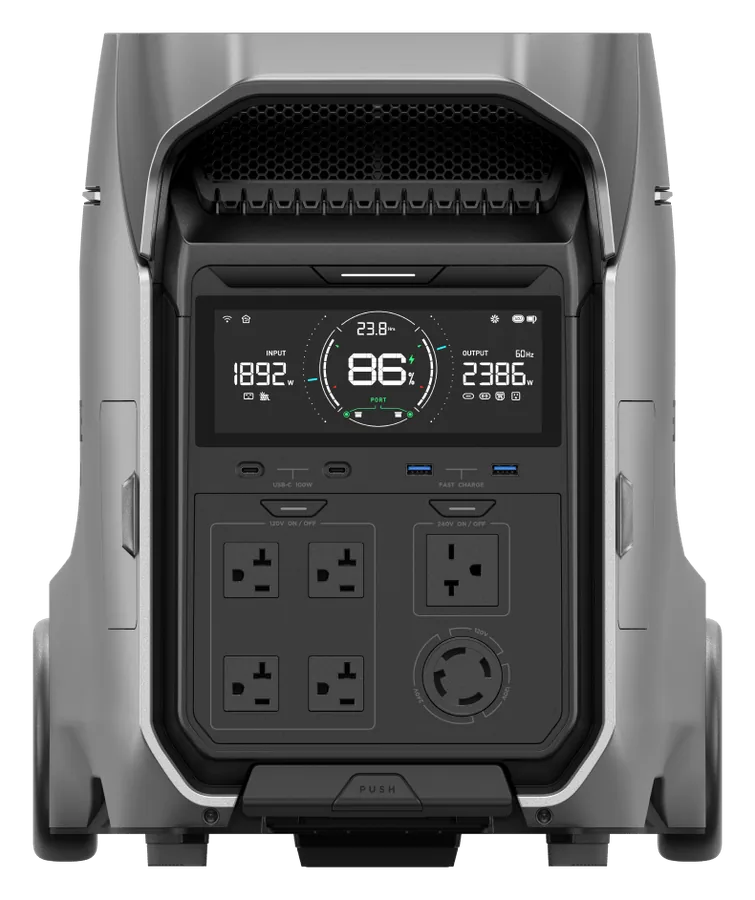
EcoFlow DELTA Pro 3
4,096 Wh, 4,000 W and 120/240 V output; expands to 12.3 kWh and works with EcoFlow's Smart Home Panel 2.
- Capacity
- 4,096 Wh
- Output
- 4,000 W
- Weight
- 113.5 lb
- UPS
- 10 ms
Paid link
Check price on AmazonWhich portable system fits your outage?
Each row runs our sizing engine on a fridge, Wi-Fi, two phones and two LED lights for a unit that stays in one place. Open any row in the quiz to add your own devices.
A full day of essentials
1.5 kWh/day · 24 h
Open this in the quiz and change the devices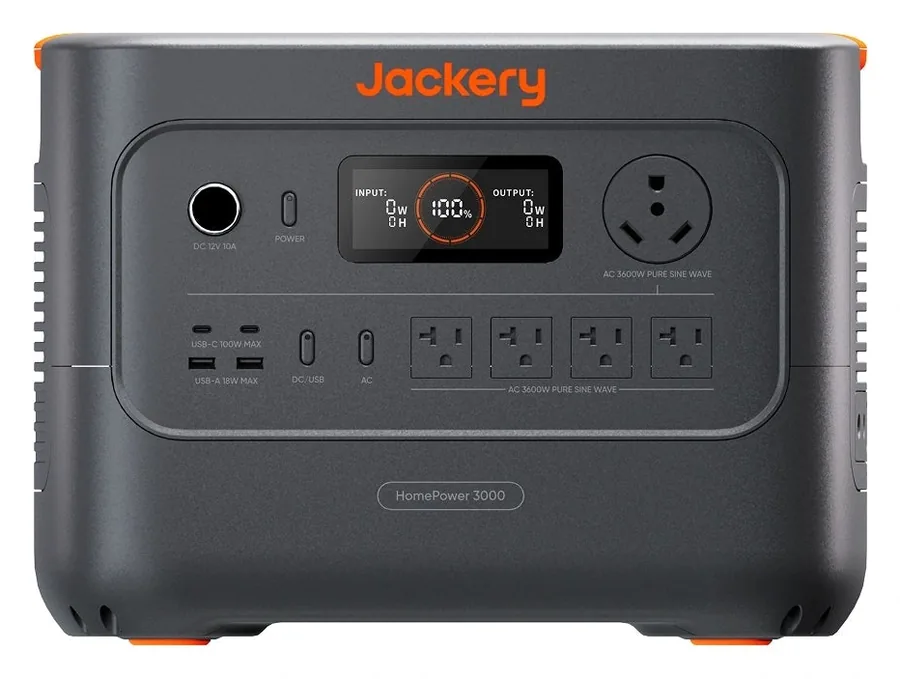
Engine's pick
Jackery HomePower 3000
About 30 h · also Bluetti Elite 400, Anker SOLIX F3000
Two to three days, room to add batteries
1.5 kWh/day · 3 days
Open this in the quiz and change the devices
Engine's pick
DJI Power 1000 V2
About 4.9 days with an extra battery · also DJI Power 2000, Anker SOLIX F3000
Two to three days, plus a sump pump
2.5 kWh/day · 3 days
Open this in the quiz and change the devicesEngine's pick
DJI Power 1000 V2
About 3.1 days with an extra battery · also DJI Power 2000, Anker SOLIX F3000
A full day, feeding 240 V circuits
1.5 kWh/day · 24 h
Open this in the quiz and change the devicesEngine's pick
EcoFlow DELTA Pro 3
About 35 h · also Jackery Explorer 5000 Plus, Anker SOLIX F3800 Plus
Longer, recharging with solar
1.5 kWh/day · 24 h
Open this in the quiz and change the devices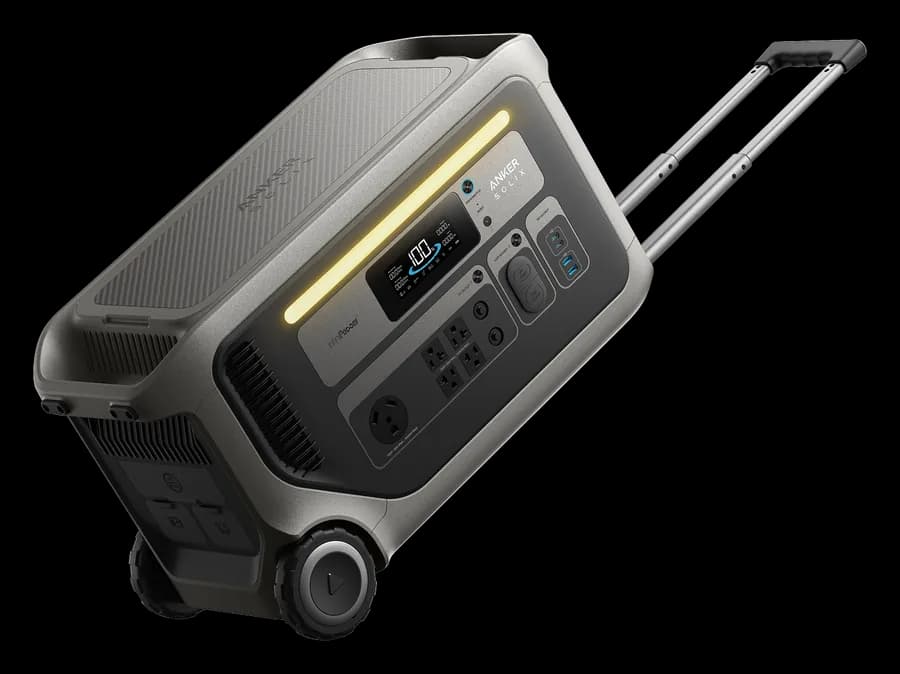
Engine's pick
Anker SOLIX F3000
About 30 h · also EcoFlow DELTA Pro 3, Jackery Explorer 5000 Plus
Picks come from the same engine as the quiz, recalculated whenever our catalog changes.
What people actually ask
Can a portable power station replace a home battery like a Powerwall?
For essentials, partly. A 2 to 4 kWh station runs a fridge, Wi-Fi, lights and phones by extension cord. A home battery is wired into your panel, switches over automatically and backs up 240 V circuits. The largest expandable portable systems can do much of that too, through a transfer switch or smart panel installed by a licensed electrician.
How much battery does a house need for backup?
It depends on what you back up. A fridge, Wi-Fi, three phones and three LED lights use about 1.6 kWh a day at the devices. Central air, electric heat, an electric range or a 240 V well pump multiply that, and they also need 240 V output.
Do I need a permit for a home battery or transfer switch?
Usually, yes. Any permanent connection to house wiring, whether a home battery, inlet box, interlock or transfer switch, is electrical work that normally needs a permit and inspection. Hire a licensed electrician; manufacturers of brand smart panels require professional installation.
Is there still a federal tax credit for home batteries?
Not for new systems. The 30% Residential Clean Energy Credit, which covered home batteries, ended for systems placed in service after December 31, 2025. Portable power stations generally never qualified on their own. Confirm your situation on IRS.gov or with a tax professional.
Which portable power stations can power 240 V circuits?
Only split-phase units. Of the current models we track, those are the Anker SOLIX F3800 Plus, Bluetti Apex 300, EcoFlow DELTA Pro 3, Jackery HomePower 3600 Pro Max and Jackery Explorer 5000 Plus. Each needs an electrician-installed transfer switch or brand panel to feed home circuits.
The bottom line
If you need essentials through outages of hours to a day, a portable power station does it with no installation. If you want automatic switchover for your panel and 240 V loads, a whole-home battery or an expandable 240 V station with an electrician-installed transfer switch is the step up. Start from your must-run list: the sizing quiz turns it into ranked models, the comparison chart shows 240 V output for every model, and the power station vs generator guide covers the fuel-powered alternative.
Sources (checked 2026-11-01)
- Powerwall 3 overview (13.5 kWh, 11.5 kW continuous)
- EcoFlow Smart Home Panel 3 (official)
- EcoFlow Smart Home Panel 2 owner manual
- Anker SOLIX F3800 Plus (official)
- Anker SOLIX F3800 and Home Power Panel owner manual
- Jackery Explorer 5000 Plus (official)
- Jackery Smart Transfer Switch listing
- Generac: why you should never back-feed your electric panel
- SEIA: Residential Clean Energy Credit (25D) changes
- Hawaii State Energy Office: federal residential credit FAQ (25D)
- IRS: Residential Clean Energy Credit