Get a portable power station if your outages last hours to about a day and you need quiet power indoors for a fridge, Wi-Fi, lights or a CPAP; get a generator if you need days of power or big loads like a well pump, and can run it outdoors. A station holds a fixed amount of energy but makes no exhaust and no noise to speak of. A generator runs as long as you have fuel, but it has to sit at least 20 feet from the house. A common setup uses both: the generator recharges the station by day, and the station runs indoors overnight.
As an Amazon Associate, RightSizePower earns from qualifying purchases. That never changes how models are ranked. How we recommend
How do they compare, factor by factor?
The short version: a station trades total energy for silence, indoor use and almost no upkeep.
| Factor | Portable power station | Gas generator |
|---|---|---|
| Energy | Fixed: what the battery holds, from about 0.3 to 5 kWh per unit (more with add-on batteries) | Keeps going as long as you can refuel |
| Indoor use | Yes: no combustion, no exhaust | Never: outdoors only, 20+ ft from windows, doors and attached garages |
| Noise | Near silent at low loads; fans get loud during fast charging and heavy output | About 48 dBA at quarter load and 57 dBA at rated load on a Honda EU2200i inverter generator; open-frame models are usually louder |
| Upkeep | Top up the charge every few months | Oil changes, carburetor care, fuel that goes stale in storage |
| 240 V and home circuits | Only large split-phase units, through an electrician-installed transfer switch | Many larger models have an L14-30 outlet, also through an electrician-installed transfer switch or interlock |
| Energy per dollar | Lower: you pay up front for every kilowatt-hour of storage | Higher in long outages, since fuel is the only running cost |
Why does carbon monoxide decide so many of these choices?
Because generators kill people every year, mostly when they run in the wrong place. The Consumer Product Safety Commission counts an average of 85 US deaths a year from carbon monoxide poisoning from portable generators. Most happen at home, with the generator in a basement, garage or living space, and more than half of all CO deaths happen between November and February.
Ready.gov's rule is plain: generators and fuel stay outdoors, at least 20 feet from windows, doors and attached garages, and every level of the home needs a working CO alarm. That rules out generators for many apartments, condos and townhouses with no safe outdoor spot. A battery station has no combustion and no exhaust, so it can sit in the kitchen or the bedroom.
Which gives you more hours: a tank of gas or a full charge?
The generator, by a wide margin. Honda lists its EU2200i inverter generator at 8.1 hours on its 0.95-gallon tank at quarter load, and 3.2 hours at its rated 1,800 W. Worked out from that spec, it makes about 3.8 kWh of electricity per gallon at a light load.
A power station delivers less than its label, because the battery keeps a reserve and the inverter loses some energy turning DC into AC:
| Station size | AC energy per full charge | Same energy from gas, light load |
|---|---|---|
| 1,024 Wh | 0.8 kWh | about 0.2 gal |
| 2,048 Wh | 1.6 kWh | about 0.4 gal |
| 4,096 Wh | 3.1 kWh | about 0.8 gal |
Station energy uses our runtime formula (90% usable, 85% inverter efficiency). Gas figure derived from the Honda EU2200i spec at quarter load; generators are less efficient at very light loads and more efficient near full load.
That gap is why a station alone is a plan for hours to a day or two, and a generator, or solar, is what turns it into a plan for a week. For your own devices, the runtime calculator shows how long each size lasts.
Can a power station handle the surge a generator handles?
For the loads most people back up, yes. A top-freezer fridge needs about 1,200 W for a moment when the compressor starts. Current 1 kWh-class stations we track have a median surge rating of 2,850 W, and 2 kWh-class units 4,000 W. A half-horsepower sump pump is the harder case at about 2,150 W to start, which rules out some smaller units. Well pumps and central air often need 240 V, which only large split-phase stations and larger generators provide.
Boost modes such as X-Boost or Power Lifting don't help here: they lower the voltage for heating appliances and don't count as surge capacity for motors.
What does each one cost to own, beyond the purchase?
A generator's running cost is fuel, and it delivers more energy per dollar in a long outage. It also needs oil changes and carburetor care, and stored gasoline goes stale. A power station costs more per kilowatt-hour up front but has almost no running cost: top it up every few months and recharge it from the wall, solar or a car.
When does a power station win?
- Apartments, condos and townhouses where there's nowhere 20 feet from the building to run a generator.
- Medical devices such as a CPAP that need quiet power through the night. Talk to your doctor or device maker about backup runtime.
- Short outages of a few hours to a day: the fridge, Wi-Fi, phones and lights.
- Planned shutoffs such as California's Public Safety Power Shutoffs, which usually come with a day or two of notice to charge up.
When does a generator win?
- Multi-day outages after hurricanes, derechos and ice storms, when daily use is more than any battery holds.
- Big or 240 V loads such as a well pump, central air or an electric water heater, connected through a transfer switch installed by a licensed electrician.
- Lowest cost per kilowatt-hour matters more to you than noise or indoor use.
How does the hybrid setup work?
Run the generator outdoors for a few hours in the daytime to keep the fridge cold and recharge the station through its AC charger. At night, shut the generator off and let the station run the fridge, router and CPAP quietly indoors. An inverter generator is the better partner, because some station chargers shut down on the rougher waveform of cheap open-frame generators.
Some large units are built for this. Anker says the SOLIX F3800 Plus charges at up to 6,000 W through its 240 V Home Power Panel or generator port. The generator still has to stay outdoors and 20 feet from openings; pairing it with a battery doesn't change the carbon monoxide rule.
Never connect either one to a wall outlet or dryer outlet to power the house. That back-feeds the utility lines and can electrocute line workers. Home circuits need a transfer switch or interlock installed by a licensed electrician.
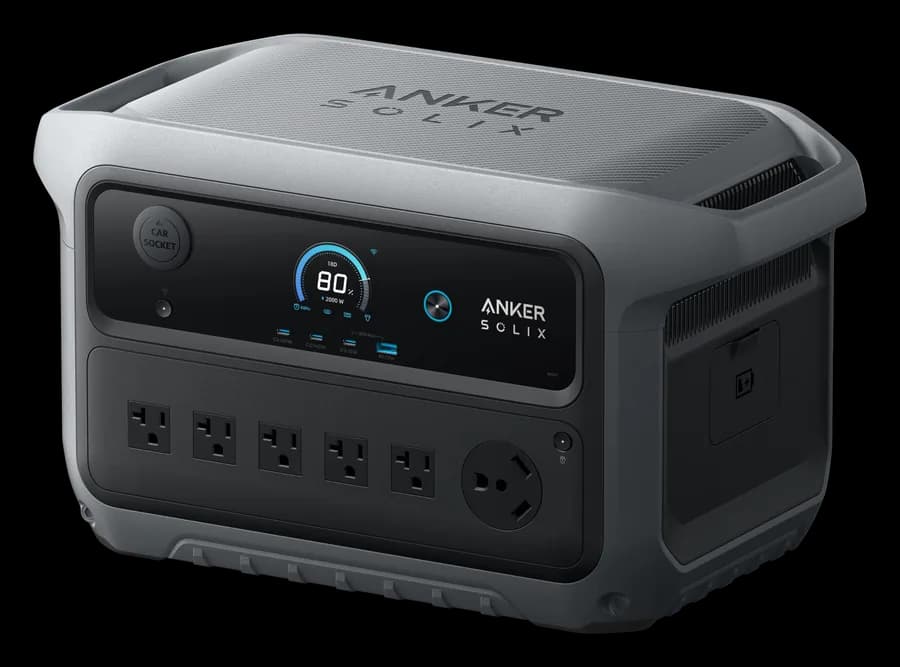
Anker SOLIX C2000 Gen 2
2,048 Wh and 4,000 W surge at 41.7 lb: a fridge, Wi-Fi, phones and lights for most of a day, indoors and silent.
- Capacity
- 2,048 Wh
- Output
- 2,400 W
- Weight
- 41.7 lb
- UPS
- 10 ms
Paid link
Check price on Amazon
Anker SOLIX F3800 Plus
3,840 Wh, 6,000 W and 120/240 V output, with a generator port and expansion to 26,880 Wh. Home circuits need an electrician-installed panel.
- Capacity
- 3,840 Wh
- Output
- 6,000 W
- Weight
- 132.3 lb
- UPS
- 20 ms
See today's price on Amazon
Paid link
Find on AmazonIf you go battery-only, which station fits?
Each row runs our sizing engine on a fridge, Wi-Fi, two phones and two LED lights, changing only how long the outage lasts and what else you add. Open any row in the quiz to swap in your own devices.
One night, carried with two hands
1.5 kWh/day · 10 h
Open this in the quiz and change the devicesEngine's pick
Anker SOLIX C2000 Gen 2
About 18 h · also Jackery Explorer 1500 Ultra, Anker SOLIX S2000
A full day, on wheels
1.5 kWh/day · 24 h
Open this in the quiz and change the devices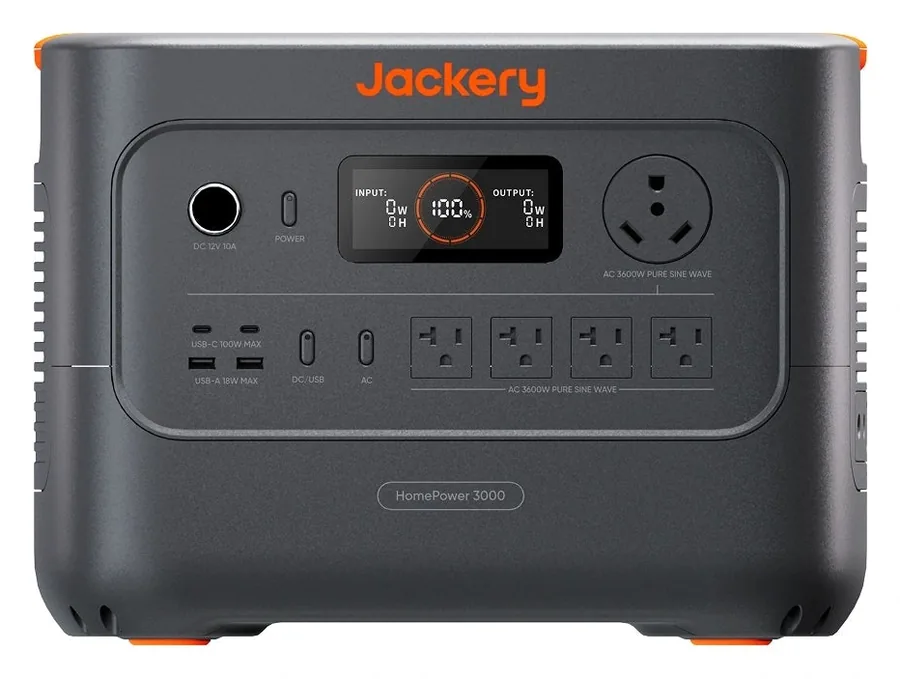
Engine's pick
Jackery HomePower 3000
About 30 h · also Bluetti Elite 400, Jackery HomePower 3600 Plus
A full day, plus a CPAP with humidifier
1.9 kWh/day · 24 h
Open this in the quiz and change the devicesEngine's pick
Jackery HomePower 3000
About 25 h · also EcoFlow DELTA Pro 3, EcoFlow DELTA 3
Two to three days, stays in one place
1.5 kWh/day · 3 days
Open this in the quiz and change the devices
Engine's pick
DJI Power 1000 V2
About 4.9 days with an extra battery · also DJI Power 2000, Anker SOLIX F3000
Longer, recharging with solar
1.5 kWh/day · 24 h
Open this in the quiz and change the devicesEngine's pick
Jackery HomePower 3000
About 30 h · also Jackery HomePower 3600 Plus, Anker SOLIX F3000
Picks come from the same engine as the quiz, recalculated whenever our catalog changes.
What people actually ask
Is a power station better than a generator for a power outage?
For short and medium outages with modest loads, usually yes: it's silent, needs no fuel and can sit indoors next to the fridge or CPAP. For multi-day outages with big loads such as a well pump or central air, a generator outdoors supplies far more energy, and many households combine the two.
Can I use a power station indoors?
Yes. A battery power station burns nothing, so it gives off no carbon monoxide. Keep it dry and ventilated as its manual says. A gas generator is different: Ready.gov says to run it outdoors only, at least 20 feet from windows, doors and attached garages.
How many gallons of gas equal a power station charge?
Less than you'd expect. A full 2,048 Wh station delivers about 1.6 kWh of AC power after its reserve and inverter loss. A Honda EU2200i makes about 3.8 kWh per gallon at a light load, based on its tank size and runtime spec, so that's under half a gallon.
Can a generator recharge a power station?
Yes. Plug the station's AC charger into the generator's outlet with the generator outdoors. Inverter generators are the safer match, because some station chargers reject the rougher power of cheap open-frame generators; check your station's manual.
Can a power station start a fridge or sump pump like a generator can?
Most 1 kWh and larger units can start a fridge, which needs about 1,200 W for a moment. A half-horsepower sump pump needs about 2,150 W to start, so check the station's surge rating against it before you rely on it.
The bottom line
A power station is the right first purchase if your outages are measured in hours, you live where a generator can't run safely, or you need quiet power for a CPAP. A generator is the right purchase for multi-day outages and big 240 V loads, as long as it runs outdoors, 20 feet from the house. If you face both, buy the station for indoor nights and let a generator or solar refill it. The sizing quiz ranks stations for your own devices, the comparison chart lists every model's surge and capacity, and the home backup guide has picks by outage length.
Sources (checked 2026-11-01)
- CPSC: portable generator carbon monoxide deaths
- CPSC staff report on portable generator CO incidents
- Ready.gov: power outages
- Honda EU2200i specifications (tank, runtime, noise)
- Generac: why you should never back-feed your electric panel
- Anker SOLIX F3800 Plus (official)
- PG&E PSPS post-event report, June 2026