A TT-30 is a 120 V, 30 A RV outlet; an L14-30 is a 120/240 V, 30 A twist-lock used to feed a house through a transfer switch; a 14-50 is a 120/240 V, 50 A outlet used by larger generators and 50 A RVs. Only power stations with split-phase output can supply 240 V, and any connection to house wiring needs a licensed electrician. Of the current models we track, 10 have a TT-30, 3 have an L14-30 and 3 list a 14-50.
As an Amazon Associate, RightSizePower earns from qualifying purchases. That never changes how models are ranked. How we recommend
What does each outlet type supply?
Maximum watts are volts times amps at the outlet's rating; the continuous figure is 80% of that, the usual rule for loads that run for hours. A power station can never deliver more than its own continuous rating, whatever the outlet says.
| NEMA type | Voltage | Wires | Rating | Max / continuous | Where you see it |
|---|---|---|---|---|---|
| 5-15 | 120 V | 3 (hot, neutral, ground) | 15 A | 1,800 W / 1,440 W | Ordinary household outlet |
| 5-20 | 120 V | 3 | 20 A | 2,400 W / 1,920 W | Household outlet with a T-shaped neutral slot |
| TT-30 | 120 V | 3 | 30 A | 3,600 W / 2,880 W | 30 A RV hookup. Not 240 V, and not an L14-30 |
| L5-30 | 120 V twist-lock | 3 | 30 A | 3,600 W / 2,880 W | Some generators; feeds a 120 V inlet |
| 6-20 | 240 V only | 3 (two hots, ground) | 20 A | 4,800 W / 3,840 W | Some shop tools and window ACs; no neutral, so no 120 V |
| L14-30 | 120/240 V twist-lock | 4 (two hots, neutral, ground) | 30 A | 7,200 W / 5,760 W | Standard generator-to-house inlet connection |
| 14-50 | 120/240 V | 4 | 50 A | 12,000 W / 9,600 W | Larger generators and 50 A RV hookups |
For 120/240 V types the figure is at 240 V across both hot legs; each leg supplies 120 V.
Why is a TT-30 not the same as an L14-30?
Both say “30”, and that's where the similarity ends. A TT-30 has three wires: one hot, a neutral and a ground, so it supplies 120 V only. An L14-30 has four: two hots, a neutral and a ground. Between either hot and the neutral you get 120 V; between the two hots you get 240 V. That's the same split-phase arrangement a US home uses, which is why the L14-30 is the standard plug for feeding a house inlet.
The practical rule: a station with only 5-15, 5-20 and TT-30 outlets is a 120 V station. However big its battery, it can't run a 240 V well pump, central air conditioner, electric dryer or range. Several large units sit in exactly that spot, with a TT-30 but no 240 V output: Anker SOLIX C2000 Gen 2, Bluetti Elite 300, Anker SOLIX F3000, EcoFlow DELTA 3 Ultra Plus, Jackery HomePower 3000, Jackery HomePower 3600 Plus, EcoFlow DELTA Pro.
What is a 14-50 outlet, and which stations have one?
A 14-50 is a 120/240 V, four-wire, 50 A receptacle with straight blades, not a twist-lock. On a power station it is the 240 V outlet on a few home-backup units: Bluetti Apex 300, Jackery HomePower 3600 Pro Max, Jackery Explorer 5000 Plus. The outlet's 50 A rating doesn't mean the station supplies 50 A; the station's inverter sets the limit. Jackery's manual for the HomePower 3600 Pro Max, for example, rates its 14-50 at 4,000 W, and notes it is a 14-50, not an L14-30.
Which current power stations have which outlets?
Every current model in our catalog with a TT-30, L14-30 or native 240 V output, smallest first. All of them also have standard 120 V outlets.
| Model | 120 V outlets | TT-30 | L14-30 | 14-50 | 240 V output | Continuous | Notes |
|---|---|---|---|---|---|---|---|
| Anker SOLIX C2000 Gen 2 | 4 | Yes | — | — | — | 2,400 W | TT-30 limited to 20 A |
| Bluetti Apex 300 | 4 | Yes | — | Yes | Yes | 3,840 W | 14-50 is 120/240 V selectable |
| Bluetti Elite 300 | 1 | Yes | — | — | — | 2,400 W | — |
| Anker SOLIX F3000 | 4 | Yes | — | — | — | 3,600 W | 240 V only with two units linked |
| EcoFlow DELTA 3 Ultra Plus | 4 | Yes | — | — | — | 3,600 W | — |
| Jackery HomePower 3000 | 4 | Yes | — | — | — | 3,600 W | 30 A RV-style outlet, shown in the manual without a NEMA name |
| Jackery HomePower 3600 Plus | 4 | Yes | — | — | — | 3,600 W | 240 V only with two units linked |
| Jackery HomePower 3600 Pro Max | 2 | — | — | Yes | Yes | 2,000 W | — |
| EcoFlow DELTA Pro | 4 | Yes | — | — | — | 3,600 W | — |
| Anker SOLIX F3800 Plus | 6 | Yes | Yes | — | Yes | 6,000 W | — |
| EcoFlow DELTA Pro 3 | 4 | Yes | Yes | — | Yesplus a 6-20 | 4,000 W | — |
| Jackery Explorer 5000 Plus | 4 | — | Yes | Yes | Yes | 7,200 W | maker lists the 240 V outlet as L14-30R/14-50 |
From each maker's spec page or manual, as stored in our catalog. Continuous is the rated output stored in our catalog; for the HomePower 3600 Pro Max it is the 120 V per-outlet figure, and Jackery lists 4,000 W at 240 V. Every spec is in the comparison chart.
What does a TT-30 on a power station connect to?
Mostly an RV. A 30 A travel trailer's shore cord plugs straight into it, and the whole 120 V side of the RV runs from the station: outlets, the converter that charges the house battery, and the air conditioner if the station can start it. The station's own limit applies first. The Anker SOLIX C2000 Gen 2, for instance, limits its TT-30 to 20 A, about 2,400 W at 120 V, and its inverter is rated 2,400 W. A 13,500 BTU rooftop AC is a hard start (surge watts explained); see whether a power station can run an RV air conditioner before counting on it.
One RV wrinkle: some surge protectors and energy management systems check for a neutral-ground bond and refuse to pass power without one. Anker says its stations use a floating ground and that devices needing a bond need a ground-neutral plug. If your RV's protector faults on a power station but not at a campground pedestal, that's the likely reason. More on sizing in the RV picks.
What does an L14-30 connect to?
A generator inlet box on the outside of the house, wired to either a manual transfer switch for selected circuits or a backfeed breaker with a mechanical interlock in the main panel. Either way, the transfer equipment keeps the station and the utility from ever being connected at the same time. The NEC requires that kind of transfer equipment for standby sources, and the 2020 edition requires it to be listed; check the edition your state has adopted.
This is work for a licensed electrician, with a permit and inspection in most places. The electrician also sets up the neutral-ground bonding to match your switch, which differs between floating-neutral and bonded-neutral sources. Brand systems such as Anker's Home Power Panel, Jackery's Smart Transfer Switch and EcoFlow's Smart Home Panel 2 skip the cord and switch automatically, and their makers require professional installation too. Every option, from cords to panels, is compared in how to connect a power station to your house.
Never connect a power station or generator to a wall outlet, dryer outlet or panel without a transfer switch or interlock installed by a licensed electrician. Power can flow back out through the meter and transformer onto lines that crews think are dead.
Are outlet adapters safe?
An adapter changes the plug shape, never the voltage or current behind it. Three rules keep that from going wrong:
- It can't add 240 V. A 50 A RV cord on a TT-30 adapter gets 120 V and no more than the TT-30 supplies, so the RV's 240 V appliances, if it has any, won't run.
- Rate it for the full current and buy it from the station or RV maker where you can. Anker, for one, sells an L14-30R-to-L14-50P adapter for specific home setups.
- Never use an adapter or cord to reach house wiring. The only safe path into a home circuit is an inlet and transfer equipment installed by an electrician.
Models with an L14-30 for home circuits
The current models we track with a 120/240 V L14-30 outlet. Each needs an electrician-installed inlet or transfer switch to feed a house.

Anker SOLIX F3800 Plus
3.8 kWh, 6,000 W rated output, 132 lb. Also has a TT-30.
- Capacity
- 3,840 Wh
- Output
- 6,000 W
- Weight
- 132.3 lb
- UPS
- 20 ms
See today's price on Amazon
Paid link
Find on Amazon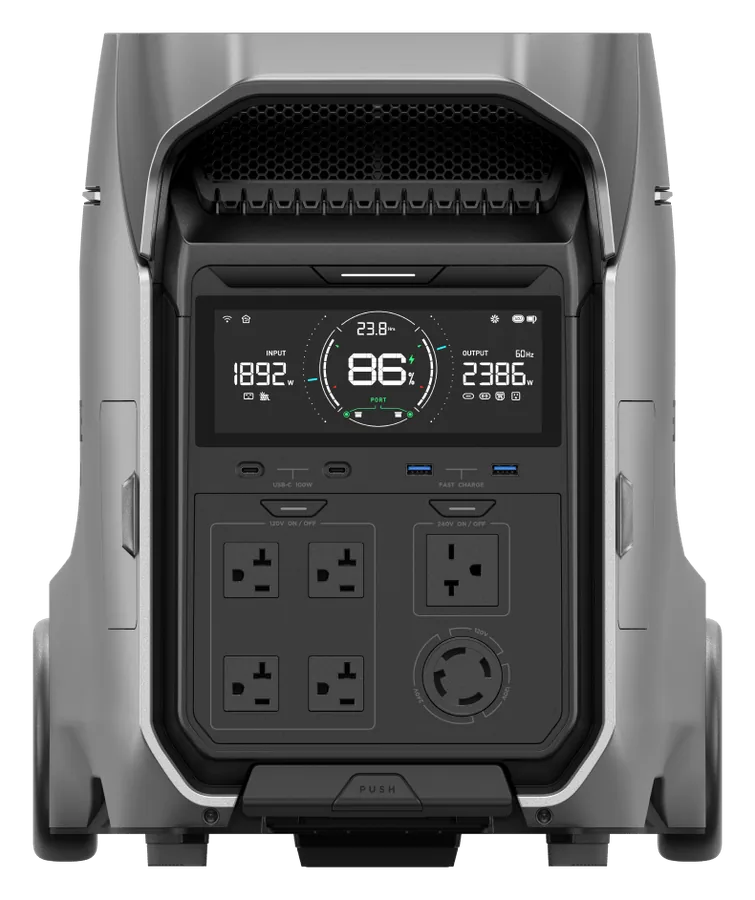
EcoFlow DELTA Pro 3
4.1 kWh, 4,000 W rated output, 114 lb. Also has a TT-30.
- Capacity
- 4,096 Wh
- Output
- 4,000 W
- Weight
- 113.5 lb
- UPS
- 10 ms
Paid link
Check price on Amazon
Jackery Explorer 5000 Plus
5.0 kWh, 7,200 W rated output, 135 lb.
- Capacity
- 5,040 Wh
- Output
- 7,200 W
- Weight
- 134.5 lb
- UPS
- 0 ms
Paid link
Check price on AmazonChange one thing, see the pick change
A fridge and a gas furnace blower for a day, then one change per row. Each row runs the quiz engine on the full catalog, including the 240 V check.
Fridge and furnace blower for a day (120 V)
4.8 kWh/day · 24 h
Open this in the quiz and change the devices
Engine's pick
DJI Power 1000 V2
About 41 h with an extra battery · also DJI Power 2000, Anker SOLIX F3000
Must feed 240 V home circuits
4.8 kWh/day · 24 h
Open this in the quiz and change the devicesEngine's pick
EcoFlow DELTA Pro 3
About 41 h with an extra battery · also Jackery HomePower 3600 Pro Max, Jackery Explorer 5000 Plus
Add a 1/2 hp 240 V well pump
5.2 kWh/day · 24 h
Open this in the quiz and change the devicesEngine's pick
EcoFlow DELTA Pro 3
About 39 h with an extra battery · also Jackery Explorer 5000 Plus, Anker SOLIX F3800 Plus
Two to three days, expandable
4.8 kWh/day · 3 days
Open this in the quiz and change the devices
Engine's pick
DJI Power 2000
About 3.3 days with an extra battery · also Jackery HomePower 3600 Pro Max, Jackery HomePower 3600 Plus
An RV instead: rooftop AC and TV overnight
6.1 kWh/day · 10 h
Open this in the quiz and change the devicesClosest fit
Jackery Explorer 5000 Plus
Covers about 6 h · also EcoFlow DELTA Pro 3, Anker SOLIX F3800 Plus
Picks come from the same engine as the quiz, recalculated whenever our catalog changes.
What people actually ask
Is a TT-30 outlet 240 volts?
No. TT-30 is a 120 V, 30 A outlet, the standard 30 amp RV hookup. It can't run 240 V appliances, and it isn't interchangeable with an L14-30, which is a four-wire 120/240 V twist-lock. Confusing the two is a common buyer mistake.
Can I plug my RV into a power station's TT-30 outlet?
Yes, a 30 A RV cord plugs straight into it. The RV then gets 120 V, limited to the outlet's rating and the station's continuous output, whichever is lower. Some RV surge protectors and energy management systems expect a neutral-ground bond that many stations don't have; Anker, for example, says its stations use a floating ground and sells a ground-neutral plug for those devices.
What do I need to connect a power station to my house?
A listed transfer switch, or an inlet box with a breaker interlock, installed by a licensed electrician with a permit, plus a station with a matching output such as an L14-30. Never connect a power station or generator to a wall outlet, dryer outlet or panel without one: backfeeding can electrocute utility workers.
Can an adapter turn a TT-30 into 240 V or an L14-30?
No. An adapter changes the plug shape, not the power behind it. A 120 V TT-30 stays 120 V and 30 A whatever is plugged into it. Use adapters only from the station or RV maker, rated for the full current, and never to connect to house wiring.
Which power stations have an L14-30 outlet?
Among the current models we track: Anker SOLIX F3800 Plus, EcoFlow DELTA Pro 3, Jackery Explorer 5000 Plus. These are large home-backup units with 120/240 V split-phase output, built to feed an electrician-installed inlet or transfer switch.
Who needs which outlet
- Plugging appliances in with cords: standard 5-15 and 5-20 outlets are all you need.
- A 30 A RV: a TT-30, on a station whose continuous rating covers what the RV draws.
- Home circuits, including 240 V loads: an L14-30 or 14-50 on a split-phase unit, plus an electrician-installed inlet and transfer switch. See home backup picks and well pumps.
- Whole-home backup: compare with an installed battery in power station vs home battery.
The bottom line
TT-30 means 120 V RV power, L14-30 means 120/240 V for a house inlet, and 14-50 means 120/240 V at a higher plug rating. The outlet only tells you the plug; the station's inverter decides how much power comes out, and 240 V needs split-phase output. Anything that touches house wiring goes through a licensed electrician. To find the right size for your loads, take the sizing quiz, check runtimes in the runtime calculator, and compare outlets in the comparison chart.
Sources (checked 2026-11-01)
- Generac: why you should never back-feed your electric panel
- Okanogan PUD: generator hazard flyer (backfeed)
- IAEI: transfer equipment for optional standby systems
- Anker SOLIX C2000 Gen 2 manual (floating ground)
- Anker SOLIX F3800 Plus product page
- Anker SOLIX F3800 and Home Power Panel owner manual
- Jackery Explorer 5000 Plus product page
- EcoFlow Smart Home Panel 2 owner manual
- Anker SOLIX C2000 Gen 2 (official)
- Bluetti Apex 300 (official)
- Bluetti Elite 300 (official)
- Anker SOLIX F3000 (official)
- EcoFlow DELTA 3 Ultra Plus (official)
- Jackery HomePower 3000 (official)
- Jackery HomePower 3600 Plus (official)
- Jackery HomePower 3600 Pro Max (official)
- EcoFlow DELTA Pro (official, US spec table)
- Anker SOLIX F3800 Plus (official)
- EcoFlow DELTA Pro 3 (official)
- Jackery Explorer 5000 Plus (official)