You can connect a power station to your house in two safe ways: plug your appliances into it with extension cords, which needs no electrician, or have a licensed electrician install a power inlet with a transfer switch, an interlock or the station maker's own panel so it can feed selected circuits. Never plug a station into a wall or dryer outlet to backfeed the house. Cords cover most short outages. Hard-wired loads such as a furnace blower or well pump need the installed route and a station with a matching output.
As an Amazon Associate, RightSizePower earns from qualifying purchases. That never changes how models are ranked. How we recommend
Quick decision
- Fridge, Wi-Fi, lamps, phonesExtension cords, any station
- Gas furnace blower or a few hard-wired circuitsInlet + manual transfer switch
- Flexible use of the main panelInlet + interlock, if your inspector accepts it
- Automatic switchover and app controlThe station maker's panel
- A wall outlet or dryer outletNever
What are the options, side by side?
From simplest to most complete. Every option except cords is electrical work for a licensed electrician.
| Option | What it is | What it powers | Station needs | Install |
|---|---|---|---|---|
| Extension cords | Plug each appliance into the station's own outlets | Anything with a plug: fridge, lamps, router, sump pump | Any station with AC outlets | None |
| Power inlet + manual transfer switch | An outdoor inlet box feeds a small switch panel; you move selected circuits to the station one by one | Hard-wired circuits you pick: furnace, well pump, lights | A matching output, usually an L14-30 for 120/240 V | Licensed electrician, permit in most places |
| Power inlet + breaker interlock | The inlet feeds a breaker in your main panel; a sliding plate stops it and the main breaker from being on together | Any circuits you switch on, within the station's output | Same as a transfer switch | Licensed electrician and permit; acceptance varies by inspector |
| Brand smart panel | The station maker's own panel or transfer switch, switching over automatically | Selected circuits, managed in the app | That brand's home-backup unit | Professional installation required by the makers |
Why can't you plug a power station into a wall outlet?
Never connect a power station or generator to a wall outlet, dryer outlet or panel without a transfer switch or interlock installed by a licensed electrician. The classic shortcut is a double-male “suicide cord” plugged into a dryer or wall receptacle. With the main breaker on, power flows back out through your meter and the utility transformer, which steps it up to thousands of volts on lines that repair crews think are dead. Utilities and Generac warn it can electrocute line workers; it can also start a fire when grid power comes back, and the cord's unplugged end has live prongs. There is no safe version of it, with or without the main breaker off.
How far can extension cords take you?
Further than most people expect. A station indoors with cords to the fridge, the router, a couple of lamps and phone chargers covers what most short outages need, with no wiring work and no permit. Use cords rated for the load, run them where nobody trips on them, and don't cover them with rugs. The limits are hard-wired loads, which have no plug, and 240 V appliances, which a standard outlet can't supply. For what a station runs this way, see the home backup picks.
What does a transfer switch with a power inlet do?
An electrician mounts a weatherproof inlet box on the outside wall and wires it to a small manual transfer switch next to your main panel. In an outage you run one cord from the station to the inlet and flip the circuits you chose, typically the furnace, fridge, well pump and some lights, from utility to backup. The switch makes it impossible for those circuits to be connected to the utility and the station at once, which is what US electrical code requires of transfer equipment; the 2020 NEC requires it to be listed, so check the edition your state has adopted.
The inlet and cord have to match the station. Home inlets normally take a 120/240 V L14-30 plug or a 120 V L5-30. The plug types, and why a TT-30 RV outlet isn't an L14-30, are covered in TT-30 vs L14-30 vs 14-50.
What is an interlock kit?
An interlock is a sliding plate on your main panel. The inlet feeds a dedicated breaker, and the plate physically stops that breaker and the main breaker from being on together. It lets you power any circuit in the panel, which is flexible but also makes it easy to switch on more than the station can supply; you manage the load by hand. Whether a listed interlock is accepted is up to your local inspector, so this is a choice to make with the electrician.
Do power station makers sell their own home panels?
Yes, for their large home-backup units. In our catalog, the Anker SOLIX F3800 Plus works with the Anker Home Power Panel and the Jackery Explorer 5000 Plus works with the Jackery 60A Smart Transfer Switch. These switch the chosen circuits over automatically and are set up through the maker's app. Both makers require installation by a licensed electrician, as they do for any panel or transfer-switch wiring.
What else does the electrician set up?
Neutral-ground bonding. A source feeding a house through a transfer switch has to have its neutral bonded or floating to match the switch. Many power stations use a floating ground; Anker says so of its stations and sells a ground-neutral plug for devices that expect a bond. Matching it to your switch is part of why the installation needs an electrician.
Which current models can feed 240 V home circuits?
Every current model in our catalog with an L14-30 outlet or native 240 V output, smallest first.
| Model | Capacity | Rated output | L14-30 | Brand panel in our catalog |
|---|---|---|---|---|
| Bluetti Apex 300 | 2,765 Wh | 3,840 W | — | — |
| Jackery HomePower 3600 Pro Max | 3,584 Wh | 2,000 W | — | — |
| Anker SOLIX F3800 Plus | 3,840 Wh | 6,000 W | Yes | Anker Home Power Panel |
| EcoFlow DELTA Pro 3 | 4,096 Wh | 4,000 W | Yes | — |
| Jackery Explorer 5000 Plus | 5,040 Wh | 7,200 W | Yes | Jackery 60A Smart Transfer Switch |
From maker spec pages and manuals, as stored in our catalog. Rated output is the figure stored in our catalog; for the HomePower 3600 Pro Max that is the 120 V per-outlet figure, and Jackery lists 4,000 W at 240 V. See the outlets guide for which have a 14-50 instead of an L14-30.

Anker SOLIX F3800 Plus
3.8 kWh, 6,000 W rated output, L14-30 outlet. Works with the Anker Home Power Panel. Needs an electrician-installed connection.
- Capacity
- 3,840 Wh
- Output
- 6,000 W
- Weight
- 132.3 lb
- UPS
- 20 ms
See today's price on Amazon
Paid link
Find on Amazon
Jackery Explorer 5000 Plus
5.0 kWh, 7,200 W rated output, L14-30 outlet. Works with the Jackery 60A Smart Transfer Switch. Needs an electrician-installed connection.
- Capacity
- 5,040 Wh
- Output
- 7,200 W
- Weight
- 134.5 lb
- UPS
- 0 ms
Paid link
Check price on Amazon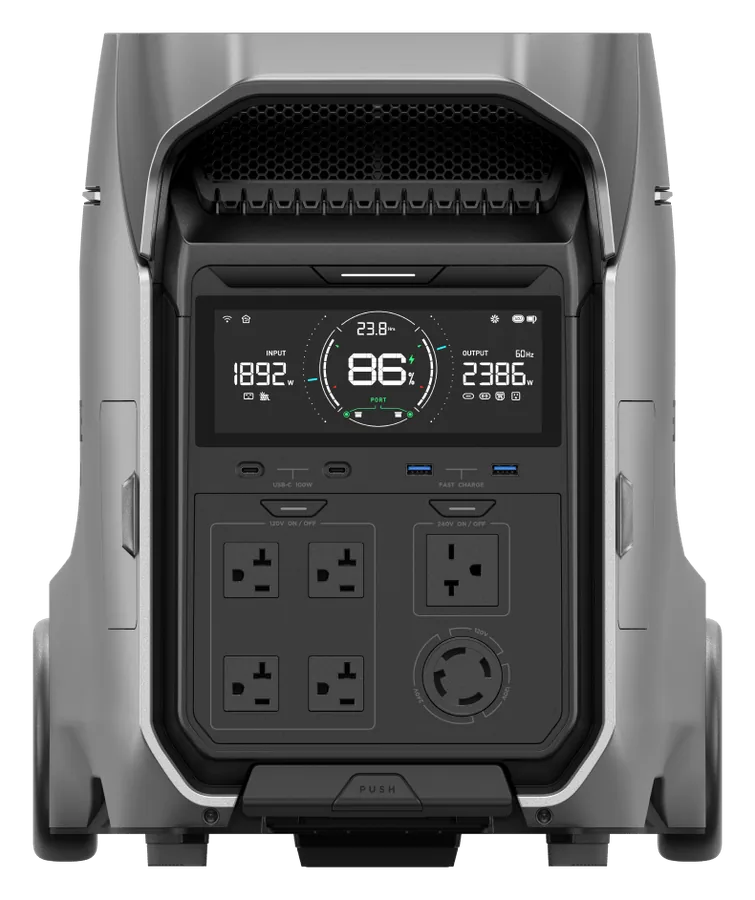
EcoFlow DELTA Pro 3
4.1 kWh, 4,000 W rated output, L14-30 outlet. Needs an electrician-installed connection.
- Capacity
- 4,096 Wh
- Output
- 4,000 W
- Weight
- 113.5 lb
- UPS
- 10 ms
Paid link
Check price on AmazonChange one thing, see the pick change
A fridge, router and gas furnace blower for a day, then one change per row. Each row runs the quiz engine on the full catalog, including the 240 V check.
Fridge, router and furnace blower for a day
5.2 kWh/day · 24 h
Open this in the quiz and change the devices
Engine's pick
DJI Power 1000 V2
About 38 h with an extra battery · also DJI Power 2000, Anker SOLIX F3000
Must feed 240 V home circuits
5.2 kWh/day · 24 h
Open this in the quiz and change the devicesEngine's pick
EcoFlow DELTA Pro 3
About 39 h with an extra battery · also Jackery Explorer 5000 Plus, Anker SOLIX F3800 Plus
Add a 240 V well pump
5.5 kWh/day · 24 h
Open this in the quiz and change the devicesEngine's pick
EcoFlow DELTA Pro 3
About 37 h with an extra battery · also Jackery Explorer 5000 Plus, Anker SOLIX F3800 Plus
Add a sump pump
6.2 kWh/day · 24 h
Open this in the quiz and change the devices
Engine's pick
DJI Power 2000
About 2.6 days with an extra battery · also Anker SOLIX F3000, EcoFlow DELTA Pro 3
Cords only: fridge, router and lamps overnight
1.5 kWh/day · 10 h
Open this in the quiz and change the devices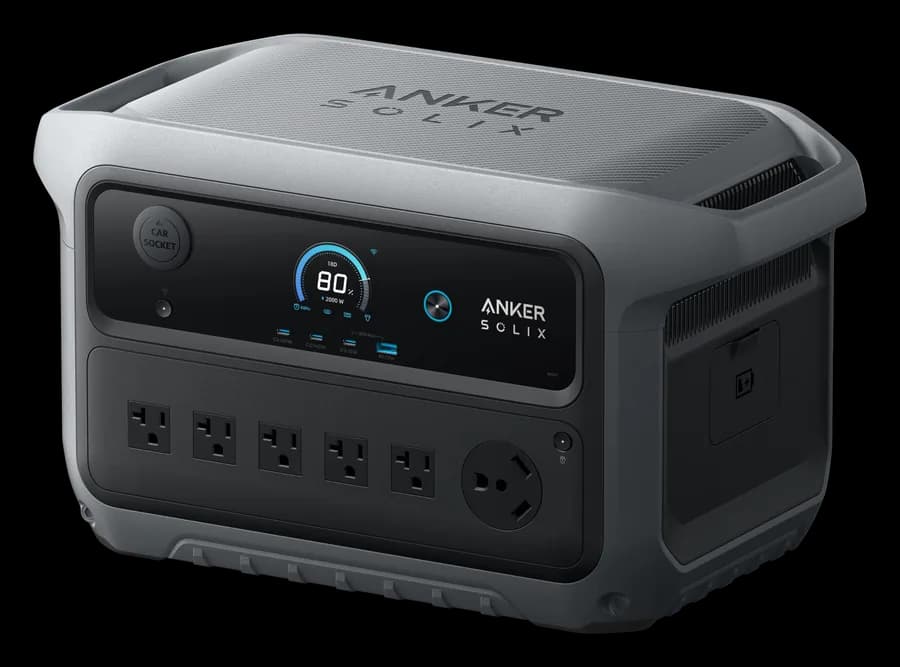
Engine's pick
Anker SOLIX C2000 Gen 2
About 19 h · also Jackery Explorer 1500 Ultra, Anker SOLIX S2000
Picks come from the same engine as the quiz, recalculated whenever our catalog changes.
What people actually ask
Can I plug a power station into a wall outlet to power my house?
No. Feeding a house through a wall or dryer outlet, often with a double-male "suicide cord", sends power back out through the meter onto utility lines that crews think are dead, and leaves live prongs exposed on the cord. It can kill a line worker or a family member and start a fire when grid power returns. The only safe paths into house wiring are a transfer switch, an inlet with an interlock, or a brand panel, installed by a licensed electrician.
What's the easiest safe way to use a power station in an outage?
Extension cords. Set the station indoors, plug the fridge, router, lamps and phones into it directly or through heavy-duty cords, and nothing touches your home's wiring. It doesn't reach hard-wired loads like a furnace blower or well pump; those need an inlet and transfer equipment.
Do I need an electrician to connect a power station to my house?
Yes, for anything that connects to house wiring: an inlet box, a transfer switch, an interlock kit or a brand panel. That work normally needs a permit and inspection under your local electrical code, and the makers of brand panels require professional installation. The electrician also sets the neutral-ground bonding to suit the station and switch.
Which power stations can connect to a transfer switch?
Units with an L14-30 outlet plug into a standard 120/240 V inlet. Among the current models we track: Anker SOLIX F3800 Plus, EcoFlow DELTA Pro 3, Jackery Explorer 5000 Plus. A few others have 240 V on a 14-50 outlet instead. Stations with only standard and TT-30 outlets supply 120 V, so they can't run 240 V circuits.
Transfer switch or interlock: which is better?
Both keep the station and the utility from being connected at the same time. A manual transfer switch moves a handful of pre-chosen circuits; an interlock lets you use any circuit in the main panel, which makes it easier to overload the station. Whether your inspector accepts an interlock varies, so the electrician's advice for your panel decides.
Who should choose which
- Renters and short outages: extension cords and a station indoors; see the apartment picks.
- A gas furnace or a few hard-wired circuits: an inlet and manual transfer switch, installed by a licensed electrician; see running a gas furnace.
- 240 V loads such as a well pump: a split-phase unit with an L14-30 or 14-50, plus transfer equipment; see well pumps.
- Whole-home convenience: a brand panel, or compare with an installed battery in power station vs home battery.
The bottom line
Cords are the safe default and cover most outages. To power hard-wired circuits, hire a licensed electrician to install an inlet with a transfer switch or interlock, or the maker's panel, with a permit, and buy a station whose output matches. Never backfeed through a wall or dryer outlet. To size the station for your circuits, take the sizing quiz or check loads in the runtime calculator.
Sources (checked 2026-11-01)
- Generac: why you should never back-feed your electric panel
- Okanogan PUD: generator hazard flyer (backfeed)
- Maryland Department of Emergency Management: generator safety
- IAEI: transfer equipment for optional standby systems
- Anker SOLIX C2000 Gen 2 manual (floating ground)
- Anker SOLIX F3800 and Home Power Panel owner manual
- Ready.gov: power outages
- Bluetti Apex 300 (official)
- Jackery HomePower 3600 Pro Max (official)
- Anker SOLIX F3800 Plus (official)
- EcoFlow DELTA Pro 3 (official)
- Jackery Explorer 5000 Plus (official)