For an RV's fans, TV, laptop and lights, the best portable power station is a 2 kWh unit with a TT-30 outlet, so the shore cord plugs straight in. A 13,500 BTU rooftop air conditioner is a different job: it needs about 1,760 W continuous and 2,800 W to start, and even the biggest TT-30 units here run it only about 3.2 h per charge. The picks below come from our sizing engine, run on four common RV setups. The engine marks down models without a TT-30 outlet for RV use.
As an Amazon Associate, RightSizePower earns from qualifying purchases. That never changes how models are ranked. How we recommend
Quick picks
- Fans, TV and a laptopAnker SOLIX C2000 Gen 2
- A microwave and coffee makerJackery HomePower 3600 Plus
- Boondocking with solarJackery HomePower 3000
- A few hours of rooftop ACJackery Explorer 5000 Plus (closest)
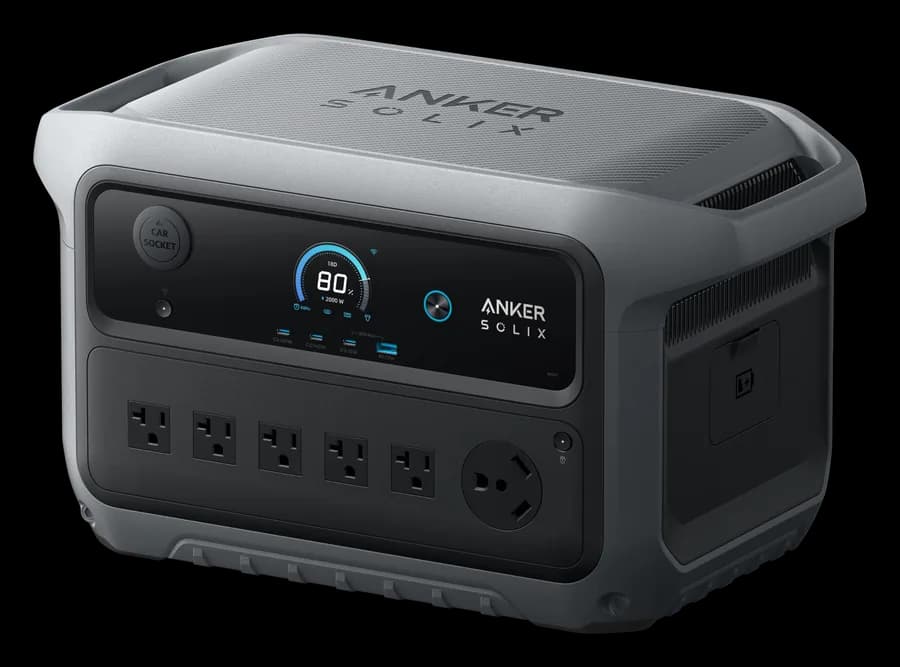
Anker SOLIX C2000 Gen 2
2,048 Wh, 2,400 W continuous, TT-30 RV outlet; starts a 13,500 BTU AC and runs it about 1.6 h.
- Capacity
- 2,048 Wh
- Output
- 2,400 W
- Weight
- 41.7 lb
- UPS
- 10 ms
Paid link
Check price on Amazon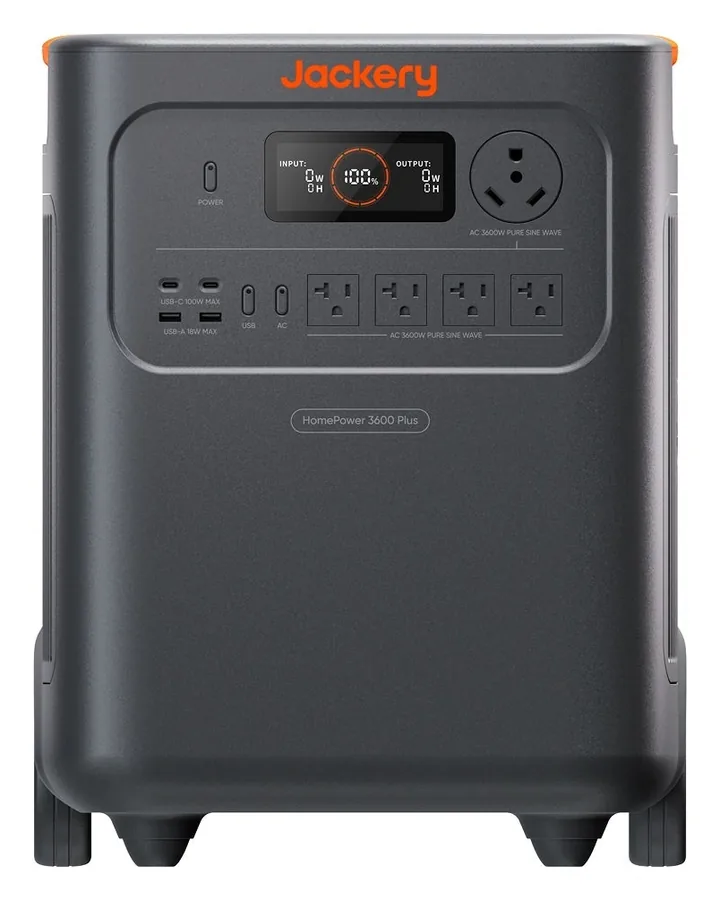
Jackery HomePower 3600 Plus
3,584 Wh, 3,600 W continuous, TT-30 RV outlet; starts a 13,500 BTU AC and runs it about 2.8 h.
- Capacity
- 3,584 Wh
- Output
- 3,600 W
- Weight
- 77.2 lb
- UPS
- 10 ms
Paid link
Check price on Amazon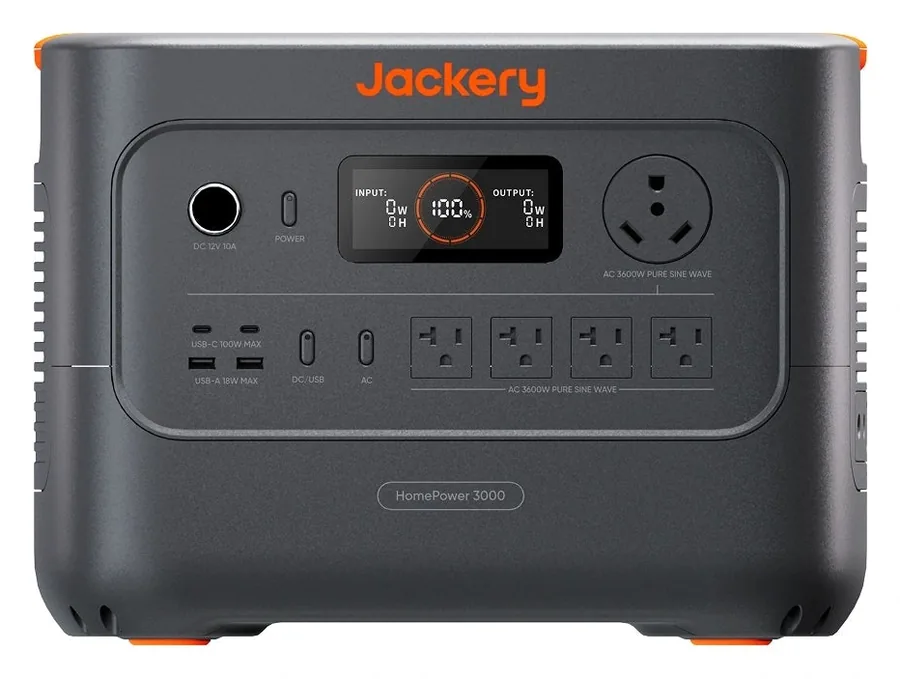
Jackery HomePower 3000
3,072 Wh, 3,600 W continuous, TT-30 RV outlet; starts a 13,500 BTU AC and runs it about 2.4 h.
- Capacity
- 3,072 Wh
- Output
- 3,600 W
- Weight
- 59.5 lb
- UPS
- 20 ms
Paid link
Check price on AmazonBest for fans, TV and a laptop
A fan, a 50 to 55 in TV, a laptop and two phones for a full day; wheels are fine. About 1.0 kWh a day at the devices.
Engine's pick
Anker SOLIX C2000 Gen 2
Black mark: the 24 h you asked for (the low end falls short).
- Covers the start-up surge (about 216 W; it handles 4,000 W).
- Refills from a wall outlet in about 58 min.
- 42 lb, two-hand carry.
- TT-30 outlet: plug the RV's 30 A shore cord straight in.
- Not for you if: you need 240V or more than 2400W at once.
Also a fit: Jackery HomePower 3000 (about 42 h) and Bluetti Elite 200 V2 (about 29 h).
Best for a microwave and coffee maker
The same basics plus a microwave and a drip coffee maker for short daily use. About 1.6 kWh a day at the devices.
Engine's pick
Jackery HomePower 3600 Plus
Black mark: the 24 h you asked for.
- Covers the start-up surge (about 2,716 W; it handles 7,200 W).
- 77 lb.
- TT-30 outlet: plug the RV's 30 A shore cord straight in.
- Not for you if: you need 240V from a single unit; that takes two units paralleled.
Also a fit: Jackery HomePower 3000 (about 29 h) and EcoFlow DELTA Pro (about 30 h).
Best for boondocking with solar
The basics plus a 12 V fridge, a day on battery, then solar panels to keep going. About 1.3 kWh a day at the devices.
Engine's pick
Jackery HomePower 3000
Black mark: the 24 h you asked for.
- Covers the start-up surge (about 216 W; it handles 7,200 W).
- Takes up to 1,000 W of solar.
- 60 lb.
- TT-30 outlet: plug the RV's 30 A shore cord straight in.
- Not for you if: you want to add batteries later; Jackery lists it in its standard (non-expandable) series.
Also a fit: Anker SOLIX F3000 (about 34 h) and Bluetti Elite 300 (about 34 h).
Best for a few hours of rooftop AC
A 13,500 BTU rooftop air conditioner for six hours of an evening and night, plus a TV and phones; the station stays in place. About 6.2 kWh a day at the devices.
Closest fit
Jackery Explorer 5000 Plus
Black mark: the 10 h you asked for (the low end falls short).
- That's about 3.9 h of the AC actually running, with the compressor cycling, before the battery is empty.
- Covers the start-up surge (about 2,896 W; it handles 14,400 W).
- 135 lb.
- No TT-30 outlet. It has a 30 A L14-30 instead, so you'd need an L14-30 to TT-30 adapter; check the maker's guidance first.
- Covers about 6 h of the 10 h you asked for. Recharge once, cut a device or add an extra battery to close the gap.
- Not for you if: the unit has to be lifted by one person; it weighs about 135 lb.
Also a fit: EcoFlow DELTA Pro 3 (about 4.9 h) and Anker SOLIX F3800 Plus (about 4.6 h).
Which power stations have a TT-30 outlet, and can they run the AC?
Every current model in our catalog with a TT-30 RV outlet. "AC hours" is a 13,500 BTU rooftop unit at 1,600 W running, the compressor on 60% of the time, on one full charge with nothing else plugged in.
| Model | Capacity | Continuous | Starts 13,500 BTU AC? | AC hours | Weight |
|---|---|---|---|---|---|
| Anker SOLIX C2000 Gen 2 | 2,048 Whup to 4,096 Wh | 2,400 W | Yes | 1.6 h | 42 lb |
| Bluetti Apex 300 | 2,764.8 Whup to 19,353.6 Wh | 3,840 W | Yes | 2.1 h | 84 lb |
| Bluetti Elite 300 | 3,014.4 Wh | 2,400 W | Surge not published | — | 58 lb |
| Anker SOLIX F3000 | 3,072 Whup to 12,288 Wh | 3,600 W | Yes | 2.4 h | 92 lb |
| EcoFlow DELTA 3 Ultra Plus | 3,072 Whup to 11,264 Wh | 3,600 W | Yes | 2.4 h | 74 lb |
| Jackery HomePower 3000 * | 3,072 Wh | 3,600 W | Yes | 2.4 h | 60 lb |
| Jackery HomePower 3600 Plus | 3,584 Whup to 21,504 Wh | 3,600 W | Yes | 2.8 h | 77 lb |
| EcoFlow DELTA ProOlder model, limited stock | 3,600 Whup to 10,800 Wh | 3,600 W | Yes | 2.8 h | 99 lb |
| Anker SOLIX F3800 Plus | 3,840 Whup to 26,880 Wh | 6,000 W | Yes | 3 h | 132 lb |
| EcoFlow DELTA Pro 3 | 4,096 Whup to 12,288 Wh | 4,000 W | Yes | 3.2 h | 114 lb |
* TT-30 outlet not stated on the maker's spec sheet; confirm before you buy.
The rooftop AC reality
A 13,500 BTU rooftop air conditioner draws about 1,600 W while the compressor runs and around 2,800 W for the moment it starts. In our catalog, 23 current models clear both numbers, and 8 more have the continuous output but a surge rating that's unpublished or too low. Starting it is the easy part. Running it is the problem: at six hours a day, the AC alone uses about 5.8 kWh, more than most portable stations hold.
With the Anker SOLIX C2000 Gen 2, that works out to about 1.6 h of cooling. Extra batteries help in proportion: the AC hours scale with total capacity. To cool through a hot afternoon on battery, plan on solar that can keep up, a generator, or shore power.
What a soft start does, and doesn't
A soft starter, such as Micro-Air's EasyStart or Dometic's SmartStart, ramps the compressor up instead of slamming it on. The makers claim it cuts the inrush current by 65 to 75% compared with the compressor's locked-rotor current, so a station with a modest surge rating may start the AC where it otherwise trips. It doesn't change the running watts, so you still need about 1,760 W of continuous output and the same battery energy per hour of cooling. Fitting one means wiring inside the AC unit, so have an RV technician do it if you're unsure.
Using a TT-30 outlet the right way
- TT-30 is 120 V only. It's the standard 30 A RV plug, rated about 3,600 W. It isn't the 240 V L14-30 used for home transfer switches.
- The station sets the limit, not the plug. A station with 2,400 W of output supplies 2,400 W through its TT-30, however the plug is rated.
- Turn off the converter or battery charger in the RV, or it will spend the station's battery charging the house battery.
- Without TT-30, an adapter into a standard outlet runs lights, fans and the TV, but that outlet's rating leaves little or no room for the rooftop AC.
If you also carry a generator to recharge, run it outdoors only, at least 20 feet from the RV and away from doors, windows and vents, and keep a working carbon monoxide alarm inside.
Specs of the picks
| Spec | Anker SOLIX C2000 Gen 2 | Jackery HomePower 3600 Plus | Jackery HomePower 3000 |
|---|---|---|---|
| Capacity | 2,048 Wh | 3,584 Wh | 3,072 Wh |
| Continuous output | 2,400 W | 3,600 W | 3,600 W |
| Surge | 4,000 W | 7,200 W | 7,200 W |
| Boost mode (heating loads) | None | None | None |
| Battery | LiFePO4, 3,000 cycles to 80% | LiFePO4, 6,000 cycles to 70% | LiFePO4, 4,000 cycles to 70% |
| Weight | 41.7 lb | 77.16 lb | 59.52 lb |
| AC outlets | 4 + TT-30* | 4 + TT-30 | 4 + TT-30 |
| USB-C | 3 × up to 140 W | 2 × up to 100 W | 2 × up to 100 W |
| 12 V car outlet | Yes | No | Yes |
| Wall charge, 0–100% | 58 min | Not published | 132 min |
| Solar input | 800 W, 11-60V, 17A (XT60i) | 1000 W, 2 x DC8020, PV 16-60V (24A max) | 1000 W, 2 x DC 8mm, 16-60V, 12A each |
| UPS switchover | ≤10 ms | ≤10 ms | ≤20 ms |
| Extra batteries | Up to 4,096 Wh | Up to 21,504 Wh | Not expandable |
| Warranty | 5 years | 3 years | 3 years |
* Not stated on the maker's spec sheet, or derived from other official figures.
Change one thing, see the pick change
A fan, TV, laptop and phones for a day in the RV, then one change per row. Each row runs the quiz engine.
Fan, TV, laptop, phones: one day
1.0 kWh/day · 24 h
Open this in the quiz and change the devicesEngine's pick
Anker SOLIX C2000 Gen 2
About 28 h · also Jackery HomePower 3000, Bluetti Elite 200 V2
Only overnight, carried with two hands
1.0 kWh/day · 10 h
Open this in the quiz and change the devicesEngine's pick
Anker SOLIX C2000 Gen 2
About 14 h · also Jackery Explorer 2000 v2, Anker SOLIX S2000
Add a microwave
1.4 kWh/day · 24 h
Open this in the quiz and change the devicesEngine's pick
Jackery HomePower 3000
About 33 h · also Jackery HomePower 3600 Plus, Anker SOLIX F3000
Two to three days, stays in place
1.0 kWh/day · 3 days
Open this in the quiz and change the devices
Engine's pick
EcoFlow DELTA 3
About 3.2 days with an extra battery · also EcoFlow DELTA 3 Plus, Anker SOLIX F3000
Add the 13,500 BTU rooftop AC
6.7 kWh/day · 24 h
Open this in the quiz and change the devices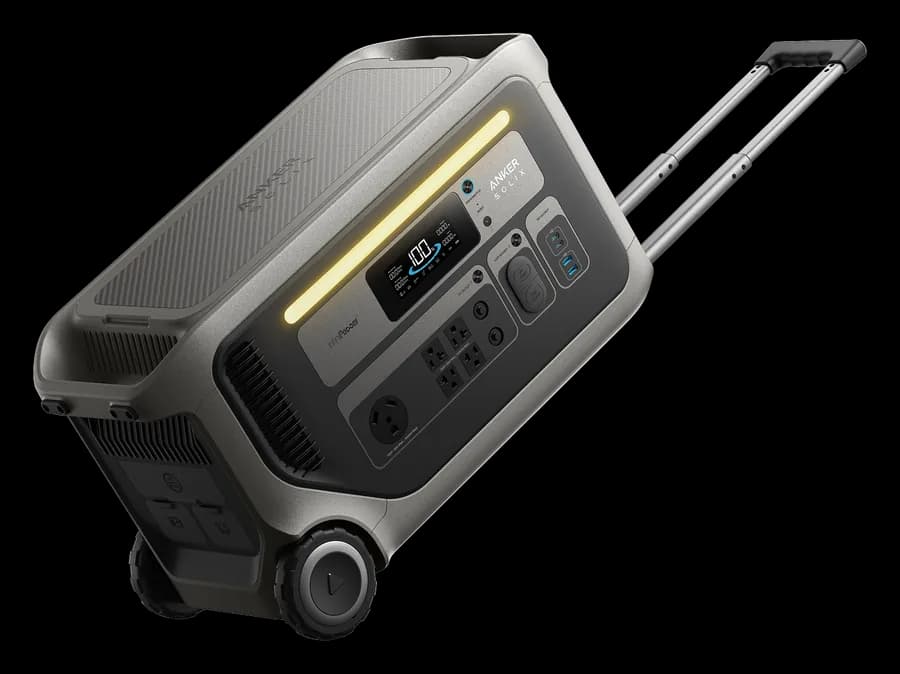
Engine's pick
Anker SOLIX F3000
About 32 h with an extra battery · also EcoFlow DELTA Pro 3, Jackery HomePower 3600 Plus
Picks come from the same engine as the quiz, recalculated whenever our catalog changes.
What people actually ask
Can a portable power station run an RV air conditioner?
Some can start one, few can run it for long. A 13,500 BTU rooftop unit draws about 1,600 W running and around 2,800 W to start, so the station needs at least 1,760 W continuous and 2,800 W of surge. Even the largest TT-30 units in our catalog run it about 3.2 h on a charge with the compressor cycling.
Which power stations have a TT-30 RV outlet?
Of the current models we track: Anker SOLIX C2000 Gen 2, Bluetti Apex 300, Bluetti Elite 300, Anker SOLIX F3000, EcoFlow DELTA 3 Ultra Plus, Jackery HomePower 3000, Jackery HomePower 3600 Plus, EcoFlow DELTA Pro, Anker SOLIX F3800 Plus, EcoFlow DELTA Pro 3. A TT-30 outlet lets you plug the RV's 30 A shore cord straight in. The station still supplies only its own rated output, not the full 30 A.
Does a soft start let a smaller power station run the RV AC?
It helps the start, not the running. A soft starter such as the Micro-Air EasyStart cuts the inrush current at start-up, so a station with a lower surge rating may start the compressor. The AC still draws about 1,600 W once running, so you need roughly 1,760 W of continuous output either way.
What size power station do I need for an RV?
For a fan, TV, laptop and phones, about 1 kWh a day at the devices, so a 2 kWh unit covers about a full day. A microwave and coffee maker add output more than energy: running both at once takes about 2,750 W of continuous output. Rooftop AC on battery takes several kilowatt-hours per day, which only solar or a generator can keep up with.
Can I plug my RV into a power station without a TT-30 outlet?
Yes, with a TT-30 to household-plug adapter into a standard AC outlet, but you're then limited by that outlet and the station's output. Fine for lights, a fan and a TV; the outlet's rating leaves little or no room for the rooftop AC. Turn off the RV's converter or battery charger, or it will drain the station charging the house battery.
Who should buy which
- Weekend RV basics (fans, TV, laptop, lights): a 2 kWh unit with a TT-30 outlet.
- A microwave and coffee maker too: a 3 kWh-class unit with about 3,000 W or more of output.
- Boondocking for days: a 3 kWh-class unit with high solar input, or an expandable one.
- Rooftop AC: one of the largest units, plus solar or a generator; on battery alone, expect a few hours.
The bottom line
For most RVs, a 2 kWh station with a TT-30 outlet runs the everyday loads and plugs in without adapters. The rooftop air conditioner is the exception: several stations can start it, but none runs it for long on battery alone. For your own devices, the sizing quiz runs the same engine; check the runtime calculator and the comparison chart next, and see what each size can run.
Sources (checked 2026-11-01)
- Honda generator wattage estimation guide (RV AC running and starting watts)
- Good Sam forum: Dometic rooftop AC current
- Micro-Air EasyStart soft starter (retailer spec page)
- ENERGY STAR certified televisions (dataset)
- CPSC: portable generator carbon monoxide hazards
- Anker SOLIX C2000 Gen 2 (official)
- Jackery HomePower 3600 Plus (official)
- Jackery HomePower 3000 (official)
- Jackery Explorer 5000 Plus (official)