Plug the station's car charging cable into the 12 V socket, start the engine, and drive: a typical socket is fused at 10 A and delivers about 100 W, so you put back roughly 1 kWh in 10 hours of driving. That keeps a small station or a day of 12 V fridge use topped up. For refilling a 1 to 2 kWh unit, an alternator charger, solar or an outlet is far faster.
As an Amazon Associate, RightSizePower earns from qualifying purchases. That never changes how models are ranked. How we recommend
How do you charge a power station from a car, step by step?
- Use the maker's car charging cable. Many stations take it through the same DC input as solar (XT60 on EcoFlow, barrel or Anderson inputs on others). Check the input's voltage range in the manual.
- Start the engine first. EcoFlow and Jackery both say to, so the station doesn't drain the starter battery. Many cars switch the socket off with the ignition anyway.
- Seat the plug firmly. Jackery warns against car charging on bumpy roads where a loose plug can overheat. If the plug gets hot, stop.
- Leave the fuse alone. Sockets are usually fused at 10 A, sometimes 15 A. The fuse protects the wiring; a bigger one removes that protection.
- Unplug when you park unless the socket switches off with the ignition.
How long does car charging take by size?
Hours of driving at about 100 W from a 12 V socket, and at about 200 W from a 24 V truck socket on stations that accept it. Real times run longer if the station pulls less, as some do by default.
| Station size | Empty to full, 12 V | 20% to 80%, 12 V | Empty to full, 24 V |
|---|---|---|---|
| 288 Wh | 2.9 h | 1.7 h | 1.4 h |
| 512 Wh | 5.1 h | 3.1 h | 2.6 h |
| 1,024 Wh | 10 h | 6.1 h | 5.1 h |
| 1,536 Wh | 15 h | 9.2 h | 7.7 h |
| 2,048 Wh | 20 h | 12 h | 10 h |
| 3,072 Wh | 31 h | 18 h | 15 h |
Rated watt-hours divided by charging watts. As a cross-check, BLUETTI's AC70P manual gives 7 to 9 hours to refill its 864 Wh battery from a 12 V port and 4 to 5 hours from 24 V.
Why is car charging so slow?
Because the socket is the bottleneck, not the station. At 12 V and a 10 A fuse, the socket can supply about 120 W at most, and stations draw a little under that: EcoFlow's DELTA 2 defaults to 8 A, roughly 100 W. Some stations list a higher car input. The EcoFlow RIVER 3 Plus accepts up to 220 W at 11 to 55 V on its car input, but from a 12 V socket fused at 10 A it still can't get more than the socket gives. The higher figure only helps on a 24 V truck socket or another higher-voltage source.
Where car charging works well is keeping up, not filling up. A 4-hour drive puts back about 400 Wh, more than the roughly 324 Wh a 45 L 12 V fridge uses on a mild day. That's why it suits camping and road trips with a small station, and why it can't carry a 2 kWh unit through a multi-day outage.
What is an alternator charger, and how much faster is it?
An alternator charger is a DC-DC unit wired directly to the vehicle's battery, bypassing the socket. EcoFlow's 800W Alternator Charger is listed with an 11 to 31 V input at up to 76 A and 800 W of output, and EcoFlow quotes about 1.3 hours to recharge a DELTA 2. Some stations support alternator charging directly; Anker lists 800 W alternator charging for the Anker SOLIX C2000 Gen 2, which would refill its 2,048 Wh in roughly 2.6 hours of driving, against about 20 hours from a socket.
The catch is installation. Pulling 60 to 70 A from a vehicle battery takes correctly sized cable, fusing at the battery and a sound mounting, so have it done by a professional or someone competent with vehicle wiring. High-current 12 V connections are a real fire risk: Goal Zero's Yeti Link expansion modules and EC8 cables were recalled in 2024 after connections overheated and melted in vehicles.
Can an electric vehicle charge a power station?
Yes, if it has vehicle-to-load outlets. Ford's F-150 Lightning has Pro Power Onboard outlets, 2.4 kW as standard and up to 9.6 kW on equipped trims with 240 V outlets (see outlet types explained), and some other EVs offer a V2L adapter. You plug the station's normal AC cord in as if it were a wall outlet, so it charges at its regular AC rate within that outlet's limit, far faster than a 12 V socket. Treat it as an extra recharge source rather than your backup plan.
What are the safety rules for charging from a car?
- Never run the engine in a garage, attached or not, even with the door open. Carbon monoxide builds up fast. If you idle to charge, do it outdoors in open air and away from windows and doors.
- Watch the starter battery. Charging with the engine off can leave you unable to start the car.
- Keep the station ventilated and out of direct sun. Manuals warn against leaving units in a hot car.
- Don't charge below 32°F. LiFePO4 stations block charging until the cells warm up; see cold weather and storage.
Two stations that fit vehicle charging
The two models discussed above: one small enough to refill from a socket on a day's drive, one large enough to need an alternator charger.

EcoFlow RIVER 3 Plus
286 Wh, about 2.9 hours from a 12 V socket. 10.4 lb, 220 W solar input. No 12 V car output for a fridge.
- Capacity
- 286 Wh
- Output
- 600 W
- Weight
- 10.4 lb
- UPS
- 10 ms
Paid link
Check price on Amazon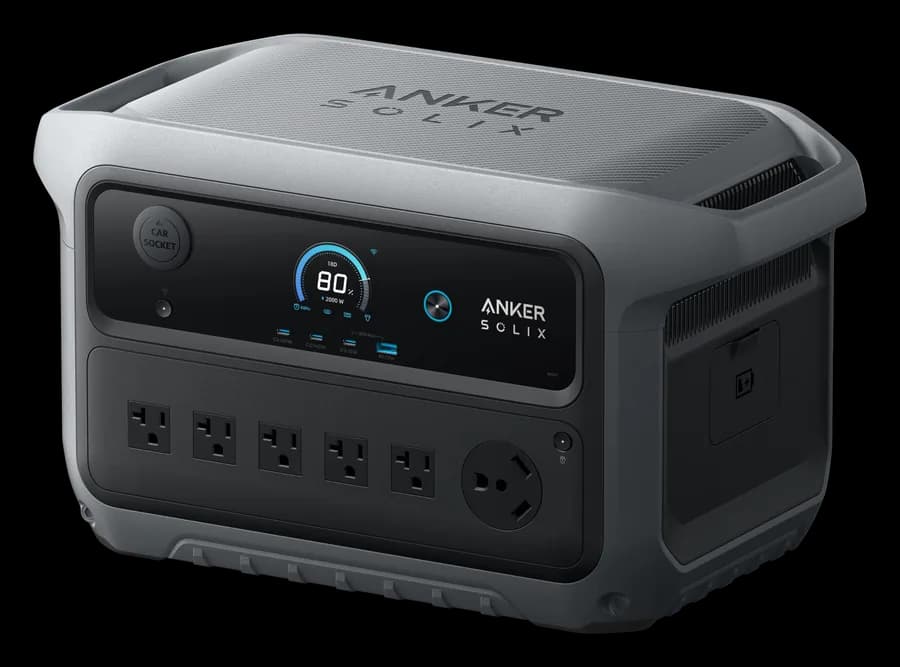
Anker SOLIX C2000 Gen 2
2,048 Wh, about 2.6 hours with an 800 W alternator charger. 42 lb, 12 V car output.
- Capacity
- 2,048 Wh
- Output
- 2,400 W
- Weight
- 41.7 lb
- UPS
- 10 ms
Paid link
Check price on AmazonChange one thing, see the pick change
A 12 V fridge and two phones for two to three days, recharged only from the car, then one change per row. Each row runs the quiz engine on the full catalog.
12 V fridge and phones, car recharge only
0.4 kWh/day · 3 days
Open this in the quiz and change the devicesEngine's pick
Anker SOLIX C2000 Gen 2
About 4.6 days · also Jackery Explorer 2000 v2, Jackery HomePower 2000 Plus v2
Add solar: a day on battery, then sun
0.4 kWh/day · 24 h
Open this in the quiz and change the devicesAnker SOLIX768 WhEngine's pick
Anker SOLIX C800X / C800 Plus
About 41 h · also EcoFlow RIVER 2 Pro, Anker SOLIX C1000 Gen 2
One hand, 24 hours
0.4 kWh/day · 24 h
Open this in the quiz and change the devicesAnker SOLIX768 WhEngine's pick
Anker SOLIX C800X / C800 Plus
About 41 h · also EcoFlow RIVER 2 Pro, Jackery Explorer 500 v2
Add a laptop
0.6 kWh/day · 3 days
Open this in the quiz and change the devicesClosest fit
Anker SOLIX C2000 Gen 2
Covers about 2.7 days · also Jackery HomePower 2000 Plus v2, EcoFlow DELTA 3 Max Plus
Starlink Mini instead of the fridge
0.8 kWh/day · 24 h
Open this in the quiz and change the devices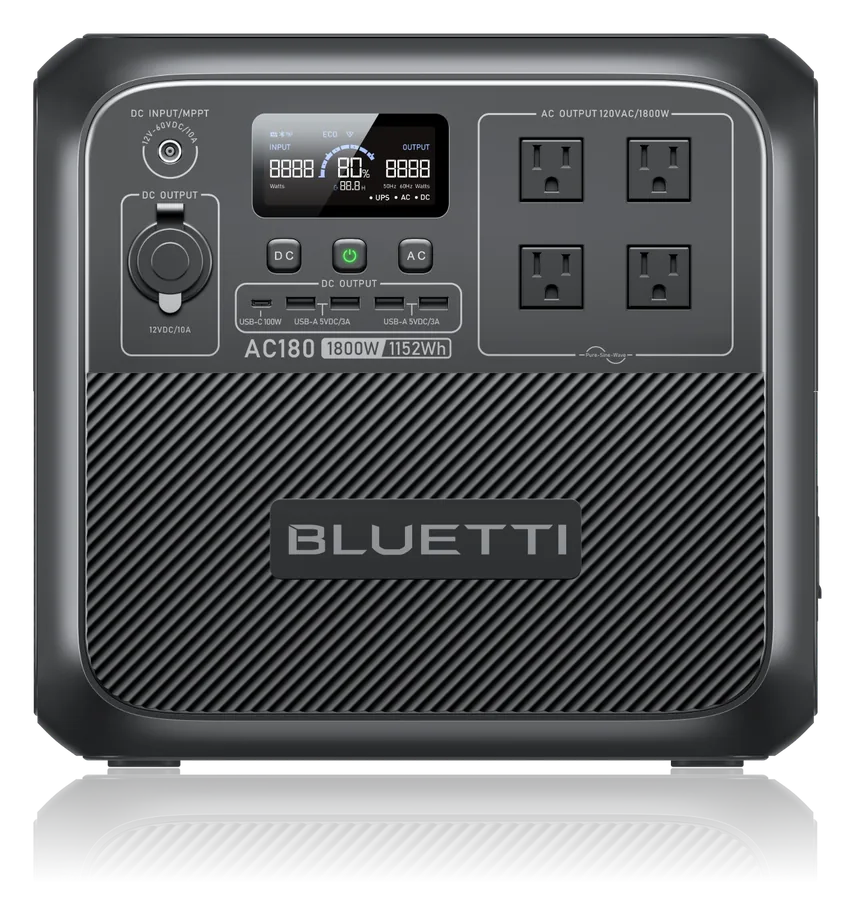
Engine's pick
Bluetti AC180
About 29 h · also Anker SOLIX C1000 Gen 2, Jackery HomePower 1000 Plus v2
Picks come from the same engine as the quiz, recalculated whenever our catalog changes.
What people actually ask
How long does it take to charge a power station in a car?
About 10 hours per kilowatt-hour from a 12 V socket, which supplies roughly 100 W. A 300 Wh unit refills in about 2.9 hours of driving; a 1,024 Wh unit takes about 10 hours from empty.
Can I charge a power station with the car turned off?
Many cars cut power to the 12 V socket when the ignition is off, and where it stays live, charging drains the starter battery. EcoFlow and Jackery both tell owners to start the engine before car charging. Charge while you drive, not while parked.
Is it safe to idle the car to charge a power station?
Only outdoors in open air, and never in a garage, even with the door open. A running engine makes carbon monoxide. During Winter Storm Uri, Texas counted 19 carbon monoxide deaths, with cars among the sources people were treated for.
Will a bigger fuse make car charging faster?
Don't fit one. The socket's wiring is sized for its fuse, usually 10 A and sometimes 15 A, so a bigger fuse removes the protection, not the limit. For faster charging, use an alternator charger wired to the battery by a competent installer.
Is an alternator charger worth it?
If you charge from the vehicle often, yes. EcoFlow's 800W Alternator Charger is listed at up to 800 W, about eight times a 12 V socket, so a 2 kWh station refills in roughly 2.6 hours of driving instead of 20. It's wired to the vehicle battery and needs proper fusing and cable.
Who should rely on which method
- A 300 to 500 Wh station: the 12 V socket refills it on a long day's drive. Good enough for phones, lights, a CPAP on DC or a tailgate TV and speaker.
- A 1 kWh station on the road: the socket keeps a 12 V fridge going, but plan on solar or an outlet to fill it.
- 2 kWh and up, or vanlife: an installed alternator charger, plus solar; see what size solar panel.
- An EV with V2L: charge through the AC outlet at the station's normal wall rate.
The bottom line
A car's 12 V socket gives about 100 W, so it tops up a station rather than refills it: about 10 hours per kilowatt-hour, engine running, outdoors only. For bigger stations, an alternator charger is about eight times faster but needs a proper install. To size a station around how you recharge, the sizing quiz asks about car and solar charging, the runtime calculator shows how long your devices last, and the comparison chart lists every model's inputs.
Sources (checked 2026-11-01)
- EcoFlow DELTA 2 user manual V1.1 (car charging 12/24 V, 8 A)
- BLUETTI AC70P user manual (12 V and 24 V car charging times)
- Jackery Explorer 1000 v2 user manual (car charging)
- EngineerFix: 12 V accessory socket fuse ratings
- AutoRoamer: power station not charging from the car
- Solartown: EcoFlow 800W Alternator Charger specs
- CPSC recall dataset (24-350: Goal Zero Yeti Link modules and EC8 cables)
- Ford: F-150 Lightning Pro Power Onboard
- Texas Uri death toll (246, incl. CO deaths)
- Mortality surveillance during Winter Storm Uri (Disaster Med Public Health Prep)
- Ready.gov: power outages
- Dometic CFX3 FAQ: power consumption
- ICECO VL45 product page
- Anker SOLIX C2000 Gen 2 (official)
- EcoFlow RIVER 3 Plus (official)