Buy the Jackery HomePower 3600 Plus if your outage essentials are all 120 V and you want a fridge, Wi-Fi, lights and phones covered for more than a day on one charge, a sump pump or furnace blower started without strain, RV power through a TT-30 outlet, and room to grow past 21 kWh. Skip it if you need 240 V from one unit, want a UPS that covers a sump pump or microwave (it caps at 1,440 W in UPS mode), or need to carry it. It holds 3,584 Wh of LiFePO4, supplies 3,600 W at 120 V with a 7,200 W surge, and weighs 77.16 lb.
As an Amazon Associate, RightSizePower earns from qualifying purchases. That never changes how models are ranked. How we recommend
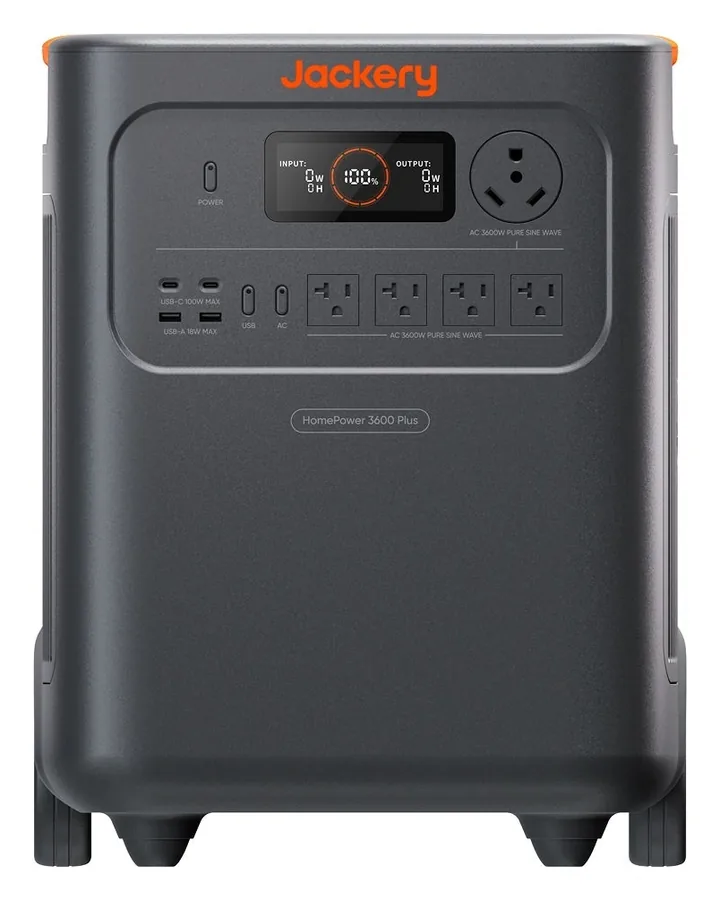
Jackery HomePower 3600 Plus
Multi-day 120V backup or RV power via TT-30, with up to five battery packs.
- Capacity
- 3,584 Wh
- Output
- 3,600 W
- Weight
- 77.2 lb
- UPS
- 10 ms
Paid link
Check price on AmazonQuick verdict
- Good fit
- A full day of fridge, Wi-Fi and lights; ½ hp sump pumps; RV power via TT-30; multi-day backup with battery packs
- Poor fit
- 240 V loads from one unit; a sump pump or microwave on UPS; anything you carry
- Weight
- 77.16 lb
- Grow later?
- Up to five Battery Pack 3600 units, 21,504 Wh total
- Watch out for
- UPS mode caps output at 1,440 W
Key specs
From Jackery's US product page and user manual. Starred values aren't confirmed on the spec sheet yet.
| Spec | Jackery HomePower 3600 Plus |
|---|---|
| Capacity | 3,584 Wh |
| Continuous output | 3,600 W |
| Surge | 7,200 W |
| Boost mode (heating loads) | None |
| Battery | LiFePO4, 6,000 cycles to 70% |
| Weight | 77.16 lb |
| AC outlets | 4 + TT-30 |
| USB-C | 2 × up to 100 W |
| 12 V car outlet | No |
| Wall charge, 0–100% | Not published |
| Solar input | 1000 W, 2 x DC8020, PV 16-60V (24A max) |
| UPS switchover | ≤10 ms |
| Extra batteries | Up to 21,504 Wh |
| Warranty | 3 years |
What will it run, and for how long?
Each device on its own from a full charge of the base unit, running nonstop (fridges, freezers, pumps, the furnace blower and air conditioners cycle as normal). With no car outlet, the CPAP runs on its AC power brick. Includes the battery reserve, conversion losses and the standby draw of a home-size unit from our published formula. The last column checks each device against the 1,440 W UPS-mode cap, start-up included.
| Device | Plugged into | Runtime or limit | On UPS mode? |
|---|---|---|---|
| Top-freezer fridgeabout 0.99 kWh a day, 1,200 W to start | AC outlet | 35–43 h | Yes |
| French-door fridgeabout 1.48 kWh a day, 1,200 W to start | AC outlet | 27–33 h | Yes |
| Chest freezerabout 0.6 kWh a day, 1,200 W to start | AC outlet | 46 h – 2.4 days | Yes |
| CPAP, humidifier off11 W | AC outlet | 2.6–3.3 days | Yes |
| Wi-Fi router and modem15 W | AC outlet | 2.4–3 days | Yes |
| Desktop PC and monitor213 W | AC outlet | 9.8–12 h | Yes |
| Sump pump, ½ hp1,050 W, 2,150 W to start, cycles on and off | AC outlet | 35–43 h | No: 2,150 W to start |
| Gas furnace blower400 W, 1,400 W to start, cycles on and off | AC outlet | 13–16 h | Yes |
| Microwave1,500 W | AC outlet | 1.5–1.9 h | No: 1,500 W |
| Window AC, 8,000 BTU533 W, 1,599 W to start, cycles on and off | AC outlet | 6.7–8.3 h | No: 1,599 W to start |
| Rooftop RV AC, 13,500 BTU1,600 W, 2,800 W to start, cycles on and off | TT-30 outlet | 2.4–2.9 h | No: 2,800 W to start |
| Well pump, ½ hp, 240 V670 W, 7,400 W to start | — | Won't run: needs 240 V; a single unit has no 240 V output | — |
A French-door fridge, a chest freezer and Wi-Fi together run about 22 h on the base unit and about 5.4 days with all five battery packs. Add your own circuits in the runtime calculator.
Where the HomePower 3600 Plus wins, and where it's ruled out
We ran eight common situations through the quiz engine. Rank is among every model that passes the hard limits.
| Situation | Result | Runtime or reason |
|---|---|---|
| Outage overnight: fridge, Wi-Fi and phones (carry it) | Ruled out | 77 lb is heavier than you want to carry. |
| Outage for a full day, same devices (wheels OK) | #3 of 20 | About 31 h |
| CPAP for two nights away, one-hand carry | Ruled out | 77 lb is heavier than you want to carry. |
| Weekend car camping: 12 V fridge, lights, phones, with solar | Ruled out | No 12 V car socket for the 12 v portable fridge (45 l). |
| RV day: fan, TV, laptop, phones | #4 of 25 | About 42 h |
| Remote work day: Starlink, laptop, phone | Ruled out | 77 lb is heavier than you want to carry. |
| Home office on UPS: router, laptop, phone, overnight | Ruled out | 77 lb is heavier than you want to carry. |
| Overnight essentials on a budget under $500 | Ruled out | 77 lb is heavier than you want to carry. |
Most of the ruled-out rows are about weight: at 77.16 lb, the engine drops it wherever you said you'd carry the unit, and the camping row needs a 12 V socket it doesn't have. Where it can stay put or roll, it ranks among the top picks for a full outage day and an RV day on one charge.
What does it do well?
- Long runtimes on one charge. About 41 h for a top-freezer fridge alone, and about 22 h with a ½ hp sump pump and Wi-Fi added.
- Starts big 120 V motors. The 7,200 W surge covers a ½ hp sump pump with a fridge running (about 2,310 W) and a 13,500 BTU rooftop RV air conditioner.
- RV-ready. A TT-30 outlet alongside 4 household outlets, 2 USB-C at 100 W and 2 USB-A.
- Grows a long way. Up to five Battery Pack 3600 units for 21,504 Wh, enough for about 10.3 days of fridge alone.
- A fast UPS for light loads. A 10 ms switchover keeps a router, desktop PC, CPAP or fridge running through an outage, within the 1,440 W cap.
- Two ways to recharge. Up to 1,800 W from a standard outlet, plus up to 1,000 W of solar across two DC8020 inputs (PV 16–60 V, 24 A max).
What should you know before you buy?
- 120 V only on its own. No 240 V outlet; Jackery says 240 V at 7,200 W needs two units paralleled through the AC expansion port. 240 V well pumps, dryers and central air are out for a single unit.
- UPS mode is capped. In UPS mode output peaks at 1,440 W, start-up included. A microwave, a space heater or a sump pump's start exceeds it, so put those on the unit's regular outlets, not the UPS path.
- It stays put. At 77.16 lb it's a unit you place once, next to the fridge or the transfer switch.
- Connecting it to the house is electrician work. A transfer switch or inlet box with an interlock needs a licensed electrician and, in most places, a permit. Never feed the house through a wall or dryer outlet; that backfeeds the grid and can electrocute utility workers.
- Jackery's own solar plugs. The DC8020 inputs take Jackery panels directly; other panels usually need an adapter cable, and the array has to stay within the input voltage range.
- No 12 V car outlet. Jackery's manual lists none, so a 12 V fridge or a CPAP's DC cable won't plug in.
- Read the cycle rating carefully. 6,000 cycles is to 70% of capacity, a looser end point than the 80% most makers quote.
- Warranty depends on where you buy. 3 years; Jackery adds 2 more only for units bought from jackery.com.
- Pick the right listing. Our button goes to the single-unit listing. Jackery also sells it in bundles with solar panels under a separate listing, so check what's in the box if you shop around.
What are the closest alternatives?
If you need 240 V from one unit, the Anker SOLIX F3800 Plus supplies 6,000 W at 120/240 V with up to 3,200 W of solar, but weighs at least 132.3 lb and switches over in 20 ms; see F3800 Plus vs HomePower 3600 Plus and our F3800 Plus guide. The EcoFlow DELTA Pro 3 gives 4,096 Wh and 4,000 W at 120/240 V with a 10 ms switchover at 113.54 lb; see our DELTA Pro 3 guide. Within Jackery's range, the HomePower 3600 Pro Max has the same 3,584 Wh battery with a 240 V outlet but only 2 household outlets at 2,000 W each, and the HomePower 3000 is lighter at 59.52 lb with 3,072 Wh and no expansion battery.

Anker SOLIX F3800 Plus
3,840 Wh and 6,000 W at 120/240 V; 20 ms switchover; 132.3 lb or more.
- Capacity
- 3,840 Wh
- Output
- 6,000 W
- Weight
- 132.3 lb
- UPS
- 20 ms
See today's price on Amazon
Paid link
Find on Amazon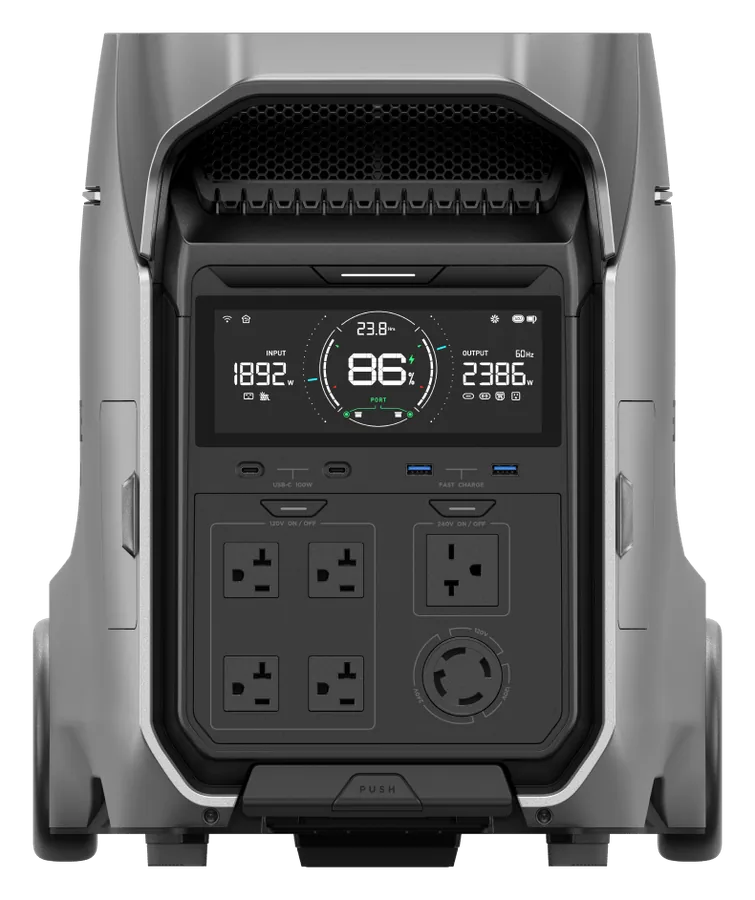
EcoFlow DELTA Pro 3
4,096 Wh and 4,000 W at 120/240 V; 10 ms switchover; 113.54 lb.
- Capacity
- 4,096 Wh
- Output
- 4,000 W
- Weight
- 113.5 lb
- UPS
- 10 ms
Paid link
Check price on AmazonWho should buy it, and who shouldn't?
- Buy it if your essentials are all 120 V: a fridge, Wi-Fi and lights for a day or more on one charge, or a sump pump, freezer and furnace blower as well once you add battery packs. It also suits RV power through the TT-30, or starting at 3.6 kWh and growing later.
- Skip it if you have a 240 V well pump or 240 V circuits to back up, need a sump pump or microwave on UPS, or want something you can carry. For a fridge and Wi-Fi overnight, a 1–2 kWh unit does it at a fraction of the weight. The sizing quiz checks your devices against every model.
More on this class: how to connect a power station to your house, TT-30 vs L14-30 vs 14-50 outlets, portable power station vs home battery, and every model in the comparison chart.
What people actually ask
Can the HomePower 3600 Plus power my whole house?
No. It supplies 3,600 W at 120 V only, enough for several selected 120 V circuits through a transfer switch or inlet installed by a licensed electrician, never by backfeeding a wall outlet. Central air, an electric range, a dryer and a 240 V well pump are out. Jackery says 240 V at 7,200 W takes two units paralleled through the AC expansion port.
How long will the HomePower 3600 Plus run a refrigerator?
About 41 h for a typical top-freezer fridge on its own, and about 31 h for a French-door model, including the standby draw of a unit this size. With all five Battery Pack 3600 units (21,504 Wh in total), the top-freezer fridge runs about 10.3 days.
Will its UPS mode keep a sump pump running?
Not through the UPS mode. Jackery caps output at 1,440 W in UPS mode, and a typical ½ hp sump pump needs about 2,150 W to start, or about 2,310 W with a fridge running. A router, computer, CPAP or fridge fits under the cap. Plugged straight into the unit outside UPS mode, the pump starts within the 7,200 W surge.
Can it run an RV air conditioner?
A typical 13,500 BTU rooftop unit, yes, through the TT-30 outlet: it needs about 2,800 W to start, inside the 7,200 W surge, and runs about 2.8 h of nonstop cooling with the compressor cycling. Longer stays need shore power, solar or extra batteries.
Can it run a 240 V well pump?
Not as a single unit: it has no 240 V output. Jackery offers 240 V by paralleling two units, which we don't model; have a licensed electrician check the pump's starting amps against the paired rating before you plan around it. Jackery's HomePower 3600 Pro Max and the Anker SOLIX F3800 Plus have 240 V outlets on one unit.
What warranty does the HomePower 3600 Plus have?
3 years, plus 2 more only when you buy it at jackery.com. Jackery rates the battery for 6,000 cycles to 70% of capacity.
The bottom line
The HomePower 3600 Plus is a 120 V home and RV unit: 3,600 W with a 7,200 W surge, a TT-30 outlet, about 41 h of fridge on one charge and a path to 21,504 Wh. Its limits are 240 V (it takes two units) and a UPS mode capped at 1,440 W. If 240 V is on your list, the Anker F3800 Plus is the one-unit answer; if not, this is the lighter way to cover 120 V essentials. Either way, have a licensed electrician install any house connection.
Jackery HomePower 3600 Plus
Multi-day 120V backup or RV power via TT-30, with up to five battery packs.
- Capacity
- 3,584 Wh
- Output
- 3,600 W
- Weight
- 77.2 lb
- UPS
- 10 ms
Paid link
Check price on Amazon