Yes, a power station can run a typical microwave if it supplies at least about 1,650 W continuous, and a 1,000 Wh unit covers about 6 five-minute runs. The catch is that the wattage on a microwave is its cooking power, not what it pulls from the outlet; a 1,000 W microwave draws about 1,500 W. Coffee makers, kettles and air fryers work the same way: high watts for a few minutes, so output decides whether it runs and capacity decides how many times.
As an Amazon Associate, RightSizePower earns from qualifying purchases. That never changes how models are ranked. How we recommend
How many watts does a microwave really draw?
Microwaves are sold by cooking power. Input power, the number a power station has to supply, is 1.3 to 1.6 times higher.
| Cooking power (label) | Draw from the outlet | Continuous W needed | Current models that can |
|---|---|---|---|
| 650 WHonda | 1,000 W | 1,100 W | 34 of 42 |
| 800 WHonda | 1,300 W | 1,430 W | 33 of 42 |
| 1,000 WHonda | 1,500 W | 1,650 W | 31 of 42 |
| 1,200 WPanasonic NN-SN686S | 1,480 W | 1,628 W | 31 of 42 |
Continuous W needed = draw plus a 10% margin. Count is current models with AC outlets in our catalog.
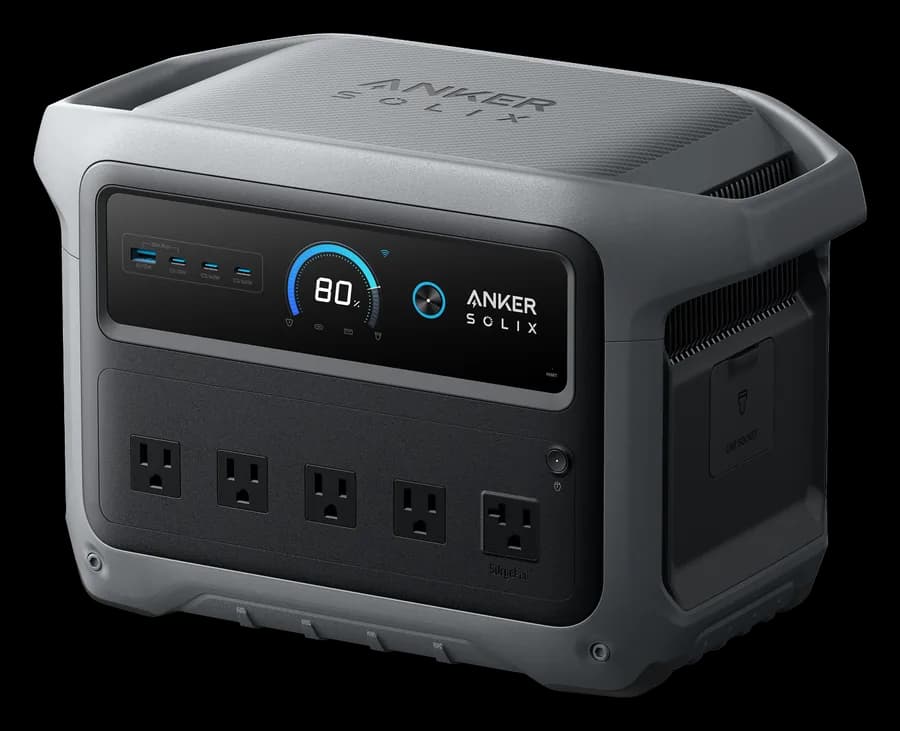
Anker SOLIX C1000 Gen 2
2,000 W continuous covers a 1,500 W microwave with room to spare; about 6 five-minute runs per charge at 24.9 lb.
- Capacity
- 1,024 Wh
- Output
- 2,000 W
- Weight
- 24.9 lb
- UPS
- 10 ms
Paid link
Check price on Amazon
EcoFlow DELTA 3 Plus
1,800 W continuous and 3,600 W surge: a microwave on its own, or a fridge between meals. Expands to 5,000 Wh.
- Capacity
- 1,024 Wh
- Output
- 1,800 W
- Weight
- 27.6 lb
- UPS
- 10 ms
Paid link
Check price on AmazonHow many uses per charge?
Energy per use is what the battery gives up, including about 15% inverter loss. Use counts assume the AC output is switched off between uses and leave the 10% battery reserve untouched. The use lengths are examples; change them in the calculator below.
| Appliance | Draw | Example use | Per use | 1,024 Wh | 2,048 Wh |
|---|---|---|---|---|---|
| Microwave (1,000–1,200 W cooking) | 1,500 W | 5 minutes | 147 Wh | 6 | 12 |
| Drip coffee maker | 1,000 W | 10-minute brew | 196 Wh | 4 | 9 |
| Pod coffee machine | 1,260 W | 2 minutes heating | 49 Wh | 18 | 37 |
| Electric kettleTypical label rating; check yours | 1,500 W | 5-minute boil | 147 Wh | 6 | 12 |
| Air fryer | 1,500 W | 15 minutes at full power | 441 Wh | 2 | 4 |
Why the label watts mislead
A microwave's magnetron turns electricity into microwaves with losses, and the fan, light and turntable add a little more. Panasonic's NN-SN686S is sold as a 1,200 W microwave and lists 1,480 W of input. Honda's generator guide puts a 1,000 W microwave at 1,500 W. So before you buy a station for a microwave, look for the input or "rated power consumption" on the label inside the door or on the back, and size the station's continuous rating at least 10% above it.
If the input is higher than the station's continuous rating, the station shuts the outlet off with an overload warning. Boost modes like X-Boost, Power Lifting and SurgePad don't help: they lower the voltage for heating elements and aren't meant for microwaves.
Short bursts: count energy per use, not hours
Runtime in hours is the wrong way to think about a microwave. A 5-minute run at 1,500 W takes about 147 Wh out of the battery, so what matters is how many runs a day you need. A 1,024 Wh unit gives you about 6 of them; a 2,048 Wh unit about 12. Every run you make is battery that isn't keeping the fridge or Wi-Fi going, so in an outage, plan meals that need one short heat-up instead of long cooking.
Turn the AC output off between uses. A mid-size station's inverter draws roughly 12 W just being on, which over a day adds up to about two microwave runs.
Coffee makers, kettles and air fryers
- Drip coffee maker. About 1,000 W while brewing, so most 1 kWh units handle it. Switch the warming plate off once the pot is done and pour into a thermos.
- Pod machine. About 1,260 W while it heats (Nespresso's 110 V figure). Energy per cup is small, but the station still has to cover the full wattage.
- Electric kettle. Most US kettles are rated 1,500 W; check the base. Boiling only the water you need cuts the time.
- Air fryer. About 1,500 W while heating; the element cycles once it reaches temperature, so a 15-minute cook usually uses less than the table shows.
Run one high-watt appliance at a time. A microwave and a drip coffee maker together draw about 2,500 W; only 11 of the 42 current models we track supply that with a 10% margin.
Which station fits your kitchen plan?
A microwave and a drip coffee maker, 15 minutes each a day, run through our quiz engine under different plans. Open any row to add your own devices.
Microwave and coffee for one night
0.6 kWh/day · 10 h
Open this in the quiz and change the devices
Engine's pick
DJI Power 2000
About 20 h · also EcoFlow DELTA 3 Max Plus
Add a fridge for a full day
1.6 kWh/day · 24 h
Open this in the quiz and change the devices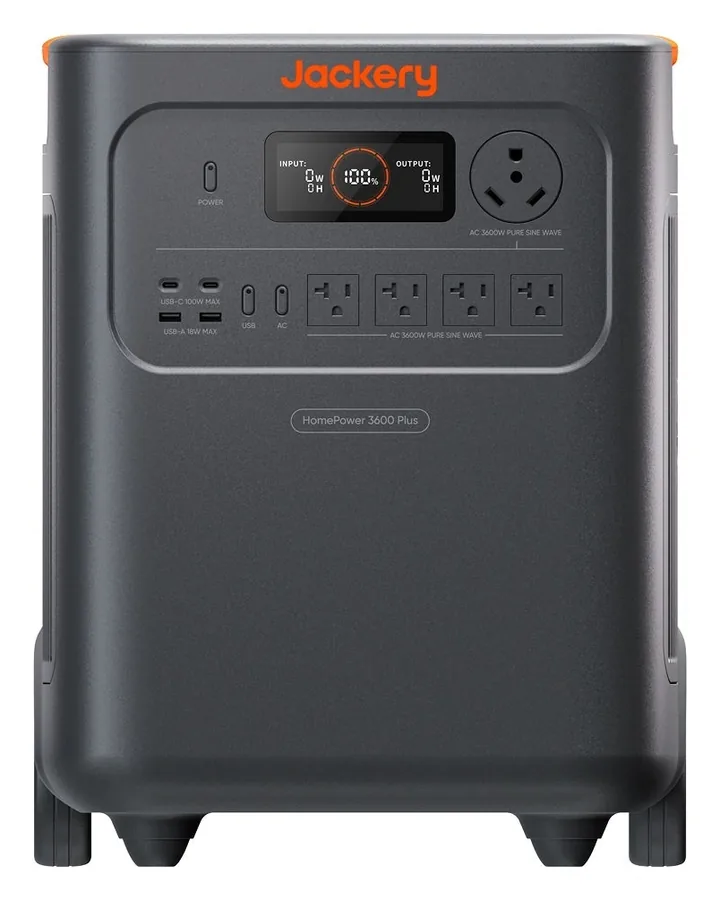
Engine's pick
Jackery HomePower 3600 Plus
About 30 h · also Jackery HomePower 3000, EcoFlow DELTA Pro
Microwave only, under $500
0.4 kWh/day · 10 h
Open this in the quiz and change the devicesEngine's pick
Anker SOLIX C1000 Gen 2
About 16 h · also OUPES Mega 1, EcoFlow DELTA 3 Classic
Camping, recharging with solar
0.6 kWh/day · 24 h
Open this in the quiz and change the devicesEngine's pick
DJI Power 2000
About 38 h · also EcoFlow DELTA 3 Max Plus
Picks come from the same engine as the quiz, recalculated whenever our catalog changes.
Check your own appliances
Enter your microwave's input watts from its label, set the minutes per day and pick a station. The full runtime calculator lets you add everything else.
1. What you want to run
Microwave (1,000–1,200 W cooking power)
The watts on the label are cooking power. It pulls 1.3 to 1.6 times that from the outlet.
Drip coffee maker
Full power only while brewing; turn the warming plate off to save energy.
2. The power station
What people actually ask
Can a 1000 W power station run a microwave?
Usually not. A microwave labelled 1,000 W cooks at 1,000 W but pulls about 1,500 W from the outlet. A station rated 1,000 W continuous can only manage a compact microwave of about 650 W cooking power, which Honda lists at 1,000 W of draw, and that leaves no margin.
How many times can I use a microwave on a 1000 Wh power station?
About six 5-minute runs of a typical microwave that draws 1,500 W, if you switch the AC output off in between. Each run uses about 150 Wh from the battery once inverter loss is counted.
Why does my power station shut off when I start the microwave?
It's overloaded. The wattage printed on the door or in the manual is cooking power; the microwave draws 1.3 to 1.6 times that from the outlet. If the draw exceeds the station's continuous rating, it trips. Look for the input watts on the label inside the door.
Can a power station run a coffee maker?
Yes, most 1 kWh units can. A drip coffee maker draws about 1,000 W while brewing and a pod machine about 1,260 W while it heats. Each brew is a short burst, so a 1 kWh unit makes several pots; turn the warming plate off to save energy.
Can I run a microwave and a coffee maker at the same time?
Only on a large unit. Together they draw about 2,500 W, so the station needs roughly 2,750 W continuous. It's easier to run them one after the other.
The bottom line
A power station runs a microwave when its continuous rating clears the microwave's input watts, about 1,500 W for a typical 1,000 W model, plus a margin. Once it can run it, capacity decides how many uses you get: about 6 five-minute runs per 1 kWh. Coffee makers, kettles and air fryers follow the same rule. Compare continuous output across models in the comparison chart, see what else each size runs in what a power station can run, or take the quiz.