Buy the EcoFlow DELTA 3 if you want a 1 kWh home-backup unit that runs a fridge overnight, starts a sump pump, charges from the wall in under an hour and can grow to about 5 kWh with extra batteries later. Skip it if you need a full day of fridge and extras without buying an extra battery, a one-hand carry for travel, or 240 V. It holds 1,024 Wh of LiFePO4, supplies 1,800 W continuously with a 3,600 W surge, and weighs 27.6 lb.
As an Amazon Associate, RightSizePower earns from qualifying purchases. That never changes how models are ranked. How we recommend

EcoFlow DELTA 3
A fridge, router and lights through an outage, with six AC outlets, a car socket and room to add extra batteries.
- Capacity
- 1,024 Wh
- Output
- 1,800 W
- Weight
- 27.6 lb
- UPS
- 10 ms
Paid link
Check price on AmazonQuick verdict
- Good fit
- A fridge, router and phones overnight; a home office on UPS; a ½ hp sump pump; adding batteries later
- Poor fit
- A full outage day on one battery; one-hand CPAP travel; 240 V loads
- Weight
- 27.6 lb
- Grow later?
- Extra batteries, up to 5,000 Wh total
- Watch out for
- X-Boost (2,200 W) is for heaters and dryers, not continuous output
Key specs
From EcoFlow's US product page. Starred values aren't confirmed on the spec sheet yet.
| Spec | EcoFlow DELTA 3 |
|---|---|
| Capacity | 1,024 Wh |
| Continuous output | 1,800 W |
| Surge | 3,600 W |
| Boost mode (heating loads) | 2,200 W |
| Battery | LiFePO4, 4,000 cycles to 80% |
| Weight | 27.6 lb |
| AC outlets | 6 |
| USB-C | 2 × up to 100 W |
| 12 V car outlet | Yes |
| Wall charge, 0–100% | 56 min |
| Solar input | 500 W, 11-60V |
| UPS switchover | ≤10 ms |
| Extra batteries | Up to 5,000 Wh |
| Warranty | 3 years* |
* Not stated on the maker's spec sheet, or derived from other official figures.
What will it run, and for how long?
Each device on its own from a full charge of the base unit, running nonstop (the fridge, sump pump and air conditioner cycle as normal). Includes the battery reserve, conversion losses and standby draw from our published formula.
| Device | Plugged into | Runtime or limit |
|---|---|---|
| Top-freezer fridgeabout 0.99 kWh a day, 1,200 W to start | AC outlet | 13–16 h |
| CPAP, humidifier off11 W | 12 V outlet | 2.6–3.2 days |
| Wi-Fi router and modem15 W | AC outlet | 26–33 h |
| Laptop60 W | USB-C | 12–15 h |
| Desktop PC and monitor213 W | AC outlet | 3–3.7 h |
| Sump pump, ½ hp1,050 W, 2,150 W to start, cycles on and off | AC outlet | 13–16 h |
| Window AC, 8,000 BTU533 W, 1,599 W to start, cycles on and off | AC outlet | 2–2.5 h |
| Microwave1,500 W | AC outlet | 26–33 min |
| Space heater on high1,500 W | AC outlet | 26–33 min |
With extra batteries up to 5,000 Wh, a fridge alone runs about 3.1 days. Add your own mix in the runtime calculator.
Where the DELTA 3 wins, and where it's ruled out
We ran eight common situations through the quiz engine. Rank is among every model that passes the hard limits.
| Situation | Result | Runtime or reason |
|---|---|---|
| Outage overnight: fridge, Wi-Fi and phones (carry it) | #4 of 20 | About 11 h |
| Outage for a full day, same devices (wheels OK) | #8 of 20 | About 2.2 days with an extra battery |
| CPAP for two nights away, one-hand carry | Ruled out | 28 lb is heavier than you want to carry. |
| Weekend car camping: 12 V fridge, lights, phones, with solar | #9 of 16 | About 27 h |
| RV day: fan, TV, laptop, phones | #18 of 25 | About 3.2 days with an extra battery |
| Remote work day: Starlink, laptop, phone | Ruled out | Runs your devices for about 7.2 h; you asked for 24 h. |
| Home office on UPS: router, laptop, phone, overnight | #2 of 20 | About 16 h |
| Overnight essentials on a budget under $500 | Ruled out | Usually sells above your budget. |
The base unit ranks near the top for an overnight outage and for a home office on UPS. For a full outage day or an RV day it passes only with an extra battery, which the engine allows when the unit stays put or rolls. It's ruled out of one-hand CPAP travel at 27.6 lb, can't cover a full Starlink workday on one charge, and usually sells above the under $500 budget band.
What does it do well?
- Starts motors with room to spare. The 3,600 W surge covers a fridge compressor or a ½ hp sump pump; even that pump starting while the fridge runs needs about 2,310 W.
- Fast wall charging. Full in 56 minutes at up to 1,500 W, so an hour of grid power refills it.
- A UPS for routers and PCs. EcoFlow lists a switchover under 10 ms; a desktop and monitor run about 3.5 h on battery.
- Room to grow. It takes DELTA 3, DELTA 2, DELTA 2 Max and DELTA Pro 3 extra batteries, up to 5,000 Wh in total.
- Outlets for a whole room. 6 AC outlets, 2 USB-C at 100 W, 2 USB-A and a 126 W car outlet, which runs a CPAP without the humidifier for about 3.1 days.
- Battery life. LiFePO4 rated for 4,000 cycles to 80% of capacity.
What should you know before you buy?
- One battery is one night. About 15 h for a fridge alone shrinks once Wi-Fi, phones and lights join in. For outages that run a day or longer, budget for an extra battery or a 2 kWh unit.
- 1,800 W covers everything at once. A microwave or space heater runs, but for only about 31 min at full power, and two 1,500 W loads together are too much. X-Boost doesn't raise this limit for motors.
- One solar input. Up to 500 W at 11-60V. If you want to split panels across two inputs, that's the DELTA 3 Plus.
- USB-C tops out at 100 W. Fine for most laptops; a 16-inch laptop under heavy load charges faster from a 140 W port.
- No 240 V. 240 V well pumps, dryers and central HVAC are out. Feeding house circuits needs a transfer switch or inlet installed by a licensed electrician; never backfeed through a wall outlet.
- Check auto-off settings. If the app has an AC timeout or energy-saving setting turned on, switch it off before you leave a fridge or CPAP on it overnight; a fridge between compressor cycles draws very little.
- Warranty depends on registration. EcoFlow's spec table lists 5 years; its US pages split that into 3 years standard plus 2 more after you register in the app.
What are the closest alternatives?
Inside EcoFlow's range, the DELTA 3 Plus is the same unit with 140 W USB-C and a second solar input, and the DELTA 3 Classic drops the car outlet and expansion; our DELTA 3 vs 3 Plus vs 3 Classic comparison sorts out the family, and the DELTA 3 Plus guide covers the Plus in depth. Outside it, the Anker SOLIX C1000 Gen 2 has the same capacity with 2,000 W output at 24.9 lb and a 5-year warranty, but no expansion battery; see our C1000 Gen 2 guide. The Jackery HomePower 1000 Plus v2 matches the 1,800 W output and 10 ms switchover at 23.8 lb, and grows further, to 11,264 Wh.
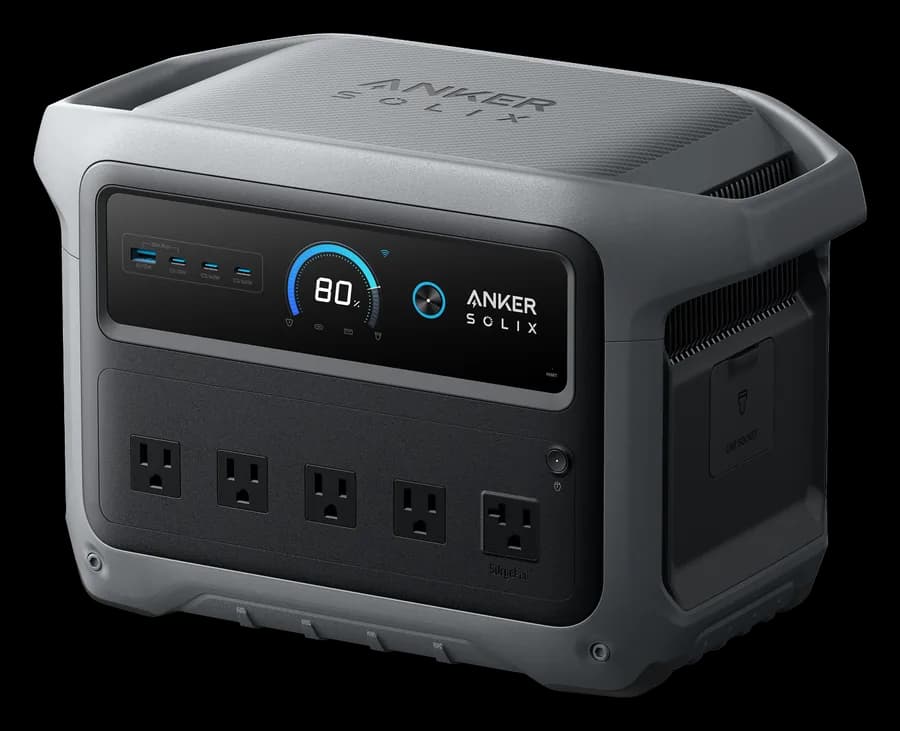
Anker SOLIX C1000 Gen 2
1,024 Wh and 2,000 W at 24.9 lb; 10 ms UPS; no expansion battery.
- Capacity
- 1,024 Wh
- Output
- 2,000 W
- Weight
- 24.9 lb
- UPS
- 10 ms
Paid link
Check price on Amazon
Jackery HomePower 1000 Plus v2
1,024 Wh and 1,800 W at 23.8 lb; expands to 11,264 Wh.
- Capacity
- 1,024 Wh
- Output
- 1,800 W
- Weight
- 23.8 lb
- UPS
- 10 ms
Paid link
Check price on AmazonWho should buy it, and who shouldn't?
- Buy it for overnight outages with a fridge, router and phones, for a home office or sump pump that shouldn't drop when the power blinks, or if you want to start at 1 kWh and add batteries as your plans grow.
- Skip it if you want a full day of fridge and extras without buying an extra battery, need a unit under 25 lb, or need 240 V. The sizing quiz checks your devices against every model.
Planning for outages: home backup picks by outage type, can a power station run a sump pump and how long a power station runs a fridge, or every model in the comparison chart.
What people actually ask
How long will the EcoFlow DELTA 3 run a refrigerator?
About 15 h for a typical top-freezer fridge on its own from a full charge. That covers a night, not a full day once Wi-Fi, phones and lights share the battery. With extra batteries up to 5,000 Wh, the same fridge runs about 3.1 days.
Should I buy the DELTA 3, the DELTA 3 Plus or the DELTA 3 Classic?
All three have the same 1,024 Wh battery, 1,800 W output and 3,600 W surge. The base DELTA 3 has the car outlet and takes extra batteries; the Plus adds 140 W USB-C and a second solar input; the Classic drops the car outlet and expansion. Our three-way DELTA 3 comparison covers every difference.
Can the DELTA 3 run a microwave?
Yes. A typical microwave draws about 1,500 W from the outlet, inside the 1,800 W rating with room to spare. Run on its own, it would drain a full battery in about 31 min of nonstop cooking, so a few minutes at a time is fine. Don't run it alongside a space heater or another 1,500 W load.
Will the DELTA 3 keep a desktop PC on when the power cuts out?
EcoFlow lists a UPS switchover under 10 ms, which routers, modems and most desktop power supplies ride through. It still isn't a zero-millisecond online UPS, so for a workstation or server, keep a dedicated UPS in the chain.
What is X-Boost on the DELTA 3?
X-Boost lets a heating appliance rated up to 2,200 W, such as a hair dryer or kettle, run at reduced power within the unit's rated output, so it heats more slowly. It isn't extra power: motors and compressors still have to fit within 1,800 W.
The bottom line
The DELTA 3 is the middle of EcoFlow's 1 kWh range and the one most home buyers should start with: 1,800 W with a 3,600 W surge, a 10 ms switchover, a car outlet and a path to 5,000 Wh. On its own it's a one-night battery, about 15 h of fridge. Add a battery when outages run longer, and pick the Plus only if you need its faster USB-C or second solar input.
EcoFlow DELTA 3
A fridge, router and lights through an outage, with six AC outlets, a car socket and room to add extra batteries.
- Capacity
- 1,024 Wh
- Output
- 1,800 W
- Weight
- 27.6 lb
- UPS
- 10 ms
Paid link
Check price on Amazon