A power station still works below freezing, down to its rated minimum (often 14°F or −4°F), but you lose about 15% of its capacity around 14°F and about 35% around −4°F, and it won't charge at all below 32°F. For storage, follow your manual: most makers want it partly charged and topped up every few months, and none want it left empty. If it's your outage backup, keep it fuller than storage advice suggests and check it on a schedule.
As an Amazon Associate, RightSizePower earns from qualifying purchases. That never changes how models are ranked. How we recommend
Does cold weather reduce a power station's capacity?
Yes. Lithium cells deliver less energy when cold. In a 2025 study of a commercial LiFePO4 module, capacity fell by about 15% at 14°F (−10°C) and about 35% at −4°F (−20°C) against room temperature. The battery isn't damaged; the energy comes back when it warms up. Manufacturers say the same in general terms: BLUETTI's manuals warn that low temperature can greatly affect capacity.
Here's what that means for a fridge and Wi-Fi router on two stations rated to discharge down to −4°F:
| Battery temperature | Anker SOLIX C2000 Gen 2 | Bluetti AC180 |
|---|---|---|
| 50°F and up | 22 h | 13 h |
| About 14°F | 19 h | 11 h |
| About −4°F | 14 h | 8.3 h |
Typical estimates from our runtime formula for a top-freezer fridge (about 990 Wh a day) and a router, with inverter standby. It's the battery's temperature that counts, not the air: a station kept indoors in an unheated house stays warmer than the porch.
What temperatures are power stations rated for?
From the manuals we've read. Discharging means running your devices; charging means refilling the battery from any source, solar included.
| Model | Discharge (use) | Charge |
|---|---|---|
| EcoFlow DELTA 2 | 14 to 113°F (−10 to 45°C) | 32 to 113°F (0 to 45°C) |
| Jackery Explorer 1000 v2 | 14 to 113°F (−10 to 45°C) | 32 to 113°F (0 to 45°C) |
| Jackery Explorer 5000 Plus | 5 to 113°F (−15 to 45°C) | 32 to 113°F (0 to 45°C) |
| BLUETTI AC70P and AC180 | −4 to 104°F (−20 to 40°C) | 32 to 104°F (0 to 40°C) |
| Anker SOLIX C2000 Gen 2 | −4 to 104°F (−20 to 40°C) | 32 to 104°F (0 to 40°C) |
Some models also cut their output in the cold: Jackery Explorer 1500 Ultra (Below 14°F, output is limited to 1000W); Jackery HomePower 3000 (Below 14°F, output is limited to 2000W); Jackery Explorer 5000 Plus (Output derates to 3600W at 5-14°F).
Why won't a power station charge below 32°F?
Charging lithium cells below freezing plates metallic lithium onto the anode, and that damage is permanent. So every manual we've read, from EcoFlow, Jackery, BLUETTI and Anker, sets 32°F (0°C) as the minimum charging temperature, and the battery management system enforces it. EcoFlow notes that it goes by the battery pack's actual temperature, not the air around it.
That matters most for solar in winter. A station left outside overnight at 20°F won't take a charge from the morning sun until the cells warm up, which can be hours. Keep it indoors, in the tent or in the cabin, and run only the panel cable outside. After a full drain, BLUETTI also asks owners to keep the unit between 41 and 95°F for 24 hours before recharging.
Do any power stations heat their own batteries?
Some 12 V LiFePO4 RV batteries have built-in heaters that warm the cells before charging. We haven't confirmed a built-in self-heating feature on any current mainstream US power station, so we don't assume one. If a listing claims cold charging, look for it in the official spec sheet or manual, with the temperature it works down to, before relying on it.
How should you store a power station?
Makers don't agree, so the manual for your model is the rule. Here's what each says:
| Manual | Storage charge | Check or top up | Storage temperature |
|---|---|---|---|
| BLUETTI AC70P | 40–60% | Fully cycle it every 3 months; charge right away if it drops below 5% | −4 to 104°F |
| BLUETTI AC180 | 40–60% | Full cycle every 6 months | Ideally 50 to 86°F |
| EcoFlow DELTA 2 | About 60% | Every 3 months, discharge to 30% and recharge to 60% | Best 68 to 86°F; not long-term above 113°F or below 14°F |
| Anker SOLIX C2000 Gen 2 | Not stated | Check weekly; if below 30%, charge to 100%. Fully charge at least every 3 months | Dry and cool |
| Jackery Explorer 1000 v2 and 5000 Plus | Never store it depleted | Check at least every 6 months; 3 to 6 months stored empty can leave it unchargeable | 5000 Plus: up to 1 year at 32 to 77°F |
BLUETTI AC70P temperatures as printed in its manual. °F converted from the printed °C.
The common ground: store it cool and partly charged, roughly half, check it about every 3 months, and never leave it empty. Battery University's general lithium-ion advice is about 40% at around 59°F, because heat combined with a full charge speeds up aging. Capacity fades slowly with time even when the unit isn't used, faster in heat and at high charge; how long a power station lasts covers cycle ratings and calendar aging.
Why does a stored power station lose charge?
The cells themselves lose little over a few months. The bigger drain is the electronics: the battery management system, the app radio and, above all, an inverter left on. Our calculator assumes about 12 W of standby for a mid-size unit with AC switched on and 18 W for a 2 kWh-class unit. That is 288 to 432 Wh a day, enough to empty a 2,048 Wh station in about 4 days with nothing plugged in.
Before you put it away, switch off AC, DC and USB outputs and close the app connection if your model lets you. Then the top-up schedule in your manual is all it needs.
How do you keep a power station ready for outages?
- Pick a storage level for your situation. In hurricane or winter-storm country, keeping it near full means it's ready when the forecast turns; the faster aging at high charge is a fair trade. If you only use it for summer trips, store it at the level your manual gives.
- Set calendar reminders at your manual's interval, usually every 3 months, to check the charge and top it up.
- Top up before the season. Atlantic hurricane season starts June 1; winter storms run December through March. Charge to full before each, and again as soon as a storm is forecast.
- Recharge right after an outage, so it isn't sitting empty, which Jackery warns can leave a unit unchargeable.
- Update the firmware while you're at it. Recent big-brand recalls were fixed by firmware.
Why turn off ECO mode for a fridge or CPAP?
Many stations switch the AC output off automatically when the load is small, to save standby power. BLUETTI's ECO mode is on by default and shuts AC off below about 40 W on the AC70P. Jackery's Energy Saving Mode, also on by default, turns all outputs off after 12 hours if the AC load is 25 W or less. A fridge between compressor cycles, or a CPAP overnight, can fall under those thresholds and get switched off. EcoFlow advises setting AC to “Always on” for a fridge holding medicine. Before an outage, turn ECO or energy-saving mode off for anything that has to keep running.
Tips for using a power station in winter
- Run it indoors. It makes no exhaust, so a heated room keeps the battery warm and its capacity up. Keep the vents clear. In a small space, see the apartment picks.
- Recharge once it's warm. Driving with the station in a heated cabin works; see charging from a car.
- Plan for less capacity. Size up by about 15% if the battery will sit near 14°F.
- Skip electric heat. A space heater drains even large stations in hours; see whether a power station can run a space heater. An electric blanket goes much further.
- Keep the furnace running instead if it's gas: the blower is the electrical part, covered in the gas furnace guide.
The full storm plan, including what to keep running, is in the winter storm power outage plan.
Two models rated to discharge down to −4°F
Both manuals list a −4 to 104°F discharge range and a 32°F charging minimum.
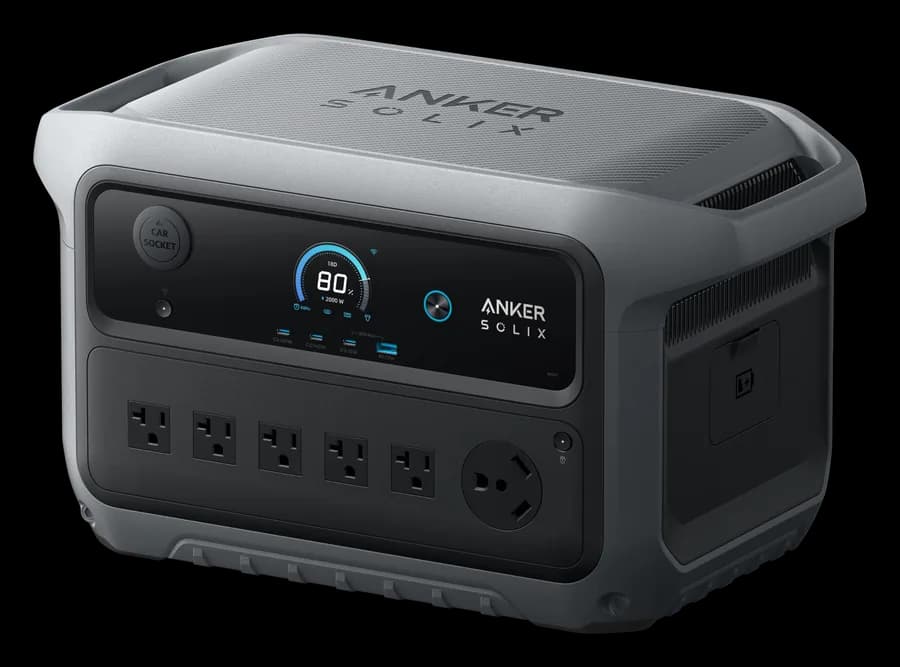
Anker SOLIX C2000 Gen 2
2,048 Wh. A fridge and router run about 22 h in mild weather, about 14 h with the battery near −4°F.
- Capacity
- 2,048 Wh
- Output
- 2,400 W
- Weight
- 41.7 lb
- UPS
- 10 ms
Paid link
Check price on Amazon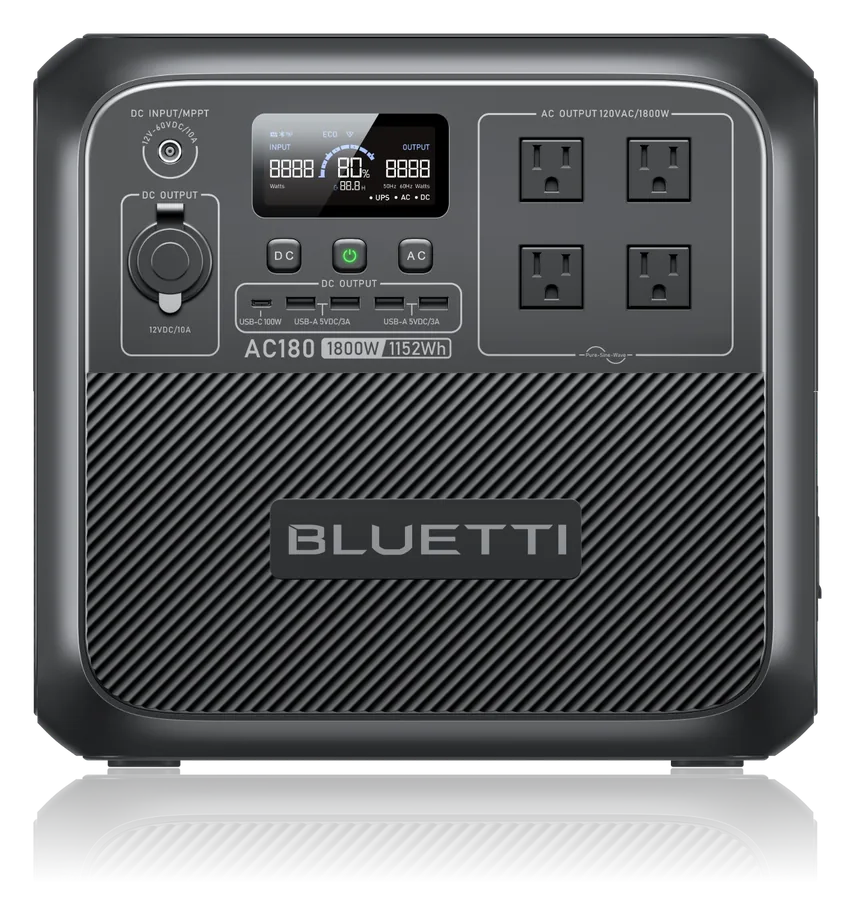
Bluetti AC180
1,152 Wh. A fridge and router run about 13 h in mild weather, about 8.3 h with the battery near −4°F.
- Capacity
- 1,152 Wh
- Output
- 1,800 W
- Weight
- 35.3 lb
- UPS
- 20 ms
Paid link
Check price on AmazonChange one thing, see the pick change
A fridge, router and two phones for a full day of a winter outage, then one change per row. Each row runs the quiz engine at normal temperatures; size up by about 15% if the battery will sit near 14°F.
Fridge, router and phones for a day
1.4 kWh/day · 24 h
Open this in the quiz and change the devices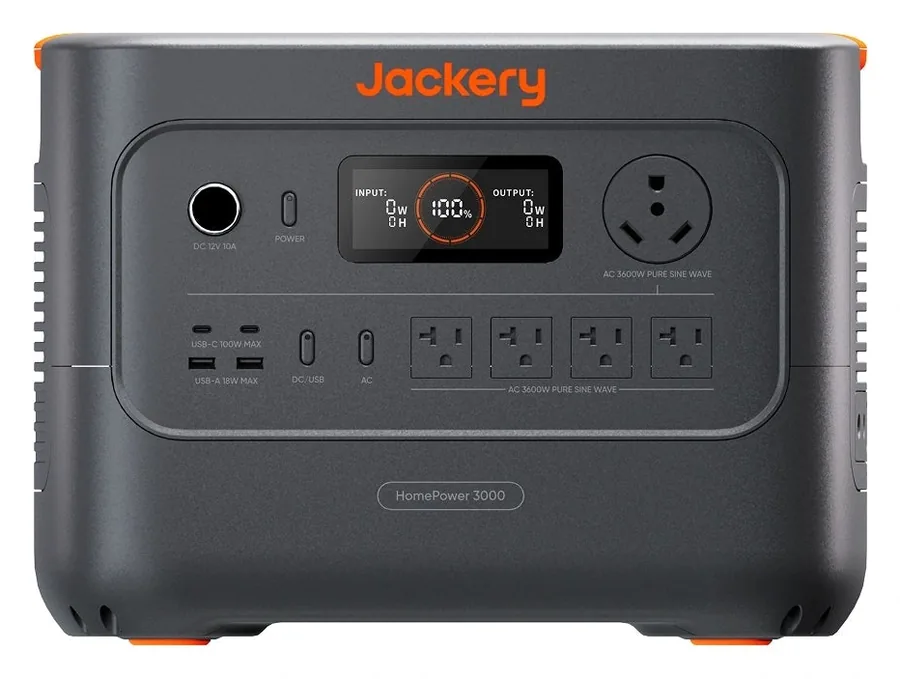
Engine's pick
Jackery HomePower 3000
About 32 h · also Bluetti Elite 400, Jackery HomePower 3600 Pro Max
Add the gas furnace blower
5.2 kWh/day · 24 h
Open this in the quiz and change the devices
Engine's pick
DJI Power 1000 V2
About 38 h with an extra battery · also Jackery HomePower 1000 Plus v2, DJI Power 2000
Add an electric blanket
1.8 kWh/day · 24 h
Open this in the quiz and change the devices
Engine's pick
Bluetti Elite 400
About 29 h · also Jackery HomePower 3000, EcoFlow DELTA Pro 3
Two to three days, expandable
1.4 kWh/day · 3 days
Open this in the quiz and change the devicesEngine's pick
DJI Power 1000 V2
About 5.3 days with an extra battery · also DJI Power 2000, Anker SOLIX F3000
Overnight only, two hands
1.4 kWh/day · 10 h
Open this in the quiz and change the devices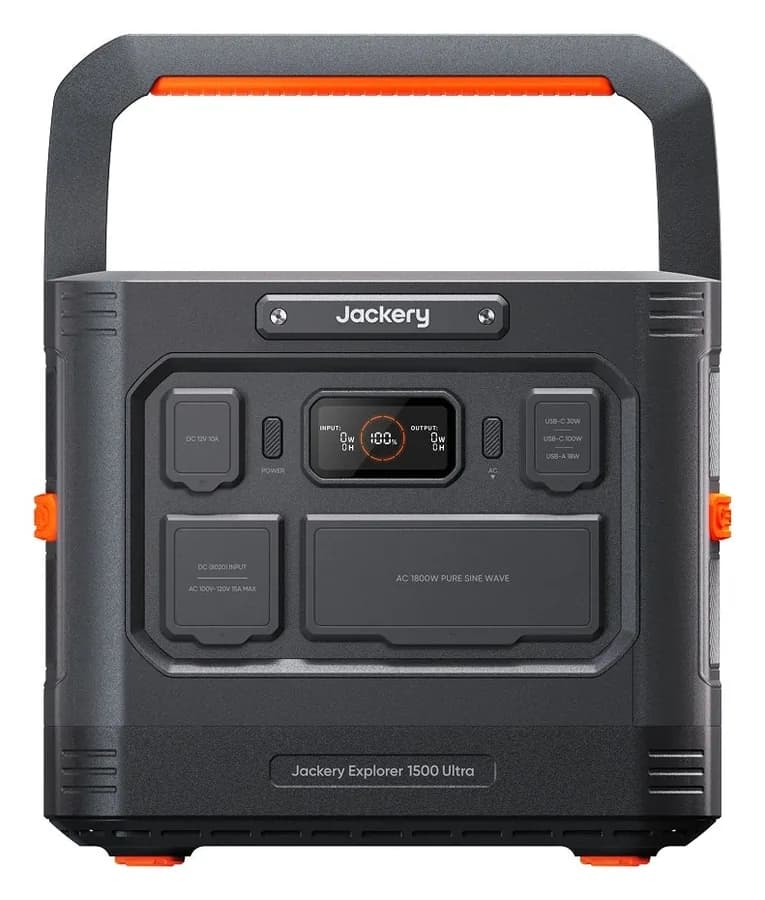
Engine's pick
Jackery Explorer 1500 Ultra
About 17 h · also Anker SOLIX C1000 Gen 2, OUPES Mega 1
Picks come from the same engine as the quiz, recalculated whenever our catalog changes.
What people actually ask
Can you charge a power station below freezing?
Not with the LiFePO4 batteries in almost every current model. EcoFlow, Jackery, BLUETTI and Anker manuals all set 32°F (0°C) as the minimum charging temperature, because charging frozen cells causes permanent lithium plating. EcoFlow notes it goes by the battery pack's own temperature, so bring the unit inside to warm up before charging.
How much capacity does a power station lose in the cold?
In one study of a commercial LiFePO4 module, about 15% at 14°F and about 35% at −4°F compared with room temperature. Our calculator applies those factors. Many models also stop discharging at their rated minimum, often 14°F or −4°F.
Should I store my power station fully charged?
Follow your model's manual, because makers disagree. BLUETTI says 40 to 60%, EcoFlow about 60%, Anker says to recharge to 100% whenever it falls below 30%, and Jackery warns never to store it empty. For general lithium-ion storage, Battery University suggests about 40% in a cool place, since heat plus a full charge speeds aging. If it's your outage backup, keeping it fuller is a reasonable trade.
How often should I charge a power station in storage?
At least every 3 months for most models, sooner if it sits with anything switched on. Anker asks for a weekly check on the C2000 Gen 2; BLUETTI's AC180 manual asks for a full cycle every 6 months. Put a reminder in your calendar, and top up to full before hurricane season and winter storms.
Can I leave a power station in the car in winter?
It's fine for a short trip, but a car gets as cold as the outside overnight, and the station won't charge until the cells are above 32°F. Bring it inside to store it, and don't leave it in a hot car in summer either; the manuals warn against direct sun and high heat.
Who should do what
- Outage backup in storm country: keep it near full, check it every 3 months, recharge after every use, ECO mode off for the fridge.
- Seasonal camping use: store it at your manual's level in a cool, dry room and top up on its schedule.
- Winter camping or ice fishing: keep the station in the warm space, size up for the cold, and charge only once the cells are above 32°F.
The bottom line
Cold costs capacity, about 15% near 14°F and 35% near −4°F, and stops charging below 32°F, so keep the battery indoors and size up for winter. In storage, follow your model's manual, switch everything off and set a reminder every 3 months. To size a station for winter loads, take the sizing quiz, run your devices in the runtime calculator with the cold setting, and compare models in the comparison chart.
Sources (checked 2026-11-01)
- Bressan et al., Batteries (2025): LiFePO4 module capacity at low temperature
- EcoFlow DELTA 2 user manual V1.1 (temperatures, storage)
- Jackery Explorer 1000 v2 user manual
- Jackery Explorer 5000 Plus user manual (US)
- BLUETTI AC70P user manual
- BLUETTI AC180 user manual
- Anker SOLIX C2000 Gen 2 manual
- Battery University BU-410: charging at high and low temperatures
- Battery University: how to store batteries
- NREL: battery calendar-life model
- NOAA: 2026 hurricane season outlook
- Jackery Explorer 1500 Ultra (official)
- Jackery HomePower 3000 (official)
- Jackery Explorer 5000 Plus (official)
- ENERGY STAR certified residential refrigerators
- Honda generator wattage estimation guide
- FirstEnergy: Understanding electricity use and cost
- Tom Barbette: home network power draw