Surge watts are the short burst a power station can deliver for a moment so a motor or compressor can start; continuous watts are what it can supply for hours. Size by continuous watts, then check that your biggest motor's start-up fits under the surge rating, and ignore boost figures, which only help heaters. A fridge that runs at 160 W can need about 1,200 W for the first instant, which is why a station with plenty of battery can still refuse to start it.
As an Amazon Associate, RightSizePower earns from qualifying purchases. That never changes how models are ranked. How we recommend
What do the three numbers on a spec sheet mean?
- Continuous (rated) output. What the inverter can supply indefinitely within its temperature limits. Add up everything that can run at once and keep it under this number, with some headroom: our quiz wants about 10% spare, and closer to 25% for loads that run for hours.
- Surge or peak. A brief burst for start-up. Makers rarely say how long it lasts; it's typically milliseconds to a few seconds. The EcoFlow DELTA 2 manual, for example, lists 1,800 W total with a 2,700 W surge.
- Boost mode (EcoFlow X-Boost, BLUETTI Power Lifting, Anker SurgePad). Not extra power. It lets a heating appliance rated above the inverter's limit run at reduced power. More on that below.
Watt-hours are a separate question: they tell you how long, not what. A bigger battery behind the same inverter starts nothing new.
Why do motors need a surge to start?
A motor at a standstill has nothing pushing back against the current, so for a moment it draws several times its running current. ABB's motor guide puts direct-on-line starting current at 10 to 12 times full-load current in the first instant, then about 6 to 8 times until the motor is up to speed. Compressors in fridges, freezers and air conditioners, and the motors in pumps and saws, all behave this way. Heaters, kettles, lights and electronics don't; they draw roughly their label wattage from the start.
Fridges with variable-speed (inverter) compressors start much more gently. Older fridges, sump pumps and window air conditioners are the hard starts.
How much surge do common appliances need?
Typical running and starting watts from our appliance data. Your appliance's label or manual beats these numbers if it lists a starting or locked-rotor figure.
| Appliance | Running | Starting | Start ÷ run |
|---|---|---|---|
| Fan (box or pedestal) | 40 W | 120 W | 3.0× |
| Mini fridge | 80 W | 240 W | 3.0× |
| Full-size refrigerator (top freezer) | 160 W | 1,200 W | 7.5× |
| Chest freezer | 100 W | 1,200 W | 12.0× |
| Gas furnace blower | 400 W | 1,400 W | 3.5× |
| Dehumidifier | 340 W | 1,020 W | 3.0× |
| Window AC (5,000–6,000 BTU) | 397 W | 1,191 W | 3.0× |
| Window AC (8,000 BTU) | 533 W | 1,599 W | 3.0× |
| Window AC (12,000 BTU) | 800 W | 2,400 W | 3.0× |
| Sump pump (1/3 hp) | 800 W | 1,300 W | 1.6× |
| Sump pump (1/2 hp) | 1,050 W | 2,150 W | 2.0× |
| Garage door opener (1/2 hp) | 720 W | 1,420 W | 2.0× |
| Circular saw (7-1/4 in, corded) | 1,400 W | 2,300 W | 1.6× |
| RV rooftop AC (13,500 BTU) | 1,600 W | 2,800 W | 1.8× |
The fridge and freezer ratios look high because the running figure is the compressor's typical draw, while the starting figure is the start-up peak from generator sizing guides. The full list is in the appliance wattage chart.
Which power station sizes start which appliances?
Each appliance on its own, checked against the median continuous and surge ratings of current models near each capacity. “Too much power” means typical models can't supply its running watts with 10% headroom.
| Appliance | 300 Wh300 W / 600 W | 1,000 Wh1,800 W / 2,850 W | 2,000 Wh2,400 W / 4,000 W | 3,000 Wh3,600 W / 7,200 W |
|---|---|---|---|---|
| Fan (box or pedestal) | Starts it | Starts it | Starts it | Starts it |
| Mini fridge | Starts it | Starts it | Starts it | Starts it |
| Full-size refrigerator (top freezer) | Won't start it | Starts it | Starts it | Starts it |
| Chest freezer | Won't start it | Starts it | Starts it | Starts it |
| Gas furnace blower | Too much power | Starts it | Starts it | Starts it |
| Dehumidifier | Too much power | Starts it | Starts it | Starts it |
| Window AC (5,000–6,000 BTU) | Too much power | Starts it | Starts it | Starts it |
| Window AC (8,000 BTU) | Too much power | Starts it | Starts it | Starts it |
| Window AC (12,000 BTU) | Too much power | Starts it | Starts it | Starts it |
| Sump pump (1/3 hp) | Too much power | Starts it | Starts it | Starts it |
| Sump pump (1/2 hp) | Too much power | Starts it | Starts it | Starts it |
| Garage door opener (1/2 hp) | Too much power | Starts it | Starts it | Starts it |
| Circular saw (7-1/4 in, corded) | Too much power | Starts it | Starts it | Starts it |
| RV rooftop AC (13,500 BTU) | Too much power | Starts it | Starts it | Starts it |
Column headings show the median continuous / surge rating of the 36 current models in these size groups; models with no published surge count at their continuous rating. Specific models differ: check yours in the comparison chart.
How do you check surge for several devices at once?
Use the rule generator sizing guides use: add the running watts of everything that will be on together, then add the extra start-up watts of the single biggest motor. Only one motor usually starts at a time, so you don't add every surge.
A fridge (160 W running) and a 1/2 hp sump pump (1,050 W running, 2,150 W starting) come to 1,210 W running. The pump's start adds 1,100 W, so the station needs about 2,310 W of surge and at least 1,331 W continuous. A typical current 1 kWh unit lists 1,800 W continuous and 2,850 W surge, so on output it clears both. Runtime is the separate question, and with a pump in the mix our quiz steps up a size; its picks for this pair are below.
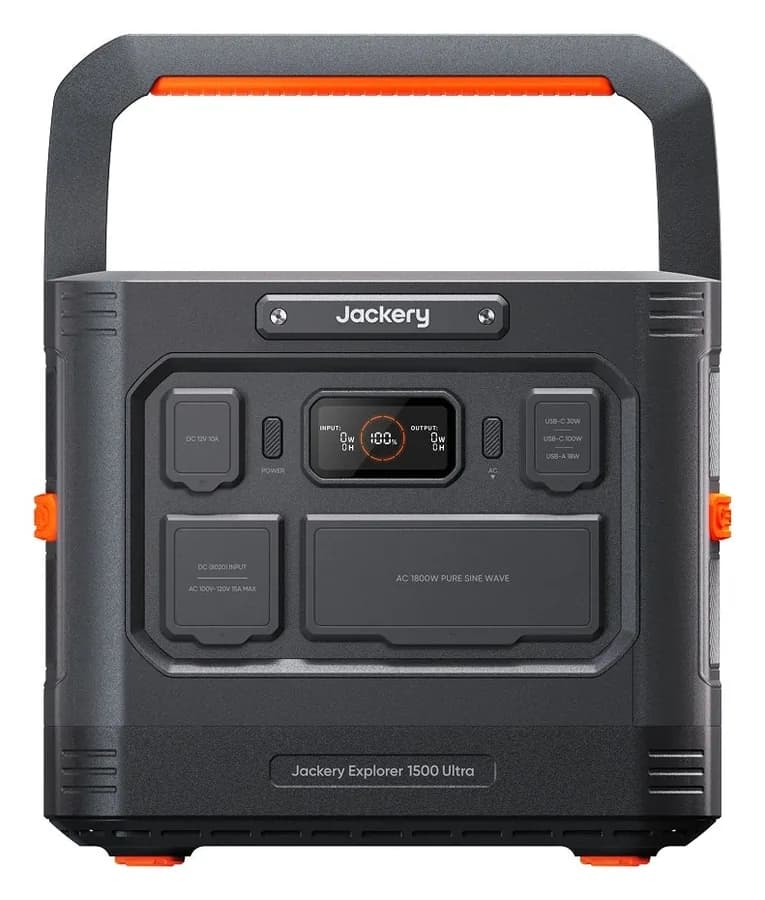
Jackery Explorer 1500 Ultra
1,800 W continuous, 3,600 W surge. About 13 h on the fridge and pump.
- Capacity
- 1,536 Wh
- Output
- 1,800 W
- Weight
- 38.6 lb
- UPS
- 20 ms
Paid link
Check price on Amazon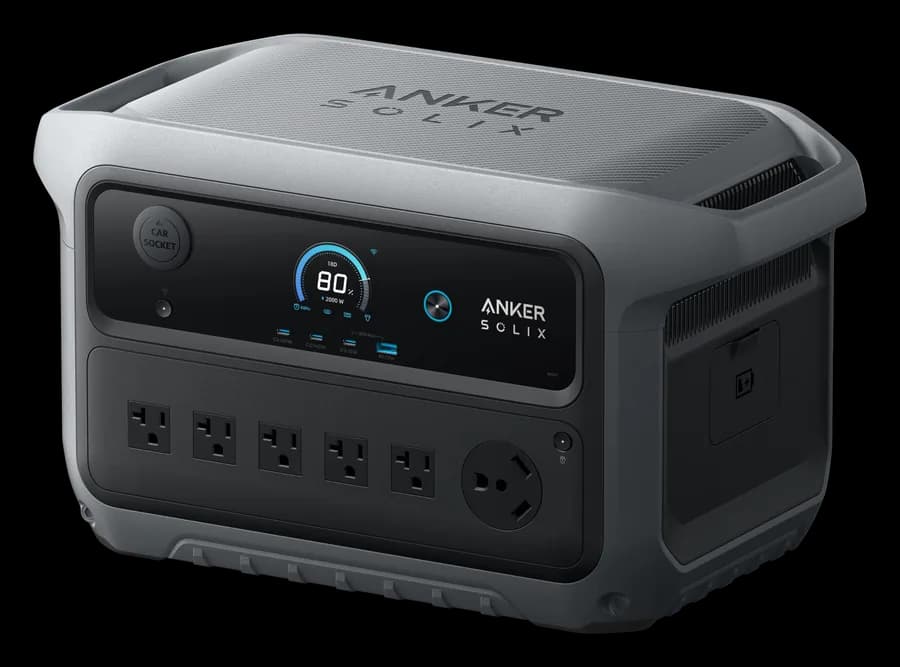
Anker SOLIX C2000 Gen 2
2,400 W continuous, 4,000 W surge. About 16 h on the fridge and pump.
- Capacity
- 2,048 Wh
- Output
- 2,400 W
- Weight
- 41.7 lb
- UPS
- 10 ms
Paid link
Check price on Amazon
Jackery Explorer 2000 v2
2,200 W continuous, 4,400 W surge. About 16 h on the fridge and pump.
- Capacity
- 2,042 Wh
- Output
- 2,200 W
- Weight
- 39.5 lb
- UPS
- 20 ms
Paid link
Check price on AmazonWhat do X-Boost, Power Lifting and SurgePad actually do?
All three lower the output voltage so a resistive heating element draws less current. A kettle or hair dryer rated above the inverter's limit then runs, but at the inverter's rated power, so it heats more slowly. The makers say so in their manuals:
- EcoFlow X-Boost powers high-wattage appliances “at the rated output power”, is “more suitable for heating devices”, doesn't support appliances with voltage protection, and isn't available while the unit charges from AC.
- BLUETTI Power Lifting on the AC180 handles pure resistive loads up to 2,700 W “while its rated output power remains 1800W”, for heaters, irons and other devices made only of heating elements.
- Anker SurgePad switches on when total output exceeds the rated output, “works better with devices that generate heat” and doesn't support precision instruments. Anker also says it isn't suited to motor-driven devices like refrigerators or air conditioners.
Boost does nothing for a motor. At reduced voltage a motor stalls or overheats instead of starting, and electronics with voltage protection shut down. So a boost figure never counts as surge or as continuous power in our quiz. The Anker SOLIX C300 is a good example: 300 W continuous and a 600 W SurgePad figure, with no published surge rating, so we treat 300 W as its start-up limit.
Which models list boost, and how does it compare with surge?
Current models in our catalog that publish a boost-mode figure. Only the surge column helps with motors.
| Model | Continuous | Surge (motors) | Boost (heaters only) |
|---|---|---|---|
| EcoFlow RIVER 3 | 300 W | 600 W | 600 W |
| EcoFlow RIVER 3 Plus | 600 W | 1,200 W | 1,200 W |
| Anker SOLIX C300 | 300 W | Not published | 600 W |
| Bluetti Elite 30 V2 | 600 W | Not published | 1,500 W |
| EcoFlow RIVER 3 Max | 600 W | 1,200 W | 1,200 W |
| Anker SOLIX C800X / C800 Plus | 1,200 W | 1,920 W | 1,600 W |
| EcoFlow RIVER 2 Pro | 800 W | 1,600 W | 1,600 W |
| Bluetti Elite 100 V2 | 1,800 W | 2,700 W | 2,700 W |
| EcoFlow DELTA 2 | 1,800 W | 2,700 W | 2,200 W |
| EcoFlow DELTA 3 | 1,800 W | 3,600 W | 2,200 W |
| EcoFlow DELTA 3 Classic | 1,800 W | 3,600 W | 2,400 W |
| EcoFlow DELTA 3 Plus | 1,800 W | 3,600 W | 2,200 W |
| Anker SOLIX C1000 (Gen 1) | 1,800 W | Not published | 2,400 W |
| Bluetti AC180 | 1,800 W | 2,700 W | 2,700 W |
| EcoFlow DELTA 3 Max | 2,400 W | 4,800 W | 3,400 W |
| EcoFlow DELTA 3 Max Plus | 3,000 W | 6,000 W | 3,800 W |
| Bluetti Elite 200 V2 | 2,600 W | Not published | 3,900 W |
| Bluetti Apex 300 | 3,840 W | Not published | 7,680 W |
| Bluetti Elite 300 | 2,400 W | Not published | 4,800 W |
| Anker SOLIX F3000 | 3,600 W | 7,200 W | 4,860 W |
| EcoFlow DELTA 3 Ultra Plus | 3,600 W | 7,200 W | 4,600 W |
| EcoFlow DELTA Pro | 3,600 W | 7,200 W | 4,500 W |
| Bluetti Elite 400 | 2,600 W | Not published | 3,900 W |
| EcoFlow DELTA Pro 3 | 4,000 W | 8,000 W | 6,000 W |
What if the spec sheet shows no surge number?
Then you can't count on more than the continuous rating for start-up. 10 of the 42 current models we track publish no surge figure, including Anker SOLIX C300, Bluetti Elite 30 V2, Jackery Explorer 300, DJI Power 1000 V2, Anker SOLIX C1000 (Gen 1), DJI Power 2000. Some of them very likely handle short peaks above their rating, but without a published number our quiz rates them at their continuous output for motor starts. If one of these is on your list and you need to start a pump or an air conditioner, ask the maker for the surge spec first.
Does pure sine wave matter for motors?
Yes. Modified (stepped) sine wave output can make motors run hotter and buzz, upset some electronics and audio gear, and is a known risk for medical devices; inverter maker Samlex explains the difference. Nearly every current mainstream power station states pure sine wave output. Treat it as a minimum, not a premium feature, and skip any listing that doesn't say it.
What about air conditioners, pumps and microwaves?
An 8,000 BTU window unit needs about 1,599 W to start and 533 W to run, which most 1 kWh units handle on output but drain within hours; see whether a power station can run a window AC. Sump pumps need surge every time they kick on, covered in the sump pump guide. A microwave has no big motor surge but draws about 1,500 W from the wall for its rated cooking power, so continuous output is the limit there; see the microwave guide.
Change one thing, see the pick change
A full-size fridge overnight, then one motor load added per row. Each row runs the quiz engine with surge checks on, so you can see when a start-up pushes the pick up a size.
Fridge overnight
1.0 kWh/day · 10 h
Open this in the quiz and change the devices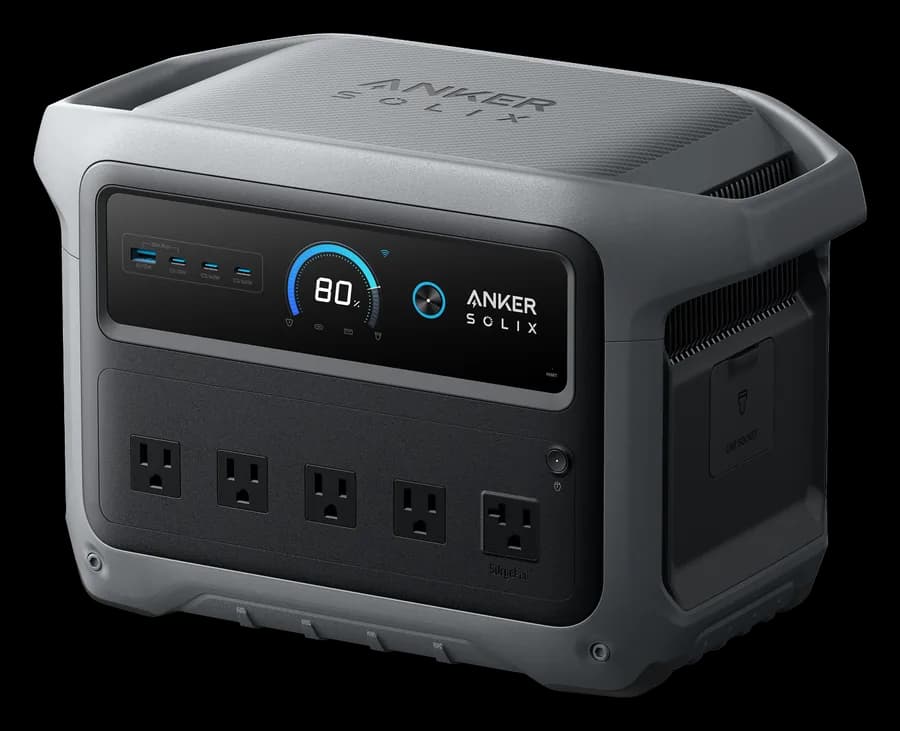
Engine's pick
Anker SOLIX C1000 Gen 2
About 15 h · also OUPES Mega 1, EcoFlow DELTA 3
Add a 1/2 hp sump pump
2.0 kWh/day · 10 h
Open this in the quiz and change the devicesEngine's pick
Jackery Explorer 1500 Ultra
About 13 h · also Anker SOLIX C2000 Gen 2, Jackery Explorer 2000 v2
Add a microwave
1.4 kWh/day · 10 h
Open this in the quiz and change the devicesEngine's pick
Anker SOLIX C2000 Gen 2
About 17 h · also Jackery Explorer 2000 v2, Jackery HomePower 2000 Plus v2
Add a gas furnace blower, full day
4.8 kWh/day · 24 h
Open this in the quiz and change the devices
Engine's pick
DJI Power 1000 V2
About 41 h with an extra battery · also Jackery HomePower 1000 Plus v2, DJI Power 2000
An 8,000 BTU window AC instead
2.6 kWh/day · 10 h
Open this in the quiz and change the devicesClosest fit
Anker SOLIX C2000 Gen 2
Covers about 5.8 h · also Jackery HomePower 2000 Plus v2, DJI Power 2000
Picks come from the same engine as the quiz, recalculated whenever our catalog changes.
What people actually ask
What is the difference between surge watts and running watts?
Running (continuous) watts are what a power station can supply for as long as the battery lasts. Surge watts are a short burst, usually milliseconds to a few seconds, that lets a motor or compressor get started. Size by continuous watts, then check that your biggest motor's start-up fits under the surge rating.
Do I need surge watts for a refrigerator?
Yes. A typical full-size fridge runs at about 160 W but needs around 1,200 W for a moment each time the compressor starts. Current 1 kWh stations typically list about 2,850 W of surge, so most of them start a fridge; many 300 Wh units don't.
Does X-Boost or SurgePad help start a motor?
No. X-Boost, Power Lifting and SurgePad lower the output voltage so a heating element draws less power. EcoFlow, BLUETTI and Anker describe them for heating appliances; Anker says SurgePad isn't suited to motor-driven devices like refrigerators or air conditioners. Low voltage makes motors stall or overheat.
What happens if an appliance needs more surge than the power station has?
The station's overload protection shuts the output off when the motor tries to start, and the appliance doesn't run. Nothing about the battery size changes that: a larger battery with the same inverter won't start it either.
Is surge the same as peak watts?
Brands use surge and peak for the same short start-up rating. Boost-mode figures are different and are sometimes printed just as large. When a spec sheet shows only a boost figure and no surge figure, our quiz treats the continuous rating as the start-up limit.
Who needs which rating
- Phones, laptops, lights, TVs, CPAP: no meaningful surge; continuous watts and battery size are all that matter, which is why small units work well in the apartment picks.
- A fridge or freezer: about 1,200 W of real surge, which most 1 kWh-class units have and many 300 Wh units don't.
- Sump pumps, window ACs, furnace blowers, saws: check the start-up against the surge rating, plus everything else that's running.
- Kettles, hair dryers, heaters: boost mode can run them slowly on a smaller unit; for full power you need continuous watts above their label. The tailgating picks show which sizes handle a kettle or coffee maker.
- 240 V pumps and RV air conditioners: surge is only half the check; the outlet has to match too, as explained in TT-30 vs L14-30 vs 14-50.
The bottom line
Size by continuous watts, check the biggest motor's start against the surge rating, and treat boost as a heater-only feature. When a model publishes no surge figure, assume its continuous rating is the limit. The sizing quiz runs these checks on your own devices, the runtime calculator adds how long they'll last, and the what a power station can run chart shows each size class at a glance.
Sources (checked 2026-11-01)
- EcoFlow DELTA 2 user manual V1.1 (X-Boost, surge)
- BLUETTI AC180 user manual (Power Lifting)
- BLUETTI AC70P user manual (Power Lifting)
- Anker SOLIX C2000 Gen 2 manual (SurgePad)
- ABB: motor starting, protection and control
- Mike Holt forum: NEC 430.7(B) locked-rotor code letters
- Samlex America: modified vs pure sine wave
- Honda generator wattage estimation guide
- FirstEnergy: Understanding electricity use and cost
- ENERGY STAR certified residential refrigerators
- ENERGY STAR certified residential freezers
- Assembly Magazine: DOE furnace fan standards
- PickHVAC: furnace power use
- Supco IG4000 hot-surface igniter listing
- ENERGY STAR certified dehumidifiers
- ENERGY STAR certified room air conditioners
- Zoeller 50 Series sump pump brochure
- Champion Power Equipment wattage chart
- Good Sam forum: Dometic rooftop AC current
- Micro-Air EasyStart soft starter